Skills-based hiring evaluates candidates against the capabilities a role requires, then asks them to produce job-related evidence. Degrees, job titles, and resumes can still inform the process. They simply stop acting as proof on their own.
That distinction matters. Removing a degree requirement from a job description is easy. Rebuilding the rest of the hiring process around evidence is harder. The employer has to define the work, choose a fair way to assess it, apply the same standard across candidates, and keep a person accountable for the decision.
This guide explains how to do that without replacing resume bias with a new set of bad tests.
What is skills-based hiring?
Skills-based hiring, also called skills-first hiring, is a recruitment approach that prioritizes demonstrated knowledge, skills, and abilities over proxies such as education, past employers, job titles, or years of experience.
The US Department of Labor’s skills-first hiring guidance makes an important part of the definition explicit: it should not matter where a person acquired the skill. The evidence may come from paid work, an apprenticeship, military service, freelance projects, self-directed learning, a community college, or another route.
This does not mean credentials never matter. A licence, certification, or degree can be a legitimate requirement when the job or the law requires it. The change is more precise: employers stop using credentials as a blanket substitute for capability when a more direct form of evidence is available.
Skills-based hiring vs traditional hiring
| Hiring decision | Traditional approach | Skills-based approach |
|---|---|---|
| Define the role | Start with title, degree, and years of experience | Start with work outcomes and required capabilities |
| Source candidates | Search for familiar employers and titles | Search for relevant skills and adjacent experience |
| Screen applications | Rank resumes and credentials | Use resumes for context, then collect job-related evidence |
| Interview | Ask different questions based on each resume | Use consistent core questions and an anchored rubric |
| Assess | Rely on education, tenure, or general tests | Use work samples, scenarios, portfolios, or structured interviews |
| Decide | Compare impressions and recommendations | Compare evidence against the same role criteria |
Why skills-based hiring matters in 2026
The skills inside many jobs are changing faster than job titles and degree programs. The World Economic Forum’s Future of Jobs Report 2025 surveyed more than 1,000 employers representing over 14 million workers. Those employers expect 39% of workers’ existing skill sets to change or become outdated by 2030.
Recruiter behavior is moving too. LinkedIn reports that 14% of recruiter searches in OECD countries use a skills filter, compared with less than 2% that use a degree filter. Its analysis also found that companies with the highest use of skills-based searches were 12% more likely to make what LinkedIn defines as a quality hire. That measure combines recruiter demand, one-year retention, and internal mobility, so it is useful platform evidence rather than proof that a skills filter caused the result. Read LinkedIn’s methodology and findings.
The gap between policy and practice is still large. A 2024 report from the Burning Glass Institute and Harvard Business School studied employers that had removed degree requirements. It estimated that the resulting opportunity reached fewer than one in 700 hires during the observed year. Most companies changed the words in their job posts without changing who they hired. Read the report summary.
That is the practical case for this guide. Skills-based hiring is not a line in an employer-brand campaign. It is a different way to define, collect, and review hiring evidence.
Are resumes becoming obsolete?
No. The resume still provides useful context. It can show where someone worked, what kind of environment they know, which projects deserve a follow-up question, and whether they appear to meet a genuine licence or work-authorization requirement.
Its limitation is the burden of proof. A resume reports what a candidate says they have done. It cannot show how they diagnose a customer problem, explain a technical trade-off, handle an objection, or learn an unfamiliar tool.
Generative AI has made that distinction harder to ignore. Candidates can now improve grammar, reorganize experience, and tailor keywords quickly. Some also exaggerate or fabricate. Trying to detect AI writing will not separate those groups reliably. A better process uses the resume to identify claims, then verifies the claims that matter.
Our guide to AI-generated job applications covers that verification problem in depth.
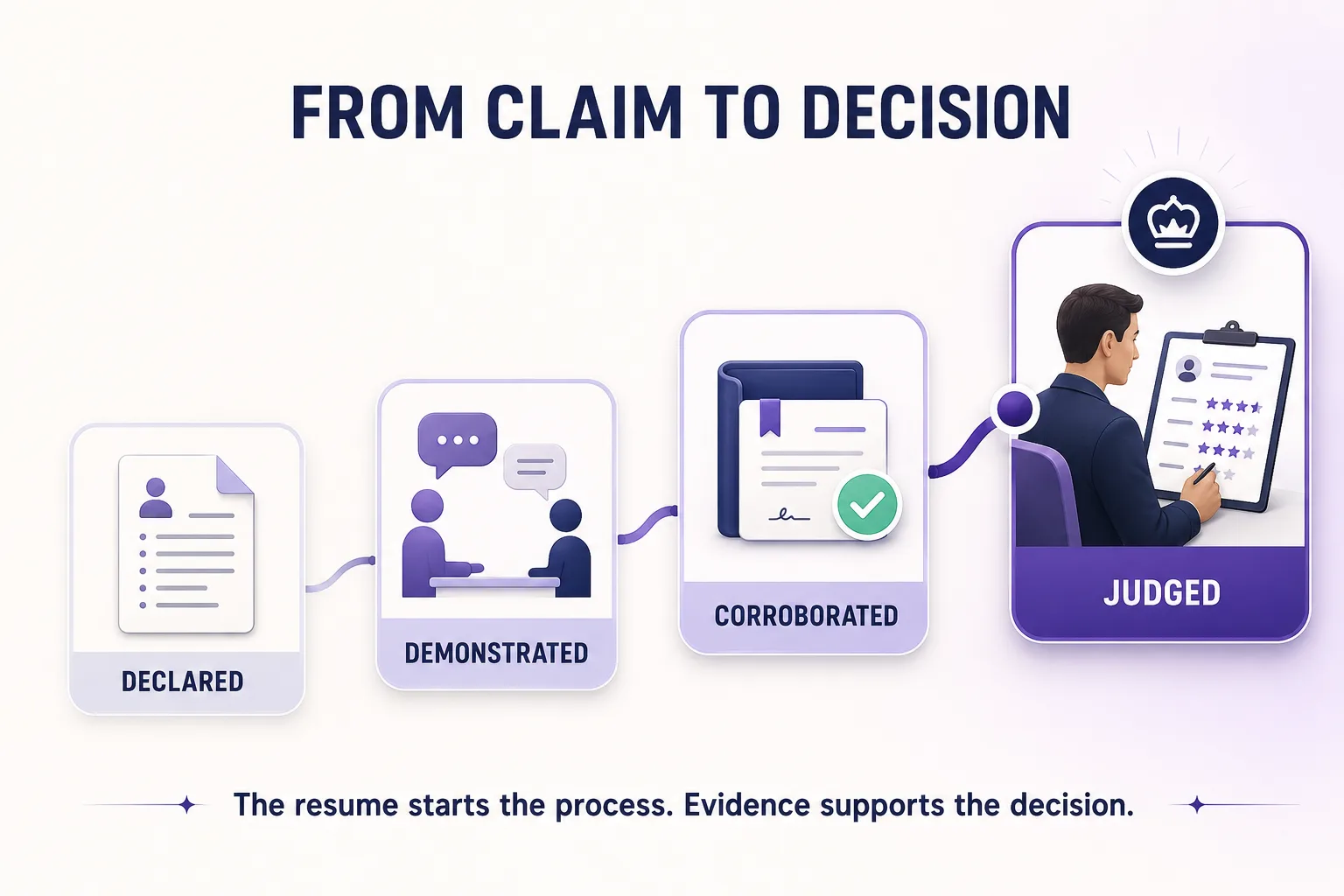
A useful skills-first funnel separates four kinds of evidence:
| Evidence level | Example | Best use |
|---|---|---|
| Declared | Resume, application answer, cover letter | Understand history and identify claims to verify |
| Demonstrated | Structured interview, role-play, simulation, work sample | Observe how the candidate applies knowledge |
| Corroborated | Portfolio, reference, certification, prior result | Confirm important claims where appropriate |
| Judged | Recruiter and hiring-manager review against a shared rubric | Decide who advances and record why |
The resume is not disappearing. It is becoming a routing document instead of the final answer.
How to implement skills-based hiring
The process starts before a recruiter sees an applicant.
1. Define the work outcomes
Ask the hiring manager what the person must be able to deliver in the first six to twelve months. Avoid starting with the profile of the last successful employee.
For a customer-support role, the outcomes may include diagnosing common product issues, calming frustrated customers, writing clear case notes, and escalating the right cases. “Three years in SaaS” is not an outcome. It is one possible route through which a candidate may have learned the work.
If the job description is vague, use InterviewFlowAI’s free job description optimizer to turn broad requirements into clearer role expectations before designing the assessment.
2. Select four to six job-critical skills
Long skill lists create noise. Separate the criteria into three groups:
Skills the person must demonstrate before starting.
Skills that are useful but can be learned quickly.
Credentials or conditions that are genuinely required.
This step prevents a preferred tool, industry label, or degree from becoming an accidental knockout rule.
3. Choose the least burdensome evidence method
Match the method to the skill. A spreadsheet exercise may be suitable for analytical work. A role-play may be better for sales or support. A structured conversation can reveal reasoning, communication, and ownership. A portfolio can show prior output, though it may not reveal the candidate’s exact contribution.
Do not add an assessment because the platform makes it easy. Add it because the result will change a real decision.
4. Write an anchored scoring rubric
Define what weak, acceptable, and strong evidence looks like before candidates enter the process.
Suppose the skill is customer de-escalation. A vague rubric says “communication: 1 to 5.” An anchored rubric is more useful:
Weak evidence: repeats policy, ignores the customer’s concern, or escalates without diagnosis.
Acceptable evidence: acknowledges the concern, clarifies the issue, explains the next step, and sets a realistic expectation.
Strong evidence: does all of the above, tests an alternative, documents the case, and explains when escalation is necessary.
The score now has a meaning that another reviewer can inspect.
5. Build consistent questions and realistic scenarios
Every candidate should receive the same structured core. Follow-up questions can vary when they are used to collect missing evidence against the same criteria.
For example:
A customer says they have already followed your troubleshooting steps twice and the problem is still unresolved. What would you say next, and what information would you collect before escalating?
Useful follow-ups ask for a choice, constraint, trade-off, or result. They make rehearsed claims less valuable without turning the interview into a trap.
You can use the free interview script generator to create role-specific questions, evaluation intent, and answer criteria for a human- or AI-led screen.
6. Explain the process to candidates
Tell candidates what the assessment measures, how long it should take, whether AI is used, who reviews the result, and how to request an accommodation. If a test requires a camera, microphone, quiet room, or specific device, say so before the candidate starts.
This is part of assessment quality. A surprise technical problem or inaccessible format can change the score without changing the candidate’s ability to do the job.
7. Review evidence and close the loop
Give reviewers the question, rubric, candidate response, and scoring rationale together. A person should be able to inspect the evidence, challenge the score, and document an override.
Move the result into the applicant tracking system with the transcript, scorecard, and reviewer notes. If the team still copies numbers between PDFs and spreadsheets, the new process has created another administrative layer.
Which assessment method should you use?
No single test proves overall ability. Combine only the methods needed to cover the job criteria.
| Method | Best for | Main limitation | Good design rule |
|---|---|---|---|
| Structured interview | Reasoning, communication, ownership, and past behavior | Can reward polished storytelling if questions stay broad | Ask for specific actions, constraints, and outcomes |
| Work sample | Observable job output | Can demand too much unpaid work or be completed by someone else | Keep it short and use a task that resembles the role |
| Role-play or simulation | Sales, support, operations and judgement under pressure | Performance can depend on unfamiliar format | Provide context and score only job-related behavior |
| Knowledge assessment | Required facts, rules or technical foundations | Recall is not the same as application | Use it only when the knowledge is needed before the job starts |
| Portfolio review | Prior work and craft | Ownership and project context may be unclear | Ask the candidate to explain their contribution and trade-offs |
| Credential or licence check | Regulated or standardized requirements | A credential may not show current application | Use it for genuine prerequisites, not general prestige |
Take-home assignments deserve particular care. Recruiters increasingly worry that AI or another person can complete them. Candidates object when they are asked for hours of unpaid work before speaking to anyone.
For an early screen, use a short task or structured conversation. If AI tools are part of the real job, consider evaluating how the candidate uses them rather than pretending they will never have access to them. State the allowed tools clearly.
How AI can support skills-first hiring
AI can help a hiring team turn a repeatable framework into a scalable workflow. It can draft questions, run a structured first-round conversation, ask controlled follow-ups, transcribe answers, associate evidence with a rubric, and organize candidates for review.
It cannot repair a vague role profile. It should not invent new criteria halfway through the process or make a consequential decision that nobody reviews.
A practical AI-assisted workflow looks like this:
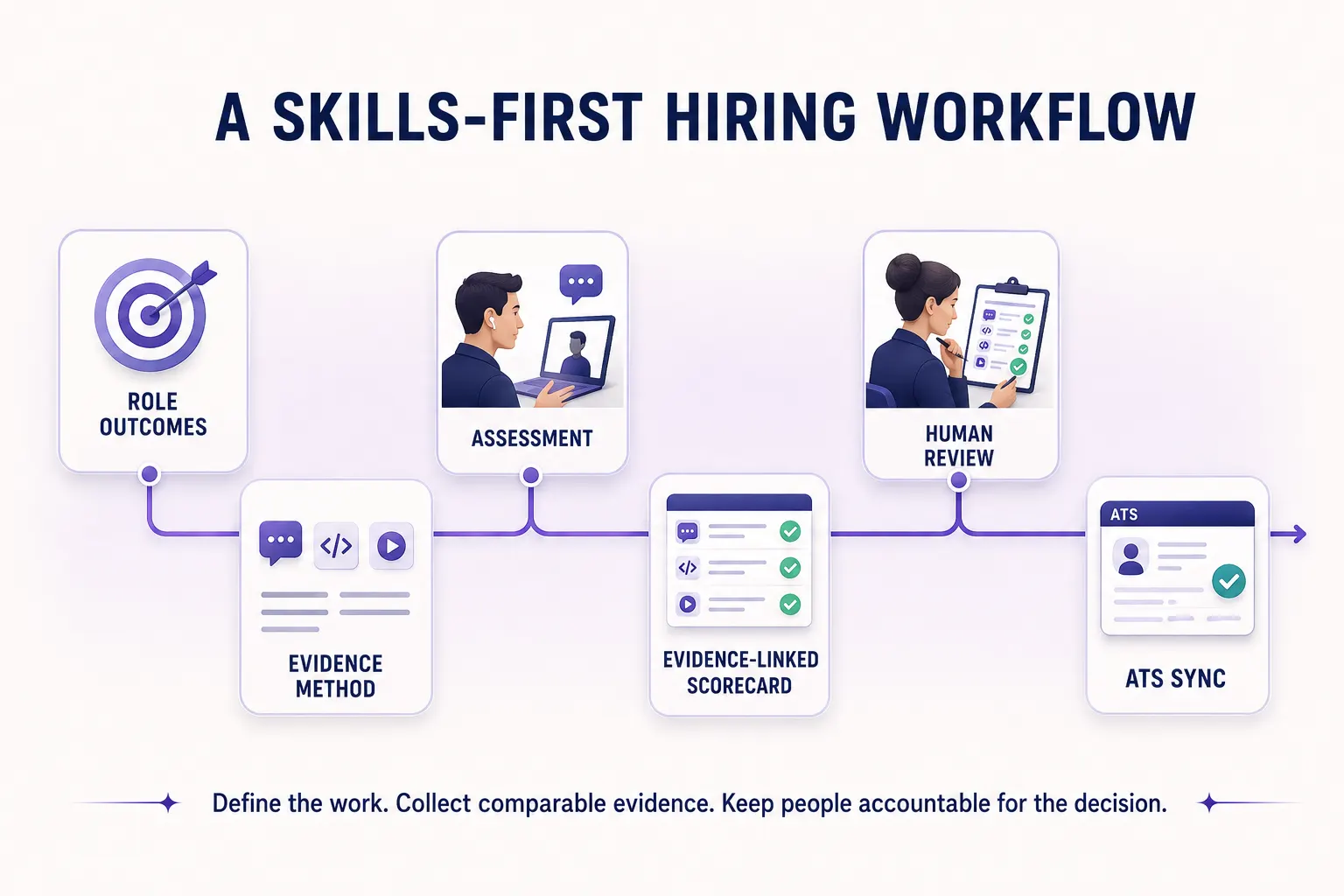
The recruiter defines the role skills, evidence standard, and pass rules.
Candidates complete a short job-related assessment or a conversational phone or video interview.
The system returns the response, transcript and evidence-linked scorecard.
A recruiter reviews the evidence, audits exceptions and decides who advances.
InterviewFlowAI supports this workflow with 100+ skills-assessment templates, custom questions, weighted pass scores and automatic progression into an AI interview. Its conversational AI interviews can ask follow-up questions, while scorecards and transcripts give reviewers the answer behind each score.
Use ranking as a review queue, not an automatic rejection list. The purpose is to help a recruiter reach stronger evidence sooner.
Candidate experience is part of assessment quality
A skills-first process asks candidates for more direct evidence. The employer should earn that effort.
The invitation should explain:
Why the assessment is being used.
Which skill it measures.
How long it normally takes.
Whether it is recorded or scored by AI.
Who reviews the result.
How to request an accommodation or another format.
What happens next and when the candidate should expect an update.
InterviewFlowAI’s first-party benchmark covers more than 100,000 completed AI interviews across 100+ businesses. It reports 70 to 85% completion within a four-day window, an average duration of about 13 minutes, and a 4.8/5 rating among candidates who completed an interview and chose to respond. These are product-specific operational benchmarks, not universal averages. The rating excludes people who abandoned the process. Review the methodology and limitations.
Frequently asked questions
What is an example of skills-based hiring?
A support team may replace a three-year SaaS requirement with a short troubleshooting scenario, a de-escalation role-play and a structured interview scored against the same rubric for every candidate. The resume still provides context, but the decision depends on job-related evidence.
Is skills-based hiring the same as competency-based hiring?
The terms overlap. Competency-based hiring often includes broader behaviors such as leadership, collaboration or judgement. Skills-based hiring usually emphasizes demonstrable capabilities and can include both technical and transferable skills. In practice, both approaches work best when the employer defines observable evidence and uses a consistent rubric.
Does skills-based hiring eliminate resumes?
No. A resume remains useful for work history, licences, project context and follow-up questions. It should not be expected to prove every capability or make the final decision by itself.
What jobs are best suited to skills-based hiring?
It works well when important tasks can be described and assessed through a short work sample, simulation or structured conversation. Examples include customer support, sales, operations, software development, analytics and many frontline roles. Regulated roles may still require specific credentials.
What are the main benefits of skills-based hiring?
It can widen the pool beyond familiar degrees and titles, make evaluation criteria clearer and give hiring managers comparable evidence. Results depend on implementation. Removing requirements without changing sourcing, assessment and review rarely changes who gets hired.
What are the risks of skills-based hiring?
The main risks are irrelevant tests, inaccessible formats, excessive candidate effort, inconsistent scoring, adverse impact and automatic decisions that nobody can explain. Job-related design, accommodations, monitoring and meaningful human review reduce those risks.
Can AI conduct a skills-based interview?
AI can run structured questions, ask controlled follow-ups, create transcripts and organize evidence against a rubric. A person should remain accountable for the criteria, review exceptions and make consequential decisions.
How do you assess soft skills fairly?
Replace labels with observable behavior. Instead of scoring “leadership” in the abstract, ask for a decision involving other people, define the evidence expected and score the response against anchored examples. Use more than one job-related observation for high-stakes decisions.