
Recruiting Analytics — Track Screening Funnel Performance & Candidate Quality, explained.
Analytics transforms InterviewFlowAI from a screening tool into a hiring intelligence platform. Track interview completion rates by role, source, and time period. Monitor candidate quality trends: are scores improving or declining over time? See where candidates drop out of your funnel and why. Compare screening performance across roles, recruiters, regions, and campaigns. Analytics gives recruiting leaders the data they need to optimize screening operations, justify headcount investments, and demonstrate hiring process improvement over time.
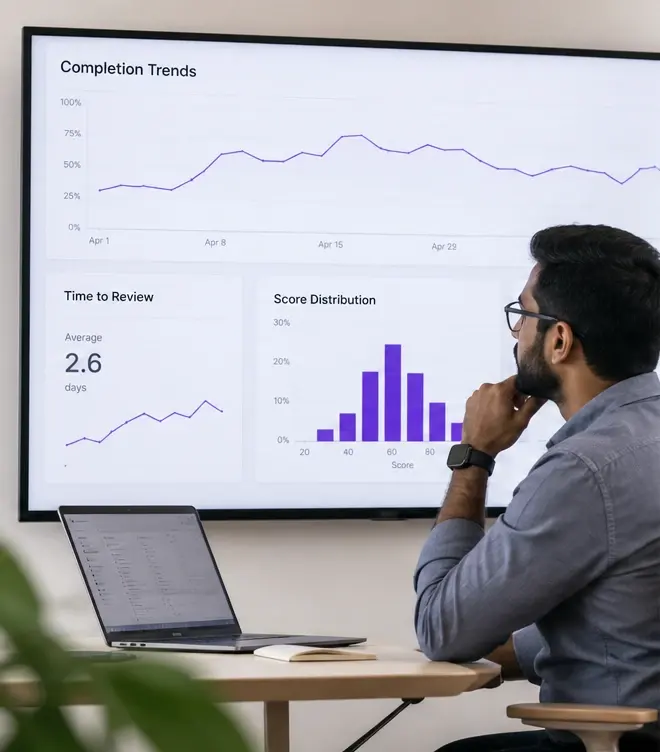
Track interview completion rates, scores, and funnel conversion by role
Analytics transforms InterviewFlowAI from a screening tool into a hiring intelligence platform. Track interview completion rates by role, source, and time period. Monitor candidate quality trends: are scores improving or declining over time? See where candidates drop out of your funnel and why. Compare screening performance across roles, recruiters, regions, and campaigns. Analytics gives recruiting leaders the data they need to optimize screening operations, justify headcount investments, and demonstrate hiring process improvement over time.
- Identify drop-off points in your screening funnel and address root causes
Monitor candidate quality trends and spot shifts before they become problems
Stop guessing whether your screening process is working. Analytics gives you visibility into completion rates, candidate quality trends, funnel conversion, and screening performance — so you can improve what you can measure.
- Export analytics data for board reports, stakeholder presentations, and BI integration
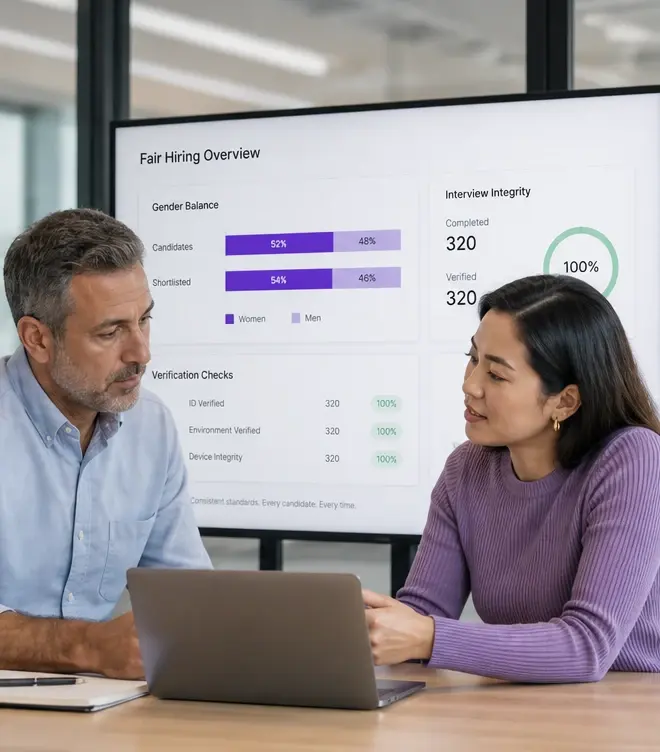
You can't improve what you can't measure
Most recruiting teams operate on anecdote and intuition. 'I think our screening is faster this quarter.' 'It feels like completion rates are down.' 'Candidates from LinkedIn seem stronger.' These gut feelings might be right — or they might be completely wrong. Without data, you're optimizing in the dark.
Analytics turns screening from a black box into a transparent, measurable process. See exactly how many candidates complete interviews, how scores trend over time, which sources produce the strongest candidates, and where your funnel leaks. Use that data to make informed decisions about process changes, resource allocation, and hiring strategy — and to demonstrate the impact of those decisions to leadership.
What analytics tracks and why it matters
Funnel conversion metrics
Invitations sent → interviews started → interviews completed → candidates shortlisted. See exactly where candidates drop out and how conversion rates trend over time.
Candidate quality trends
Average scores by competency, score distributions, and quality trends by role, source, and time period. Identify whether screening quality is improving or degrading.
Source performance
Which candidate sources (job boards, LinkedIn, referrals, agencies) produce the highest-scoring candidates? Allocate sourcing budget based on data, not habit.
Time-to-shortlist metrics
How quickly do candidates move from application/invitation to shortlist-ready? Track compression over time and identify remaining bottlenecks.
How recruiting leaders use analytics
Analytics is most powerful when it connects screening data to business outcomes — not just when it generates interesting charts.
- Demonstrate recruiting team productivity: show screening volume, completion rates, and time-to-shortlist trends to leadership.
- Justify tooling investment: prove that AI screening reduces time-to-hire or improves candidate quality with before/after data.
- Optimize sourcing spend: shift budget toward channels that produce candidates with higher interview scores and conversion rates.
- Identify process issues: if completion rates drop for a specific role or source, investigate and fix the root cause before it impacts hiring.
- Benchmark and set goals: establish baselines for key metrics and set improvement targets the team can rally around.
Analytics-driven screening vs. intuition-based screening
| Aspect | Intuition-based | Analytics-driven |
|---|---|---|
| Process improvement | Based on anecdotes and recent memory. Changes are reactive and unmeasured. | Based on trend data. Changes are targeted and measured for impact. |
| Resource allocation | Resources follow habit and hierarchy. Loudest stakeholder gets the most attention. | Resources follow data. Invest where metrics show the biggest opportunity or problem. |
| Stakeholder communication | 'It feels like screening is going well.' Hard to justify budget or headcount. | 'Completion rates up 22%, time-to-shortlist down 3 days.' Clear, defensible, persuasive. |
| Continuous improvement | Spontaneous and inconsistent. Changes happen when someone notices a problem. | Systematic and ongoing. Regular metric reviews drive incremental, measured improvements. |
Recommended analytics workflow
Establish your baseline metrics
Before optimizing, measure where you are: completion rates, score averages, time-to-shortlist, funnel conversion by stage.
Set improvement targets
Define what success looks like: 'Increase completion rate from 65% to 80%' or 'Reduce time-to-shortlist by 2 days.'
Review metrics on a regular cadence
Weekly for operational metrics (completion rates, volume). Monthly for quality trends and source performance. Quarterly for strategic reviews.
Use data to drive process changes and measure impact
When you change your screening process, use analytics to measure whether it worked. Build a culture of evidence-based improvement.
How this was verified
Feature capabilities described here were verified against the live InterviewFlowAI product pages and the published pricing page in August 2026. Plan availability can change; the pricing page is the source of truth.
Frequently asked questions
Which funnel metrics are tracked?
Invitations sent, interviews started, interviews completed and candidates shortlisted, so you can see exactly which step is losing people.
Can I see which sourcing channels work?
Yes. Source performance shows which channels produce the highest-scoring candidates rather than just the most applicants, which is usually the more useful question.
What is time-to-shortlist?
How long it takes from opening a role to having a reviewed shortlist. It is the metric most directly affected by automating the first round.
Can I compare across roles and regions?
Yes. Performance can be compared across roles, sources, regions and time periods, which is what makes a drop in one area visible rather than averaged away.
Can this data leave the platform?
Yes, via bulk export, which is how most teams feed a wider recruiting dashboard or client report.
Make your next hiring flow faster.
See how InterviewFlowAI can streamline screening for your team.