
AI Phone Interview Software for High-Volume Candidate Screening, explained.
AI phone interviews replace the most time-consuming part of early-stage hiring: the repetitive first-round phone screen. Instead of playing calendar tetris with every applicant, recruiters set up a role-specific interview once, and InterviewFlowAI conducts structured, conversational phone interviews with every qualified candidate. The AI asks relevant follow-ups, probes vague answers, and evaluates responses against the same criteria for every applicant — then delivers transcripts, recordings, scorecards, trust signals, and a ranked shortlist. Teams reviewing 50, 200, or 500 applicants can focus on the strongest candidates instead of burning hours on scheduling and note-taking.

Screen candidates 24/7 without live recruiter availability
AI phone interviews replace the most time-consuming part of early-stage hiring: the repetitive first-round phone screen. Instead of playing calendar tetris with every applicant, recruiters set up a role-specific interview once, and InterviewFlowAI conducts structured, conversational phone interviews with every qualified candidate. The AI asks relevant follow-ups, probes vague answers, and evaluates responses against the same criteria for every applicant — then delivers transcripts, recordings, scorecards, trust signals, and a ranked shortlist. Teams reviewing 50, 200, or 500 applicants can focus on the strongest candidates instead of burning hours on scheduling and note-taking.
- Achieve higher completion rates than video-only workflows
Get transcripts, scorecards, and rankings after every interview
Run two-way AI phone interviews that screen candidates 24/7 — no scheduling, no phone tag, no waiting. Every interview produces transcripts, scorecards, and rankings your team can review asynchronously.
- Evaluate communication skills and spoken clarity at scale
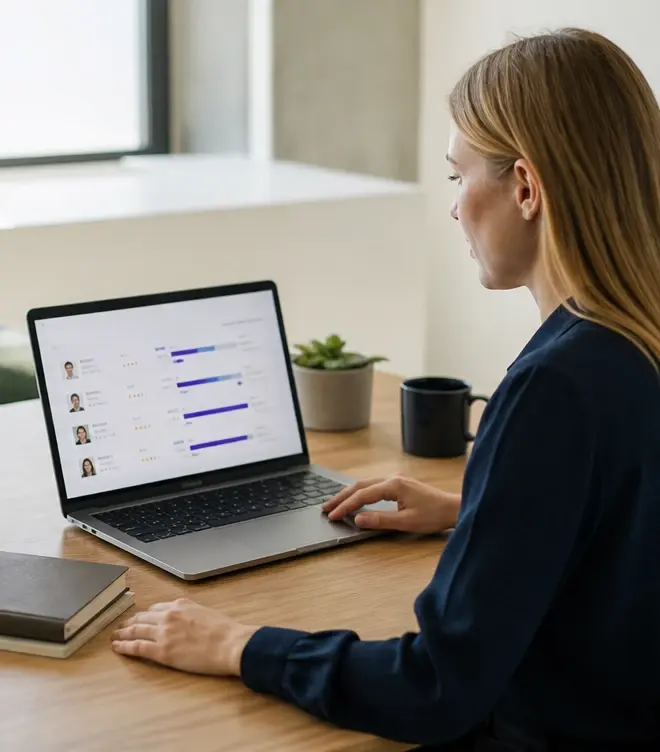
Replace phone tag with structured, repeatable phone screening
Phone screening is the universal bottleneck in recruiting. A recruiter can review 50 resumes in an hour but might spend an entire week coordinating, conducting, and documenting 50 phone screens. The math breaks at volume — and that's before accounting for no-shows, reschedules, timezone mismatches, and the cognitive drain of repeating the same qualification questions.
InterviewFlowAI's AI phone interviews solve this by decoupling the interview from the interviewer's calendar. Candidates receive an invitation, dial in when they're ready, and complete a structured, conversational phone interview with an AI that asks role-specific questions, follows up on incomplete answers, and evaluates every response against the same rubric. Recruiters open their dashboard to find completed interviews with transcripts, scorecards, recordings, and a ranked shortlist — no scheduling required.
What makes AI phone interviews different from one-way recordings
Two-way conversational AI
Unlike static one-way phone screens where candidates leave voicemail-style answers, InterviewFlowAI conducts adaptive, two-way conversations. The AI asks follow-up questions when answers are vague, probes for specifics, and mirrors the back-and-forth of a real recruiter call.
Structured evaluation, not just a recording
Every interview produces a scorecard with competency ratings, a full transcript, a summary, trust signals, and a ranking relative to other candidates — not just an audio file someone has to listen to later.
Candidate-friendly completion
Phone interviews remove the camera barrier that reduces completion rates in some candidate pools. Frontline, hourly, and mobile-first candidates are more likely to complete a phone screen than a video interview.
Instant shortlist generation
Instead of a pile of recordings your team needs to review one by one, candidates are ranked by fit so recruiters start with the strongest applicants.
When AI phone interviews work best
Phone-first screening isn't right for every role, but it's the strongest format for several common hiring patterns. Teams get the most value from AI phone interviews when the candidate pool is large, mobile-first, or time-sensitive — and when spoken communication is a genuine job requirement.
- Screen retail, hospitality, logistics, call center, and frontline applicants where phone communication mirrors the actual job.
- Run high-volume campus, seasonal, or event-based hiring campaigns without scaling recruiter headcount.
- Qualify sourced candidates from job boards, agencies, or talent databases before investing recruiter call time.
- Use phone interviews as a consistent first screen for roles where video completion rates are historically low.
- Evaluate English fluency, clarity, and professional phone manner for customer-facing and support positions.
How AI phone interviews compare to other screening methods
| Screening method | What you get | AI Phone Interview advantage |
|---|---|---|
| Manual recruiter phone screens | Live conversation, inconsistent notes, scheduling overhead. | Same conversational quality, zero scheduling, consistent evaluation criteria for every candidate. |
| One-way video/audio recordings | Static responses, no follow-up, heavy review burden. | Two-way adaptive conversation with follow-up questions, structured scorecards instead of raw recordings. |
| Written skills assessments | Tests reasoning and knowledge, misses communication and presence. | Captures spoken communication, clarity, confidence, and role-relevant verbal skills. |
| Resume-only screening | Fast but surface-level, misses communication and motivation signals entirely. | Adds structured conversational evidence without adding recruiter calendar time. |
Recommended AI phone interview workflow
Define the role rubric and interview questions
Set must-have competencies, communication expectations, and the prompts that reveal role fit. Use AI-generated questions from a job description or write custom prompts.
Invite candidates via email, link, or bulk upload
Send branded invitations with clear instructions. Candidates dial in at their convenience — no app download, no login required.
Let candidates complete interviews on their schedule
Automated reminders reduce no-shows. Candidates can interview during their commute, lunch break, or after hours.
Review the ranked shortlist
Open your dashboard to find transcripts, scorecards, recordings, trust signals, and a priority-ranked list of candidates ready for the next stage.
How this was verified
Feature capabilities described here were verified against the live InterviewFlowAI product pages and the published pricing page in August 2026. Plan availability can change; the pricing page is the source of truth.
Frequently asked questions
How is an AI phone interview different from a robocall?
A robocall plays a fixed recording. An AI phone interview is a two-way conversation: the AI listens to each answer and asks a relevant follow-up, so the candidate is genuinely interviewed rather than prompted through a script.
Do candidates need an app or a good camera?
No. A phone call is the only requirement, which is why this format suits frontline, hourly and field roles where candidates may have limited bandwidth, no quiet space or no desktop device.
Which plans include AI phone interviews?
AI phone interviews start on the Growth plan. They are not included on Pilot. Confirm the current matrix on the pricing page, as plan contents change.
What does the recruiter receive after the call?
A full transcript, a competency scorecard with a rating and rationale per criterion, trust signals, and a rank position relative to other candidates for the same role.
When is a phone screen the wrong format?
When visual presence is part of the job — on-camera sales, presenting or client-facing work — video captures signal that audio cannot. It is also a poor fit for roles needing written or coding output.
Make your next hiring flow faster.
See how InterviewFlowAI can streamline screening for your team.