
Automated Candidate Ranking — Turn Interview Data into Prioritized Shortlists, explained.
Automated Ranking is the layer that turns raw interview data into actionable hiring decisions. After candidates complete AI interviews, the platform synthesizes multiple data points — competency scores from the interview, resume screening results, trust signals, communication quality assessments, and role-specific criteria — into a single ranked view. Recruiters open their dashboard to find candidates ordered by overall fit, not by application date. The ranking is transparent: every score component is visible and explainable, so teams understand why candidates rank where they do. Automated Ranking doesn't make hiring decisions — it eliminates the manual sorting work that consumes recruiter hours and delays shortlist delivery.
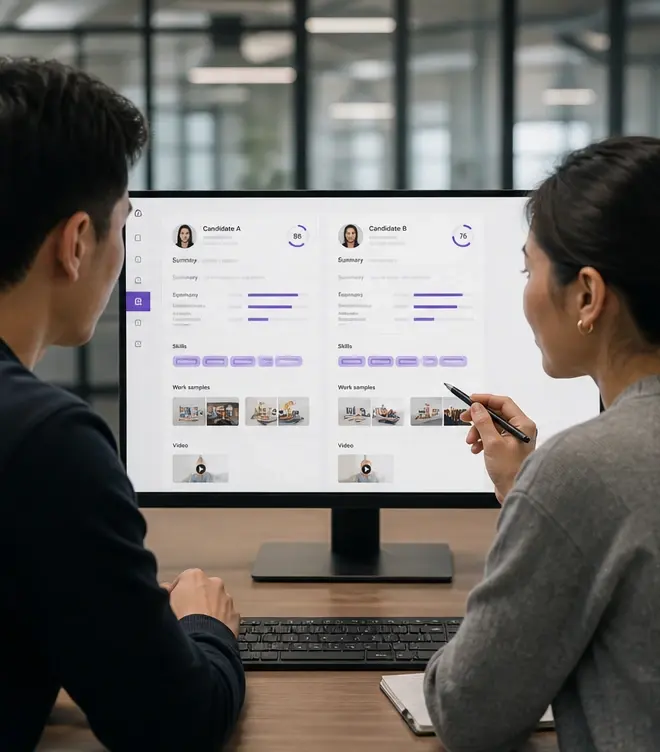
Synthesize interview scores, resume fit, and trust signals into one ranked view
Automated Ranking is the layer that turns raw interview data into actionable hiring decisions. After candidates complete AI interviews, the platform synthesizes multiple data points — competency scores from the interview, resume screening results, trust signals, communication quality assessments, and role-specific criteria — into a single ranked view. Recruiters open their dashboard to find candidates ordered by overall fit, not by application date. The ranking is transparent: every score component is visible and explainable, so teams understand why candidates rank where they do. Automated Ranking doesn't make hiring decisions — it eliminates the manual sorting work that consumes recruiter hours and delays shortlist delivery.
- Eliminate manual spreadsheet sorting and cross-referencing
Start every review session with the strongest candidates
Stop manually sorting candidates in spreadsheets. Automated Ranking turns interview outputs — competency scores, trust signals, resume fit, and communication quality — into a prioritized shortlist so your team always reviews the strongest applicants first.
- Speed up time-to-shortlist by prioritizing review order automatically

The hidden cost of manual candidate sorting
After interviews are done, most recruiting teams hit a second bottleneck: comparison. Recruiters open spreadsheets, scan notes, cross-reference resumes, pull up scorecards from different tools, and try to build a coherent shortlist from scattered data. For 20 candidates, this might take an afternoon. For 100 candidates, it can take days — and by the time the shortlist is ready, your strongest candidates may have already accepted other offers.
Automated Ranking removes this bottleneck entirely. Instead of recruiters building shortlists from scratch, the platform synthesizes all candidate data — interview competency scores, resume screening results, trust signals, communication assessments — into a single ranked view. Recruiters open the dashboard and start reviewing the strongest candidates immediately. The ranking logic is transparent and adjustable, so teams can weight the factors that matter most for each role.
What goes into the ranking
Interview competency scores
Performance on role-specific questions, scored against custom rubrics. Communication clarity, problem-solving quality, technical accuracy, and scenario responses all contribute.
Resume screening fit
Skills match, experience relevance, qualification alignment, and industry background — scored by the resume screening engine and fed into the overall ranking.
Trust and integrity signals
Interview authenticity indicators. Candidates with higher trust scores receive a confidence boost; flagged candidates are noted but not automatically penalized.
Role-specific criteria weights
Teams can adjust which factors matter most. Weight communication higher for sales roles. Weight technical accuracy higher for engineering. Weight trust higher for compliance roles.
How the best teams use automated ranking
Automated Ranking is a prioritization engine, not a hiring algorithm. The goal is to make sure recruiters spend their review time on the most promising candidates — not to replace recruiter judgment about who gets hired.
- Open the ranked dashboard and start reviewing from the top — your strongest candidates are already surfaced.
- Adjust ranking weights by role: prioritize communication for customer-facing positions, technical accuracy for engineering, trust for compliance-sensitive roles.
- Use rankings to set review SLAs: review the top 10 within 24 hours, the next 20 within 48 hours, and so on.
- Share ranked shortlists with hiring managers — they can see the evidence behind each rank instead of asking 'why this candidate?'
- Track ranking calibration over time: are highly-ranked candidates advancing further in the process? Adjust weights if not.
Automated ranking vs. manual shortlist building
| Aspect | Manual shortlist building | Automated Ranking |
|---|---|---|
| Time to shortlist | Hours to days of cross-referencing notes, scores, resumes, and impressions across multiple tools. | Instant. Open the dashboard. Start reviewing from the top. |
| Consistency | Varies by recruiter. Different people weight factors differently. Same candidate might rank differently depending on who builds the list. | Same formula for every candidate. Transparent, adjustable, and consistent across the entire applicant pool. |
| Transparency | Hard to explain why one candidate made the shortlist over another. 'They felt stronger' doesn't satisfy hiring managers. | Every rank component is visible. Hiring managers can see exactly why candidates are ordered as they are. |
| Speed to top talent | Slow. Strong candidates may accept competing offers while you're still building the shortlist. | Fast. Top candidates are surfaced immediately. Review and outreach can begin within minutes of interview completion. |
Recommended automated ranking workflow
Set ranking weights for the role
Decide what matters most: communication quality, technical accuracy, experience fit, trust signals. Adjust weights to match the role profile.
Let candidates complete AI interviews
As interviews finish, scores flow into the ranking engine automatically. No manual data entry or cross-referencing required.
Review the ranked shortlist from the top
Start with your highest-ranked candidates. Watch recordings, read transcripts, and verify scores for the strongest applicants first.
Share the shortlist and advance top candidates
Send the ranked shortlist to hiring managers. Schedule live interviews with the strongest candidates while they're still warm.
How this was verified
Feature capabilities described here were verified against the live InterviewFlowAI product pages and the published pricing page in August 2026. Plan availability can change; the pricing page is the source of truth.
Frequently asked questions
What inputs determine a candidate's rank?
Interview competency scores against your rubric, resume screening fit, and trust signals — weighted by the criteria you set for that specific role.
Can I see why a candidate ranked where they did?
Yes. The component breakdown behind each rank is visible, which matters both for recruiter trust and for explaining a decision later.
Does ranking make the hiring decision?
No. It removes manual sorting so reviewers start with the most promising candidates. Progression decisions stay with the recruiter or hiring manager.
Can weighting change between roles?
Yes. Criteria weighting is adjustable per role, so a communication-heavy role and a technical role can rank on different priorities using the same platform.
How should ranking be used responsibly?
Review candidates near the cut line rather than only the top of the list, and audit periodically for whether the rubric is measuring what the role needs. A rank is a starting point for review, not a filter to apply blindly.
Make your next hiring flow faster.
See how InterviewFlowAI can streamline screening for your team.