AI Video Interview Software for Async Candidate Screening, explained.
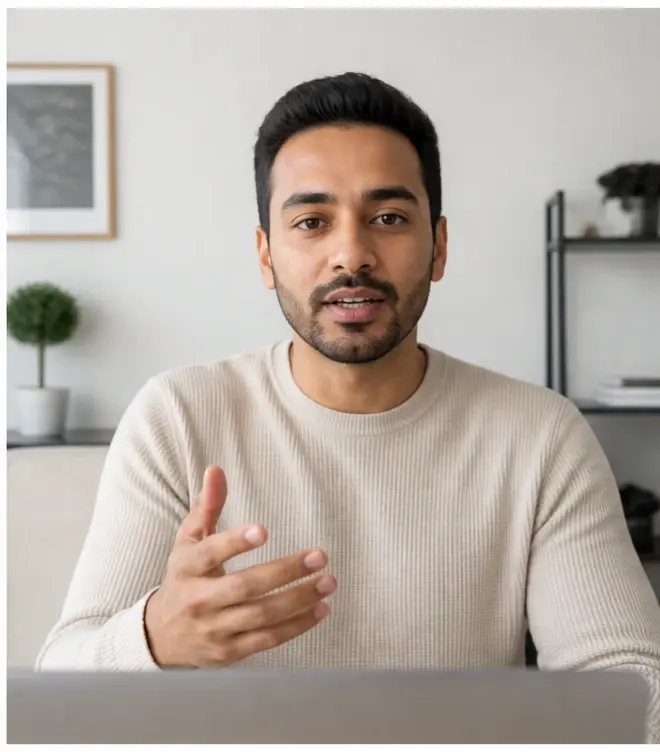
AI video interviews give hiring teams the depth of a live conversation without the scheduling friction. Candidates record responses to role-specific questions on their own schedule, while the AI evaluates communication style, clarity, presence, and response quality against a consistent rubric. Unlike static one-way video platforms, InterviewFlowAI conducts two-way conversations — asking follow-ups, probing vague answers, and adapting the interview in real time. Recruiters and hiring managers receive complete interview packets with recordings, transcripts, scorecards, trust signals, and a ranked shortlist they can review asynchronously.

See communication style, presence, and confidence before live rounds
AI video interviews give hiring teams the depth of a live conversation without the scheduling friction. Candidates record responses to role-specific questions on their own schedule, while the AI evaluates communication style, clarity, presence, and response quality against a consistent rubric. Unlike static one-way video platforms, InterviewFlowAI conducts two-way conversations — asking follow-ups, probing vague answers, and adapting the interview in real time. Recruiters and hiring managers receive complete interview packets with recordings, transcripts, scorecards, trust signals, and a ranked shortlist they can review asynchronously.
- Share interview evidence with hiring managers instantly
Review recordings, transcripts, and scorecards on your own schedule
Capture richer communication signals with AI-led video interviews that candidates complete asynchronously. Get recordings, transcripts, scorecards, and rankings — no live scheduling required.
- Standardize early-stage evaluation across every candidate
Why static one-way video interviews fall short
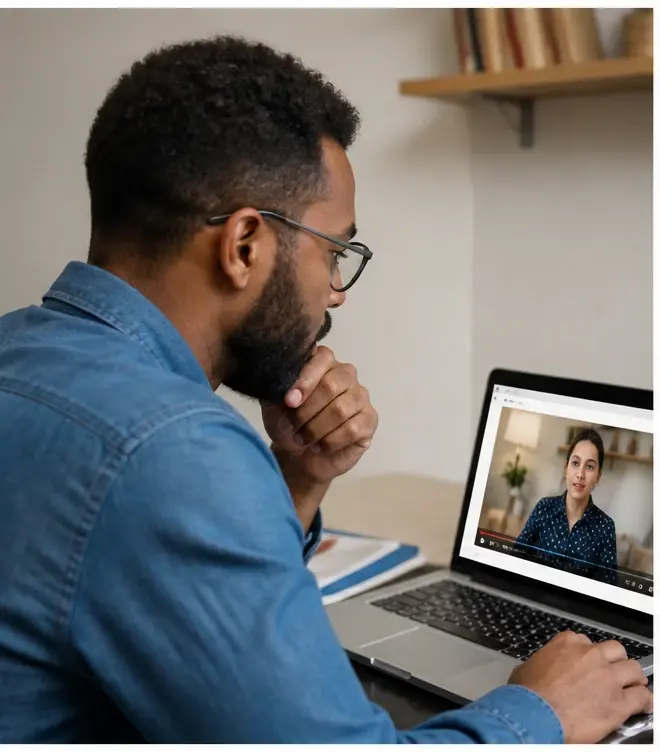
Most so-called AI video interview tools are really just one-way video recorders. Candidates read a question on screen, record an answer, and repeat. There's no follow-up, no probing, no adaptation. The result is a library of monologues that still require hours of human review — and often feel impersonal or awkward for candidates.
InterviewFlowAI's AI video interviews work differently. The AI conducts a real conversation: it asks questions, listens to responses, asks relevant follow-ups when answers are thin, and adapts its approach based on what the candidate says. The output isn't just a recording — it's a structured evaluation packet with a transcript, competency scorecard, trust signals, summary, and ranking that tells you who to talk to first.
What AI video interviews deliver that phone-only can't
Non-verbal communication signals
Video captures presence, confidence, eye contact, and professional demeanor — signals that matter for client-facing, leadership, and collaborative roles but are invisible in phone-only screening.
Asynchronous stakeholder review
Share recordings, transcripts, and scorecards with hiring managers, panel members, or clients. Everyone reviews on their own schedule instead of coordinating live interview attendance.
Richer assessment for communication-heavy roles
Sales, customer success, consulting, and leadership candidates can demonstrate presentation skills, storytelling ability, and executive presence before live rounds.
Consistent evaluation across distributed teams
When interviewers span time zones, AI-led video interviews create a shared evidence layer that replaces inconsistent live-screening notes.
Best-fit scenarios for AI video interviews
AI video interviews are strongest when the role requires visible communication skills and your team values richer signal before committing live interview time. They're not a replacement for final-round conversations — they're a structured filter that ensures live rounds are spent on the right candidates.
- Screen sales, account management, and customer success candidates for communication presence and confidence.
- Evaluate consulting, training, and leadership candidates on executive presence and clarity of explanation.
- Use video when remote teams need a shared candidate review layer across time zones.
- Add video screening for professional roles where camera comfort is part of the job.
- Replace first-round live video calls to protect hiring manager and panelist calendar time.
How AI video interviews compare to alternatives
| Approach | Experience | AI Video Interview advantage |
|---|---|---|
| One-way video platforms (HireVue, Willo, VidCruiter) | Static Q&A recording. No follow-up. Candidates talk to a timer. | Two-way adaptive conversation with AI follow-ups. More natural candidate experience, deeper signal. |
| Live video calls (Google Meet) | Rich signal but requires calendar coordination. Inconsistent evaluation across interviewers. | Same conversational depth, zero scheduling. Same rubric for every candidate. |
| Phone-only AI screening | Strong for communication, limited for presence and non-verbal signals. | Adds visual presence, professionalism, and confidence assessment for roles where it matters. |
| In-person interviews | Maximum signal, maximum coordination cost. Not scalable for first-round screening. | Filters candidates before in-person investment. Live rounds focus on depth, not qualification. |
Recommended AI video interview workflow
Build the video interview with role-relevant prompts
Use AI-generated questions or custom prompts that test communication, problem-solving, scenario response, and role-specific competencies.
Send branded invitations with flexible completion windows
Candidates receive a link, complete the interview on their own time, and get automated reminders to protect completion rates.
Review recordings, transcripts, and scorecards asynchronously
Hiring managers and panelists watch, read, and compare candidates on their own schedule — no live attendance needed.
Advance the strongest candidates to live conversations
Use live rounds for deeper role-play, team fit, work sample review, and closing — not first-round qualification.
How this was verified
Feature capabilities described here were verified against the live InterviewFlowAI product pages and the published pricing page in August 2026. Plan availability can change; the pricing page is the source of truth.
Frequently asked questions
How is this different from a one-way video interview?
A one-way tool shows a prompt and records a monologue with no follow-up. Here the AI reacts to what the candidate actually said and probes further, so a vague answer gets tested rather than simply recorded.
Do candidates have to be available at a set time?
No. The interview is asynchronous, so candidates complete it whenever suits them and reviewers watch later. No calendars are coordinated on either side.
What does the AI evaluate in a video interview?
Answer content against your rubric, plus communication clarity and delivery. Ratings are tied to transcript citations so a reviewer can check the evidence behind any score.
Can I choose how the AI interviewer looks and sounds?
Yes. Ten AI voices with matching avatars are available, so the interviewer persona can be matched to the role, brand tone or region.
Is video the right format for hourly roles?
Often not. Camera setup, bandwidth and a quiet space are real barriers at volume, and completion rates suffer. Phone or audio screening usually performs better for frontline and shift-based hiring.
Make your next hiring flow faster.
See how InterviewFlowAI can streamline screening for your team.