
AI Portfolio Screening — Evaluate Work Samples with Structured Consistency, explained.
Portfolio screening brings the same structured evaluation to creative and technical hiring that resume screening brings to traditional roles. Instead of hiring managers reviewing portfolios ad hoc — spending different amounts of time, applying different standards, and producing inconsistent notes — InterviewFlowAI applies consistent evaluation criteria to every portfolio. The AI assesses project complexity, technical execution, design thinking, problem-solving approach, and communication of process. Hiring teams get structured feedback they can compare across candidates, share with stakeholders, and use to decide who deserves a deeper conversation.
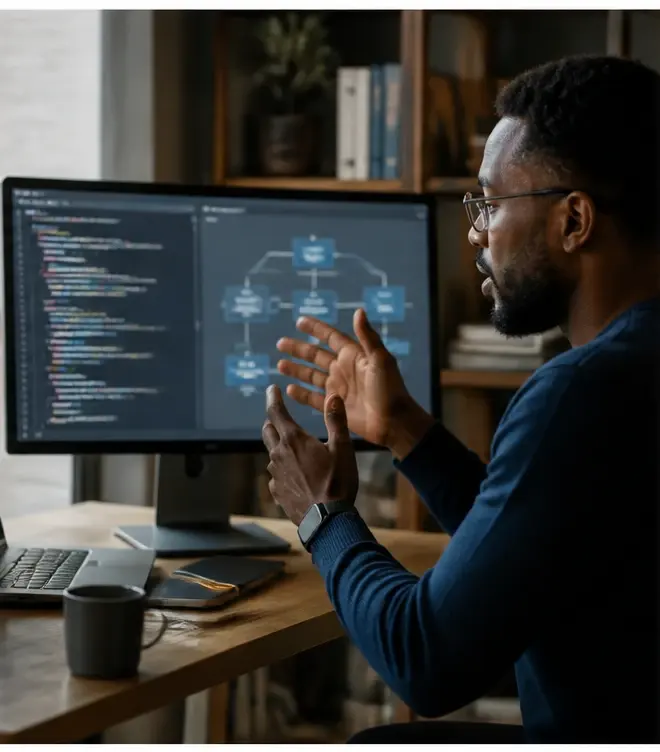
Apply consistent evaluation criteria to every portfolio
Portfolio screening brings the same structured evaluation to creative and technical hiring that resume screening brings to traditional roles. Instead of hiring managers reviewing portfolios ad hoc — spending different amounts of time, applying different standards, and producing inconsistent notes — InterviewFlowAI applies consistent evaluation criteria to every portfolio. The AI assesses project complexity, technical execution, design thinking, problem-solving approach, and communication of process. Hiring teams get structured feedback they can compare across candidates, share with stakeholders, and use to decide who deserves a deeper conversation.
- Share portfolio assessments with hiring managers and panels
Assess project complexity, execution quality, and process communication
Move beyond ad-hoc portfolio gut-checks. AI portfolio screening evaluates work samples, projects, and case studies with structured criteria — so every candidate's portfolio gets the same thorough review, not just the ones reviewed before lunch.
- Reduce the review-time gap between first and last candidate reviewed

Portfolio review is broken when it depends on reviewer energy
Portfolio review in most hiring processes is wildly inconsistent. The first portfolio of the day gets 20 minutes of focused attention. The fifth gets 8 minutes of scanning. The one reviewed right before a meeting gets skipped entirely except for the first project. And every reviewer applies different standards — one weights visual polish heavily, another cares mostly about process documentation, and a third only looks at the tools used.
AI portfolio screening doesn't replace human judgment — it standardizes the first-pass review so human judgment is applied consistently. Every portfolio gets evaluated against the same criteria: project complexity, execution quality, problem-solving approach, process communication, and tool/technology relevance. Hiring managers review structured assessments instead of raw portfolios, compare candidates more fairly, and make advancement decisions with better evidence.
What AI portfolio screening evaluates
Project complexity and scope
The AI assesses the scale, difficulty, and ambition of each project — distinguishing between simple implementations and complex, multi-faceted work.
Execution and craft quality
Visual design, code structure, research rigor, or writing quality is evaluated against role-relevant standards — not just whether the portfolio looks polished.
Problem-solving and process
How clearly does the candidate explain their approach, decisions, constraints, and outcomes? The AI evaluates process communication, not just final deliverables.
Relevance to role requirements
Portfolio work is scored against the specific skills, tools, and domain experience the role requires — not just generic quality assessment.
Roles where portfolio screening adds the most value
Portfolio screening is valuable for any role where past work samples are stronger predictors of performance than resumes or interview answers alone. It's not just for designers.
- Screen UX, product, and visual designers with consistent criteria across portfolios of varying formats and styles.
- Evaluate frontend, mobile, and full-stack engineering candidates through GitHub profiles, project write-ups, and code samples.
- Assess content designers, technical writers, and marketing candidates through writing samples and campaign case studies.
- Review data science and analytics candidates through project notebooks, dashboards, and methodology explanations.
- Give agency clients structured portfolio assessments alongside candidate submissions.
Portfolio screening vs. manual portfolio review
| Aspect | Manual review | AI Portfolio Screening |
|---|---|---|
| Consistency | Standards drift across reviews. First and last candidate get different levels of scrutiny. | Same evaluation framework applied to every portfolio. Consistent depth and criteria. |
| Review speed | 20-40 minutes per portfolio for thorough review. Reviewer fatigue reduces quality over time. | Structured assessment generated in minutes. Human reviewer focuses on evaluation, not initial analysis. |
| Stakeholder sharing | Scattered notes, screenshots, verbal summaries. Hard for hiring managers to compare independently. | Standardized assessment format. Easy to share, compare across candidates, and reference in debrief discussions. |
| Bias reduction | Reviewers naturally weight their personal preferences — visual style, tool choices, project types. | Criteria-based scoring reduces the influence of individual reviewer preference on initial assessment. |
Recommended portfolio screening workflow
Define portfolio evaluation criteria by role
Set what matters: design thinking, technical execution, process rigor, tool proficiency, communication clarity, project relevance.
Submit portfolios for AI assessment
Candidates upload or link their portfolios. The AI evaluates each against the role criteria and produces structured assessments.
Review assessments and compare candidates
Hiring managers review structured feedback, compare candidates side by side, and identify who deserves deeper portfolio walkthroughs.
Use live portfolio reviews for depth, not first-pass screening
Reserve live portfolio presentations for candidates who passed the structured screen — spend that time on deeper questions, not initial evaluation.
How this was verified
Feature capabilities described here were verified against the live InterviewFlowAI product pages and the published pricing page in August 2026. Plan availability can change; the pricing page is the source of truth.
Frequently asked questions
Which roles is portfolio screening built for?
Design and creative hiring, frontend and full-stack engineering, UX and product research, content design, technical writing, marketing and data analytics — anywhere work samples carry more signal than a resume.
What does it assess in a portfolio?
Project complexity and scope, execution and craft quality, how clearly the candidate communicates their problem-solving process, and how relevant the work is to your specific role requirements.
Does it replace a designer or engineer reviewing the work?
No. It produces a consistent first-pass assessment so specialist reviewers spend their time on a shortlist. Final craft judgement should stay with someone who does the job.
Can I compare candidates side by side?
Yes. Assessments use the same structure for every candidate, which makes them directly comparable, and can be shared with hiring managers or agency clients.
What if a candidate's best work is under NDA?
This is common in design and engineering hiring. Allow a written case description as a substitute and state that policy upfront, or you systematically disadvantage candidates from confidential environments.
Make your next hiring flow faster.
See how InterviewFlowAI can streamline screening for your team.