
Custom AI Interview Questions — Role-Specific Screening That Tests What Matters, explained.
Custom interview questions give hiring teams full control over what their AI interviews evaluate. Instead of using generic screening prompts that only scratch the surface, recruiters and hiring managers can define role-specific questions for communication skills, technical knowledge, problem-solving approach, scenario response, motivation, and culture alignment. Each question can be paired with scoring criteria so the AI knows what a strong answer looks like. The result is screening that mirrors how your best interviewers actually assess candidates — consistently, for every applicant, without the scheduling overhead.
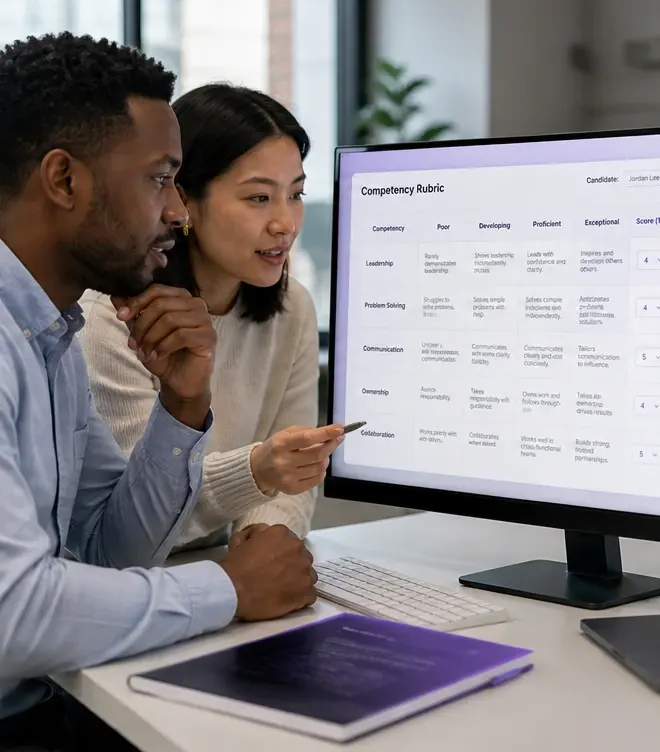
Write role-specific questions that test actual job competencies
Custom interview questions give hiring teams full control over what their AI interviews evaluate. Instead of using generic screening prompts that only scratch the surface, recruiters and hiring managers can define role-specific questions for communication skills, technical knowledge, problem-solving approach, scenario response, motivation, and culture alignment. Each question can be paired with scoring criteria so the AI knows what a strong answer looks like. The result is screening that mirrors how your best interviewers actually assess candidates — consistently, for every applicant, without the scheduling overhead.
- Create reusable question libraries for recurring roles and mandates
Define scoring criteria so the AI evaluates answers against your standards
Stop screening every role with the same generic questions. Build custom AI interview prompts and scoring rubrics tailored to each role's actual competencies — so early-stage screening tests what matters, not what's easy to ask.
- Reduce process variance — every candidate answers the same questions, scored the same way

Generic screening questions produce generic screening results
Most interview automation tools offer a fixed set of questions: 'Tell me about yourself,' 'What are your strengths and weaknesses,' 'Where do you see yourself in five years.' These questions have been asked so many times that every candidate has a rehearsed answer — and none of those answers help you distinguish between a strong hire and a polished interviewee.
Custom interview questions flip the script. Instead of adapting your evaluation to fit the tool's question bank, you build questions around the competencies that actually predict success in the role. If sales discovery skills matter, ask candidates to qualify a mock prospect. If technical judgment matters, present a real trade-off scenario your team faced. If communication matters, ask candidates to explain a complex concept to a non-technical audience — and define what a great explanation sounds like.
How to build questions that actually predict performance
Competency-first question design
Start with what you're actually trying to assess — problem-solving, customer empathy, technical judgment, communication clarity — and build questions that reveal those competencies, not just surface-level experience claims.
Scoring criteria for every question
Define what a strong, adequate, and weak answer looks like. The AI uses these criteria to evaluate responses consistently instead of applying generic quality judgments.
AI-generated question suggestions
Paste a job description and get role-relevant question suggestions in seconds. Edit, refine, or replace with your own — the AI gives you a running start.
Reusable question libraries
Save question sets for recurring roles. When you hire your fifth SDR or third backend engineer, your screening workflow is already built and proven.
Question types that work best for AI-led screening
Not every interview question format works well in an AI-led screen. The strongest questions are those where a great answer reveals genuine role competence, and where scoring criteria can be defined clearly enough for consistent evaluation.
- Situational questions: 'A client pushes back on pricing. Walk me through how you'd handle that conversation.'
- Past-behavior questions: 'Tell me about a project where you had to learn a new technology quickly. What was your approach?'
- Communication questions: 'Explain a technical concept from your field to someone with no background in it.'
- Problem-solving questions: 'Here's a simplified version of a real problem we solve. How would you approach it?'
- Motivation questions: 'What about this specific role and company made you apply — beyond the job title?'
Custom questions vs. generic question banks
| Approach | Generic question banks | Custom interview questions |
|---|---|---|
| Relevance to role | One-size-fits-all. Same questions whether hiring an SDR or a staff engineer. | Role-specific. Questions test competencies that actually predict success in this position. |
| Candidate experience | Candidates recognize recycled questions. Answers feel performative. | Questions feel relevant and thoughtful. Candidates engage more genuinely. |
| Signal quality | Low. Rehearsed answers to predictable questions reveal very little. | High. Role-relevant scenarios and competency probes surface genuine capability. |
| Hiring manager buy-in | Weak. Managers don't trust screening that doesn't reflect their evaluation criteria. | Strong. Questions built around the competencies managers actually care about. |
Recommended custom question workflow
Identify the 4-6 competencies that matter most
Work with the hiring manager to define what success looks like. Technical skills, communication, problem-solving, motivation, culture — pick what predicts performance.
Build questions that reveal those competencies
Write open-ended, scenario-based, and past-behavior questions. For each, define what strong, adequate, and weak answers contain.
Test with a few known candidates or team members
Run the questions past someone who would do well in the role and someone who wouldn't. Calibrate scoring criteria based on the results.
Launch, review, and refine
After the first batch of interviews, review question performance: which questions differentiate candidates well? Which produce uniform answers? Iterate.
How this was verified
Feature capabilities described here were verified against the live InterviewFlowAI product pages and the published pricing page in August 2026. Plan availability can change; the pricing page is the source of truth.
Frequently asked questions
Can the AI write the questions for me?
Yes. Questions can be generated from a job description as a starting point. Review them before launch — a generated question set still needs a human check that it tests what the role requires.
What question types are supported?
Situational, past-behaviour, communication, problem-solving and motivation questions, each with its own scoring criteria.
Should I set the rubric before or after interviewing?
Before, always. Rubrics defined after answers are in are far harder to defend and make candidates interviewed early incomparable with those interviewed later.
Can I reuse a question set across roles?
Yes. Saved question libraries are designed for recurring or high-volume roles, so each new campaign does not start from a blank page.
Why not use a generic question bank?
Because candidates rehearse widely-published questions, which flattens the differences between them. Role-specific questions tied to your competencies produce answers that actually discriminate.
Make your next hiring flow faster.
See how InterviewFlowAI can streamline screening for your team.