
Ask FlowAI — AI-Powered Candidate Comparison and Interview Analysis, explained.
Ask FlowAI transforms how hiring teams interact with interview data. Instead of manually comparing transcripts, re-watching recordings, and cross-referencing scorecards across candidates, recruiters and hiring managers can ask natural-language questions like 'Compare candidate A and B on problem-solving ability' or 'Which candidate showed the strongest understanding of our market?' and get structured, evidence-backed answers. Ask FlowAI can analyze individual interviews in depth, compare multiple candidates across any dimension, surface relative strengths and weaknesses, and suggest follow-up questions for live rounds. The AI works as a decision-support layer — surfacing insights from interview data while leaving final hiring decisions firmly in human hands.
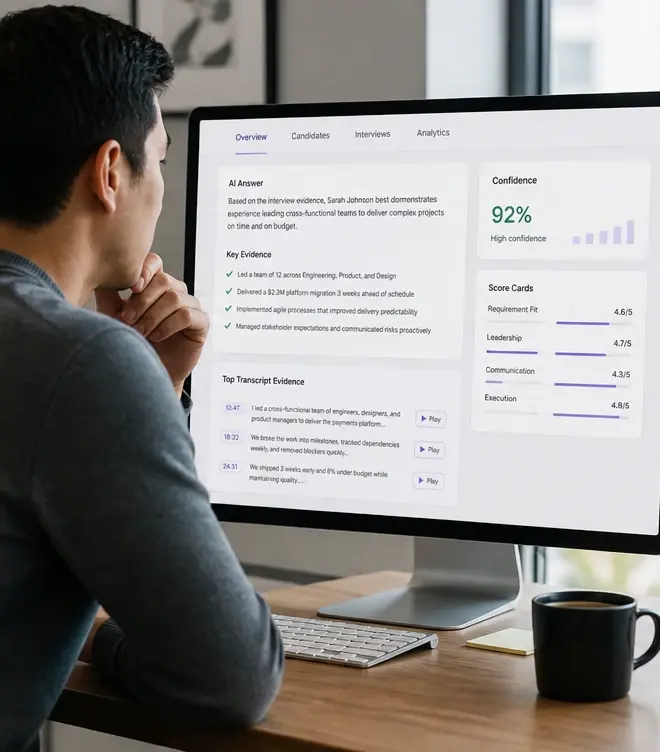
Compare two or more candidates side by side across any competency or dimension
Ask FlowAI transforms how hiring teams interact with interview data. Instead of manually comparing transcripts, re-watching recordings, and cross-referencing scorecards across candidates, recruiters and hiring managers can ask natural-language questions like 'Compare candidate A and B on problem-solving ability' or 'Which candidate showed the strongest understanding of our market?' and get structured, evidence-backed answers. Ask FlowAI can analyze individual interviews in depth, compare multiple candidates across any dimension, surface relative strengths and weaknesses, and suggest follow-up questions for live rounds. The AI works as a decision-support layer — surfacing insights from interview data while leaving final hiring decisions firmly in human hands.
- Run deep-dive analysis on technical answers, communication patterns, and resume claims
Ask natural-language questions about interview evidence and get structured answers
Ask FlowAI is your AI hiring analyst. Compare candidates side by side across competencies, ask natural-language questions about interview evidence, and get structured insights that help your team make faster, more confident hiring decisions.
- AI works as decision support — final hiring decisions always stay with your team

Interview data is only as useful as your ability to analyze it
AI interviews generate rich data: transcripts, recordings, scorecards, trust signals, rankings. But rich data can become overwhelming data when you're trying to compare five strong candidates across eight competencies and decide who to advance. Most teams fall back on gut feel — not because they don't have evidence, but because synthesizing all the evidence manually takes more time than they have.
Ask FlowAI solves the synthesis problem. It's an AI analyst that sits on top of your interview data, ready to answer any question about individual candidates or multi-candidate comparisons. Think of it as having an additional team member who has carefully reviewed every interview and can surface insights on demand — highlighting patterns, comparing strengths, and backing every observation with direct evidence from the transcript.
What Ask FlowAI can do
Multi-candidate comparison
Ask 'Compare Priya, Marcus, and Jordan on communication clarity and technical depth.' Get a structured comparison with evidence from each candidate's interview.
Deep-dive question analysis
Ask 'How did each candidate handle the objection-handling scenario?' Get a breakdown of each response with strengths and gaps identified.
Strength and weakness surfacing
Ask 'What are the top 3 strengths and weaknesses for each candidate relative to this role?' Get consolidated pros and cons aligned to job requirements.
Follow-up question generation
Ask 'What should I ask Marcus in the live round based on gaps in his AI interview?' Get suggested questions that probe areas the AI interview didn't fully cover.
How teams use Ask FlowAI across the hiring process
Ask FlowAI is valuable at multiple stages — from initial shortlist review through final-round preparation. The key is knowing what questions to ask at each stage.
- During shortlist review: 'Rank these five candidates by overall role fit and explain the key differentiators.'
- Before sharing with hiring managers: 'Summarize the top three candidates with evidence so I can write a clear recommendation.'
- During hiring manager calibration: 'Show me where these two interviewers rated the same candidate differently and why.'
- Before final-round interviews: 'What gaps or concerns should I probe in the live interview with each finalist?'
- For agency client submissions: 'Build a comparison of the top three candidates with evidence that supports each recommendation.'
Ask FlowAI vs. manual interview analysis
| Activity | Manual approach | Ask FlowAI |
|---|---|---|
| Comparing 3+ candidates | Open multiple transcripts. Jump between scorecards. Take notes. Try to remember who said what. 30-60+ minutes. | Ask one question. Get a structured comparison with evidence citations. Under a minute. |
| Identifying relative strengths | Subjective. Prone to recency bias and personal preference. Hard to defend to stakeholders. | Evidence-backed. Every observation tied to specific interview responses. Easy to share and defend. |
| Preparing for live interviews | Review notes. Guess what to ask. Hope you remember the gaps you noticed. | Ask for follow-up question suggestions based on actual gaps in the AI interview. Walk in prepared. |
| Calibrating across evaluators | Schedule a meeting. Compare notes verbally. Try to reconcile different impressions. | Ask FlowAI to surface rating divergences with evidence. Calibrate around specific responses, not abstract impressions. |
Recommended Ask FlowAI workflow
Complete AI interviews and let scores populate
Candidates finish their interviews. Transcripts, scorecards, and rankings are ready in the dashboard.
Use Ask FlowAI for initial shortlist analysis
Ask broad comparison questions to understand the landscape: top performers, relative strengths, patterns across the candidate pool.
Deep-dive on your shortlisted candidates
Ask specific, role-aligned questions about your top 3-5 candidates. Surface concerns, gaps, and differentiators.
Generate live-interview questions and prepare stakeholders
Use Ask FlowAI's follow-up suggestions and candidate summaries to brief hiring managers before live rounds.
How this was verified
Feature capabilities described here were verified against the live InterviewFlowAI product pages and the published pricing page in August 2026. Plan availability can change; the pricing page is the source of truth.
Frequently asked questions
What can I ask Ask FlowAI?
Comparisons across named candidates on chosen competencies, strengths and weaknesses per candidate, and suggested follow-up questions for a live interview. Queries are written in plain language rather than a query syntax.
Does it invent details about candidates?
Answers are grounded in the interview transcripts and scorecards and cite the evidence behind them. Check a citation before acting on anything decision-relevant.
Who gets most value from it?
Hiring managers comparing finalists, recruiters assembling a shortlist, teams calibrating how they score, and agencies preparing client submissions.
Can it prepare me for a live interview?
Yes. Asking which gaps to probe returns the areas where a candidate's answers were thin or untested, so the live round covers what the screen did not.
Does it work across roles or only within one?
It analyses the interview data you have. Comparing candidates who were interviewed against different rubrics is possible but less meaningful, since the scores are not measuring the same things.
Make your next hiring flow faster.
See how InterviewFlowAI can streamline screening for your team.