AI Resume Screening Software — Score Applicants Against Role Criteria, explained.
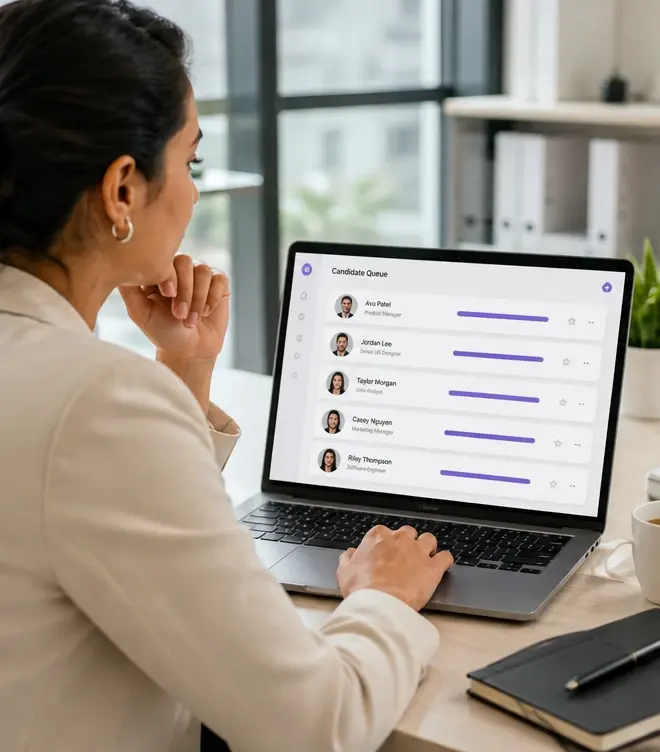
AI resume screening is the first filter in a modern hiring funnel. Instead of recruiters spending hours scanning resumes one by one — applying inconsistent criteria, fighting inbox fatigue, and still missing qualified candidates — InterviewFlowAI's resume screening engine evaluates every applicant against the same role-specific criteria. It scores resumes on skills match, experience relevance, qualification alignment, and keyword signals, then delivers a ranked list that tells recruiters who to review first. The AI doesn't reject candidates — it prioritizes them. Recruiters keep full control over who advances while spending their review time on the applicants most likely to fit.
Score hundreds of resumes against role criteria in minutes
AI resume screening is the first filter in a modern hiring funnel. Instead of recruiters spending hours scanning resumes one by one — applying inconsistent criteria, fighting inbox fatigue, and still missing qualified candidates — InterviewFlowAI's resume screening engine evaluates every applicant against the same role-specific criteria. It scores resumes on skills match, experience relevance, qualification alignment, and keyword signals, then delivers a ranked list that tells recruiters who to review first. The AI doesn't reject candidates — it prioritizes them. Recruiters keep full control over who advances while spending their review time on the applicants most likely to fit.
- Combine with AI interviews for a complete screening funnel
Same evaluation logic applied consistently to every applicant
Stop manually reviewing hundreds of resumes. AI resume screening scores every applicant against your role requirements — skills, experience, qualifications — so recruiters start their day with a ranked shortlist, not an overflowing inbox.
- Included with every InterviewFlowAI plan — no per-resume cost

Why manual resume review breaks at scale
Every recruiter knows the math: 200 applicants, maybe 15 minutes of focused review per resume if you're thorough, and roughly 50 hours of work before a single phone screen happens. In practice, recruiters scan for 6-30 seconds per resume — which means qualified candidates get missed because their resume didn't match the recruiter's scanning pattern, not because they weren't a fit.
AI resume screening changes the equation. Instead of recruiters scanning resumes hoping to spot the right signals, the AI evaluates every resume against the same criteria: skills, years of experience, relevant qualifications, industry background, and role-specific keywords. Recruiters open their dashboard to a ranked list and spend their attention on the candidates most likely to advance — not on inbox triage.
What AI resume screening actually evaluates
Skills match scoring
The AI identifies technical skills, tools, platforms, and domain expertise mentioned in each resume and scores alignment with the job requirements — catching synonyms and related terms human scanners miss.
Experience relevance
Years of experience, role progression, industry context, and company stage are evaluated against what the role actually needs, not just title matching.
Qualification verification
Education, certifications, licenses, and credentials are extracted and matched against role requirements — flagging both matches and gaps.
Consistent evaluation logic
Every resume gets the same treatment. No recruiter fatigue, no scanning bias, no end-of-day rushed reviews.
Where AI resume screening fits in your funnel
Resume screening isn't a hiring decision — it's a prioritization tool. The AI surfaces the strongest matches so recruiters can review them first, but humans make every advancement decision. This is how the best teams use it.
- Run AI resume screening as the first filter after applications come in — before any human review time is spent.
- Set role-specific criteria so the AI scores against your actual requirements, not generic keyword matches.
- Review the ranked shortlist and decide which candidates receive AI interview invitations.
- Combine resume scores with interview scores for a complete candidate evaluation picture.
- Use resume screening analytics to understand which sources and channels deliver the strongest applicants.
AI resume screening vs. ATS keyword filters
| Capability | Traditional ATS filters | AI Resume Screening |
|---|---|---|
| Matching logic | Boolean keyword matching. Misses synonyms, related terms, and context. | Semantic understanding. Recognizes equivalent skills, related experience, and contextual relevance. |
| Consistency | Filter rules are binary. Candidates pass or fail based on exact keyword presence. | Scoring is graduated. Candidates are ranked by overall fit, not eliminated by single keyword gaps. |
| False negatives | High. Qualified candidates get filtered out because they used different terminology. | Low. Semantic matching catches equivalent experience regardless of exact phrasing. |
| Recruiter experience | Configure complex boolean strings. Hope you didn't exclude someone qualified. | Define role requirements in plain language. Get a ranked list. Start reviewing. |
Recommended resume screening workflow
Define the role scoring criteria
Set must-have skills, preferred experience, required qualifications, and deal-breaker criteria the AI should weight in its scoring.
Upload or route applicants into the screening queue
Import candidates in bulk via CSV, connect your ATS pipeline, or have applicants apply through customisable job pages.
Review the AI-ranked shortlist
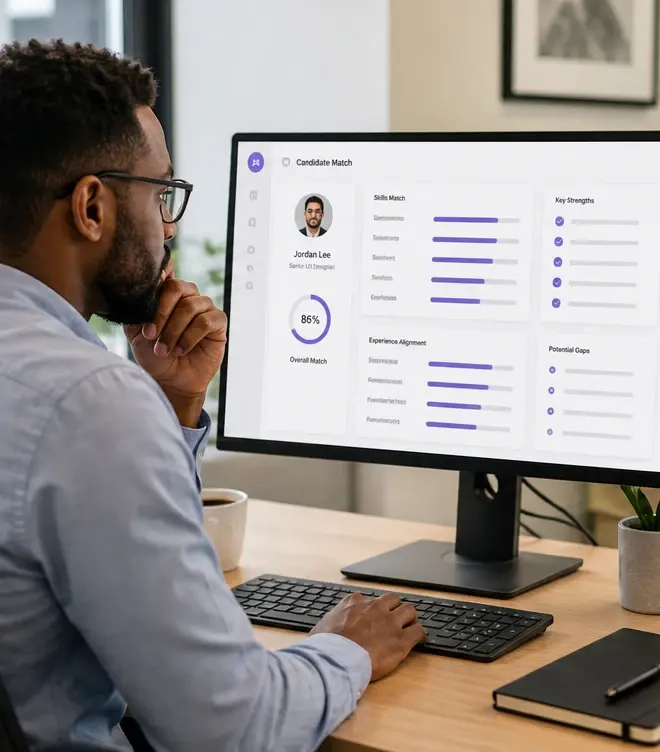
Start with the highest-scoring candidates. Read resumes with context from the AI's scoring breakdown — not from scratch.
Invite top candidates to AI interviews
Move the strongest resumes directly into AI phone or video interviews for structured communication evaluation.
How this was verified
Feature capabilities described here were verified against the live InterviewFlowAI product pages and the published pricing page in August 2026. Plan availability can change; the pricing page is the source of truth.
Frequently asked questions
Does resume screening reject candidates automatically?
No. It scores and prioritises rather than filtering out. Every applicant remains visible with a score and rationale, and a human decides who progresses.
How is this different from ATS keyword filtering?
Keyword filters match literal strings, so a candidate who wrote a synonym is discarded. Semantic matching recognises equivalent skills and related terminology, which cuts false negatives on strong applicants.
Is resume screening included on every plan?
Resume screening is listed as available on all plans including Pilot, with no per-resume charge. Confirm on the pricing page before purchase, as plan contents change.
What does the score actually measure?
Three components: skills match against required tools and domains, experience relevance including progression and industry context, and verification of stated qualifications and credentials.
Can resume screening feed straight into an interview?
Yes. Screened candidates can be moved into an AI interview in the same flow, so the resume score and interview score sit on one ranked view.
Make your next hiring flow faster.
See how InterviewFlowAI can streamline screening for your team.