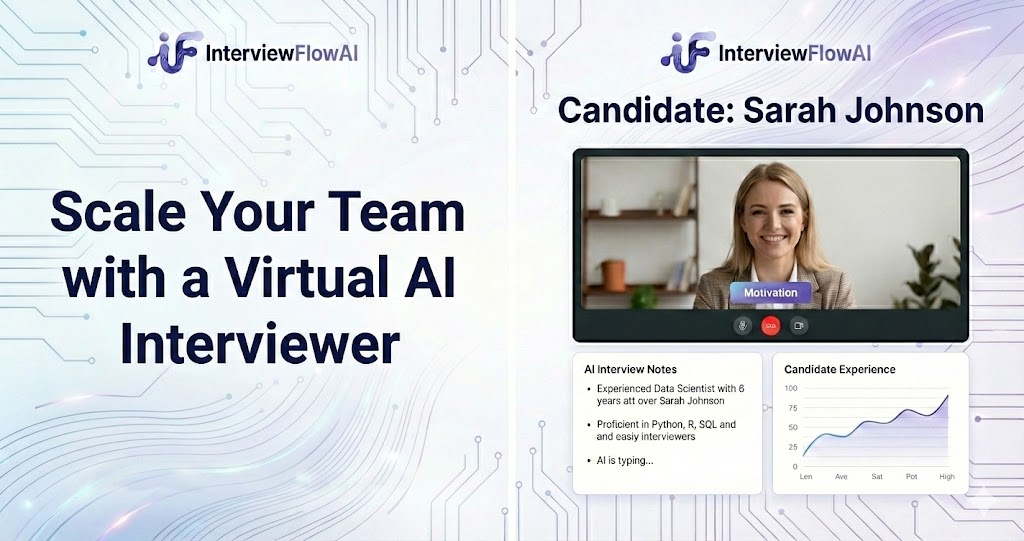
Most hiring teams have the same first-round problem: more applicants than recruiter hours, and a phone screen that varies with whoever happens to run it. InterviewFlowAI replaces that first conversation with an AI interviewer that runs structured phone or video interviews, scores every answer against your rubric, and hands your team a report to review.
This page explains what InterviewFlowAI is, how an interview works from setup to shortlist, what it measures, what it costs, and where its limits are. Every feature described here is documented in the InterviewFlowAI knowledge base.
Quick answer: InterviewFlowAI is AI interview software for employers. You set up an AI interviewer for a role, with your questions, rubric, and settings. Candidates take a 10–60 minute phone or video interview whenever suits them, in any of 16 languages, and the AI asks follow-up questions based on their answers. Each interview produces a transcript, a recording, a 0–100 score built from weighted 1–5 rubric ratings, and a ranked shortlist for a recruiter to review. Plans start at $59 per month, and a 7-day trial includes 10 interview credits.
InterviewFlowAI at a glance
| What it does | Conducts and scores first-round interviews. Also screens resumes and ranks candidates. |
|---|---|
| Interview formats | Two-way video and phone interviews with adaptive follow-up questions |
| Interview length | Configurable from 10 to 60 minutes. Completed interviews average about 13 minutes. |
| Languages | 16 languages, including English, Spanish, French, German, Arabic, Hindi, Chinese, and Japanese |
| Output | Transcript, recording, competency scorecard, 0–100 score, ranking |
| ATS integrations | Greenhouse, Ashby, Teamtailor, Workable, plus Zapier, an API, and webhooks |
| Pricing | From $59/month. About $0.83–$0.99 per interview on Growth and Scale. No per-seat fees. |
| Usage | 100,000+ completed interviews across 100+ businesses (May 2025 – July 2026) |
How an InterviewFlowAI interview works
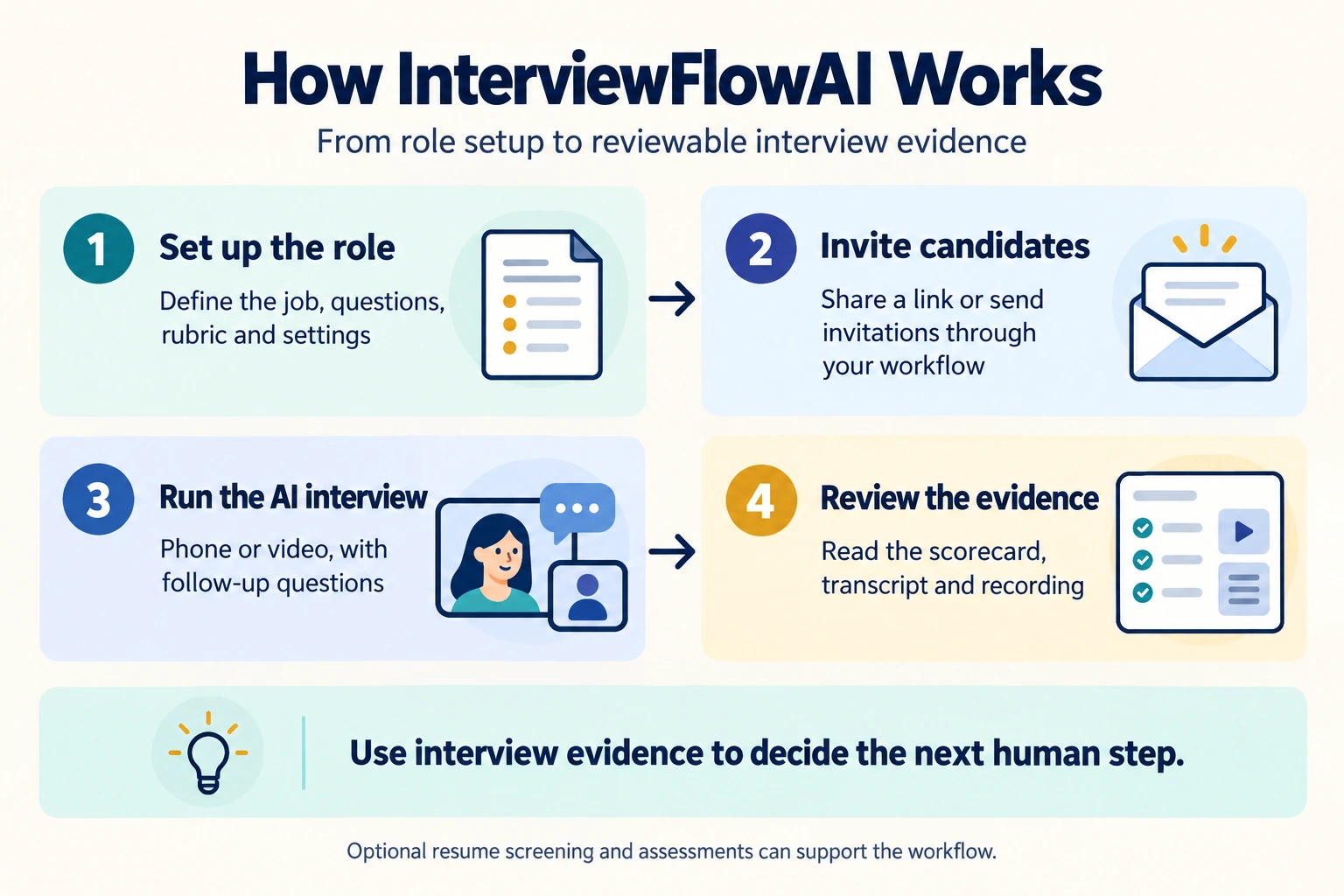
1. Create an AI interviewer for the role
Each role gets its own AI interviewer, built from scratch or from a template in five steps:
- Role details: the job title, hiring profile, and a role brief that tells the AI what the job involves.
- Interview settings: language, maximum duration (10–60 minutes), link expiry (1–10 days), retakes (1–3), and optional requirements such as video, a portfolio link, or desktop-only access.
- Application form: screening questions and knockout criteria asked before the interview.
- Question settings: which question sources to use (see the next step).
- Questions: the final order and the prompts the AI will use.
You can also customize the AI interviewer's name, voice, and avatar, and adjust how long it waits after a candidate stops speaking before it replies. The default of 1.5 seconds keeps the conversation natural without interrupting. If a role is still vaguely defined, tighten the brief first with the free job description optimizer.
2. Choose how questions are generated
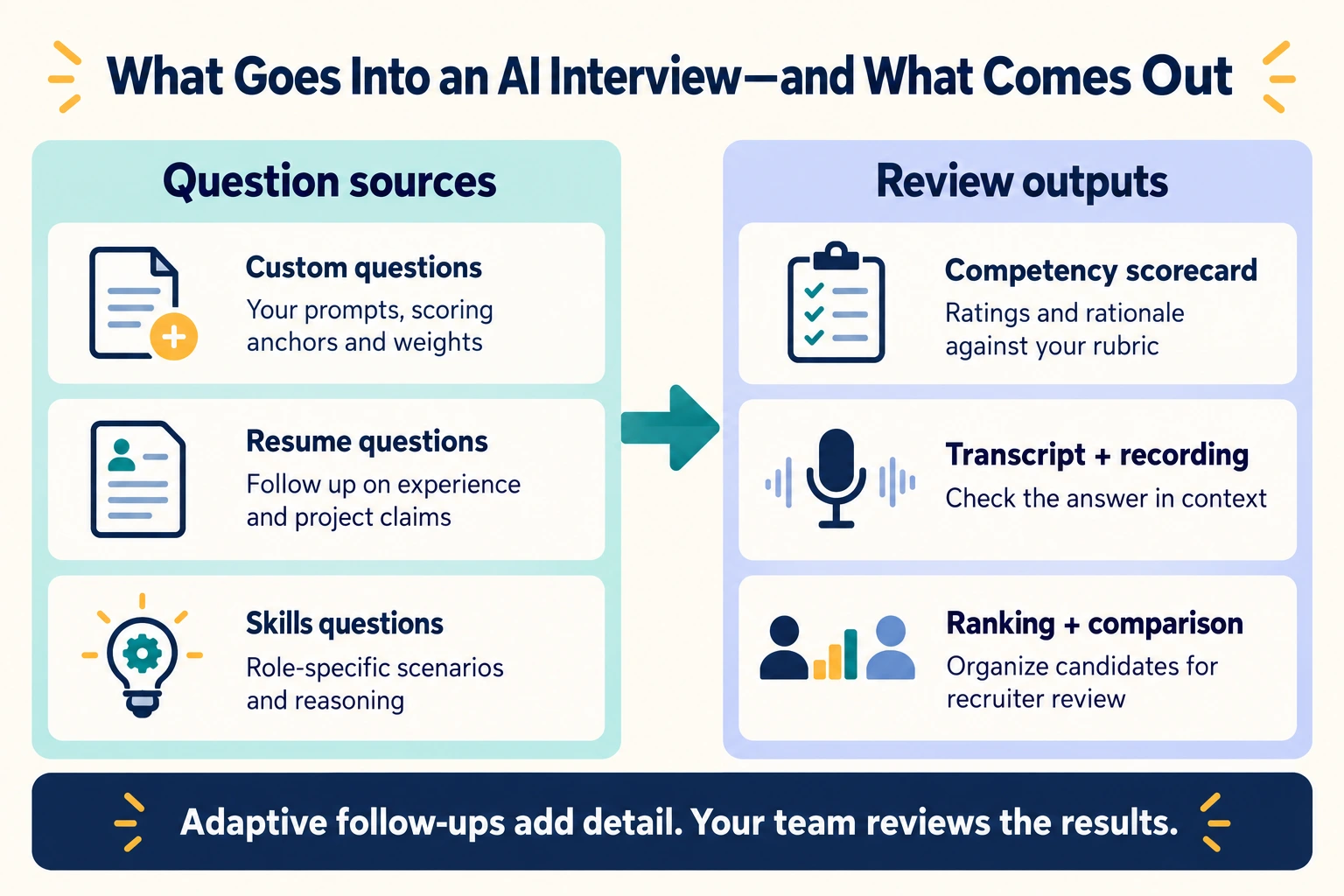
InterviewFlowAI can mix three question sources in one interview:
| Source | How it works | Best for |
|---|---|---|
| Custom questions | Questions your team writes, asked identically to every candidate, each with a rubric describing a strong (5) and weak (1) answer and a weight | Core competencies and behavioral questions that need consistent scoring |
| Resume questions | The AI reads each candidate's resume and generates up to 10 tailored questions, guided by your instructions | Verifying experience, projects, and claims on the resume |
| Skills questions | The AI creates questions and scenarios for skills you choose, such as communication, system design, or problem solving | Role-specific scenarios without writing every question yourself |
Across all three, the AI can ask up to two follow-up questions per question to probe for detail. That is what separates a conversational AI interview from a one-way video recording. See one-way video vs conversational AI interviews for the difference in practice.
3. Screen resumes before the interview (optional)
With resume screening turned on, InterviewFlowAI checks each application against your must-have requirements and scores it against weighted criteria from 1 (weak) to 5 (strong). For every rule it quotes the evidence from the resume, or marks "No evidence found," rather than guessing. You can set a minimum pass score and choose whether a failed must-have rejects the application automatically.
4. Invite candidates
Candidates can reach an interview in several ways:
- A shareable interview link, or your public careers and job pages
- Individual invitations from the dashboard, or a CSV bulk import
- An ATS hiring stage that triggers the invitation automatically in Greenhouse, Ashby, Teamtailor, or Workable, with results synced back
- The API, for your own systems or ATS
Automated reminders and branded emails keep candidates moving. To source new candidates, talent search and outreach sequences can feed directly into an interview.
5. The candidate takes the interview
Candidates interview whenever suits them, 24/7, with no scheduling. A video interview runs in the browser. A phone interview runs through a Twilio number your company connects, so candidates see your number. The AI introduces itself, explains the format (by default, about two minutes per answer), asks each question, follows up where an answer needs more detail, and closes with your message. You can add an intro video before the interview and post-interview questions after it, for example to collect a code repository or portfolio link.
6. Review scores, transcripts, and rankings
When the interview ends, the recruiter receives a scorecard and transcript. Each question is rated against its rubric, the weighted ratings roll up to a 0–100 score, and automated ranking orders candidates by fit. The full recording is attached.
To go deeper, Ask FlowAI answers questions about one candidate or compares several side by side, for example "Which of these three is strongest in problem solving?" It cannot shortlist or reject anyone. The recruiter makes the decision. The analytics dashboard tracks completion rate, score distribution, and how many candidates are waiting for review.
7. Move qualified candidates forward
With Coordinator, candidates who meet your pass score automatically receive an email with your scheduling link, after an optional delay. Your calendar tool handles availability and creates the Google Meet or Teams link. When that next conversation is led by a person, the AI Notetaker can record it, with consent, and produce a transcript and structured notes. Results can also be exported or synced back to your ATS.
See it in action: watch the product overview or browse AI interview templates by role, from software engineers to call center agents.
Interview integrity and proctoring
Proctoring can be turned on for each AI interviewer and is included in the Scale and Enterprise plans. It tracks three things and deducts points according to penalties you configure, each capped so one signal can't dominate the score:
- Tab switching: the candidate leaves the interview tab.
- Eye and face detection: the candidate stays present and focused on the screen, against a threshold you set.
- Answer authenticity: responses show signs of AI-generated content or outside help.
Use these signals as prompts for review, not automatic verdicts. Candidates look away while thinking, read captions, or manage a disability. Set thresholds conservatively and check the recording before acting on a flag. Adaptive follow-up questions remain the strongest safeguard, because generated answers rarely survive them. For more, see how to detect AI interview cheating without false accusations and the Trust Score.
What InterviewFlowAI costs
Plans are priced per interview credit, not per recruiter seat. Each interview uses one credit, and assessments use half a credit.
| Plan | Price | Credits per month | Adds |
|---|---|---|---|
| Pilot | $59/month | 20 | Video interviews, resume screening, candidate reports |
| Growth | $299/month ($250 billed yearly) | 303 | Phone interviews, ATS integrations, portfolio screening, import/export |
| Scale | $499/month ($416.60 billed yearly) | 505 | Team management, APIs, webhooks, cheat detection |
| Enterprise | Custom | Unlimited | Custom SLA, security reviews, tailored onboarding |
Unused credits roll over on Growth and Scale. The latest details are on the pricing page.
What InterviewFlowAI is not
- Not an ATS replacement. It works alongside Greenhouse, Ashby, Teamtailor, Workable, and other systems as the interview layer.
- Not a hiring decision-maker. It collects and scores evidence, and your team decides who advances. One exception: you can choose to auto-reject applications that fail a must-have resume requirement.
- Not a substitute for deep technical rounds. A spoken interview tests reasoning and experience. Hands-on coding and system design still belong in live rounds with your engineers.
- Not available in every language. It supports 16 languages today. Check that your candidate pool is covered.
Who uses InterviewFlowAI
- High-volume hiring teams replacing hundreds of repetitive phone screens
- Startups without a full recruiting team
- Recruitment agencies qualifying candidates across many clients
- Global teams screening across time zones and languages
- Talent acquisition teams standardizing first-round evaluation
Among candidates who completed an interview and left a rating, the average is 4.8 out of 5. Completion rates in InterviewFlowAI's benchmark range from 70% to 85% when interviews are clearly disclosed and conversational. Both figures and their methodology are in our AI recruitment statistics report. For a vendor-neutral buying guide, read AI interview software: how it works, what it costs, and how to choose.
Run your first AI interview this week
Start a 7-day trial with 10 interview credits, set up an AI interviewer for one role, and review the scorecards yourself.
Frequently asked questions
What is InterviewFlowAI?
InterviewFlowAI is AI interview software for employers. It conducts structured first-round phone and video interviews, asks adaptive follow-up questions, scores answers against your rubric, and gives recruiters a transcript, recording, score, and ranked shortlist to review.
How does an InterviewFlowAI interview work?
You create an AI interviewer for a role, with role details, interview settings, an application form, and questions. Candidates receive a link or invitation and take a 10–60 minute phone or video interview whenever suits them. The AI scores each answer, and your team reviews the results.
How are candidates scored?
Each question is rated from 1 to 5 against the rubric you define, with weights for its importance. The weighted ratings roll up to an overall score out of 100, and candidates are ranked. Every score comes with the transcript and recording, so reviewers can check the evidence.
Does InterviewFlowAI make hiring decisions?
No. It collects and scores evidence, and recruiters decide who advances. Ask FlowAI can compare candidates but cannot shortlist or reject them. The only automated rejection is optional: you can auto-reject applications that fail a must-have resume requirement.
Which ATS does InterviewFlowAI integrate with?
InterviewFlowAI integrates with Greenhouse, Ashby, Teamtailor, and Workable. It also connects with other systems through Zapier, its API, and webhooks. ATS integrations are included from the Growth plan.
How much does InterviewFlowAI cost?
Pilot is $59 per month for 20 interview credits. Growth is $299 per month for 303 credits, and Scale is $499 per month for 505 credits, with discounts on yearly billing. That works out to about $0.83–$0.99 per interview on Growth and Scale. Enterprise pricing is custom.
Does InterviewFlowAI detect cheating?
Yes, on Scale and Enterprise. Proctoring tracks tab switching, eye and face presence, and signs of AI-generated answers, and deducts points according to penalties you configure. Treat these signals as prompts for human review rather than automatic verdicts.
Sources
- InterviewFlowAI Knowledge Base: Create an AI interviewer, question sources, resume screening, proctoring, and Coordinator.
- InterviewFlowAI, Pricing, accessed October 2026.
- InterviewFlowAI, AI Recruitment Statistics 2026 (platform benchmark, May 2025 – July 2026).