AI interview software conducts or supports job interviews using artificial intelligence. In an early-stage screening workflow, it can ask structured questions by phone or video, probe a candidate’s answers, create a transcript, score the evidence against a role-specific rubric, and send the results to a recruiter. It should not make the final hiring decision by itself.
That boundary matters. A good platform gives hiring teams more evidence and more capacity. A poor implementation simply automates an inconsistent interview, adds friction for candidates, and makes a questionable decision harder to inspect.
This guide explains the differences between AI interview products, where they fit, what they cost, and what to test before signing a contract.
AI interview software at a glance
| Question | Short answer |
|---|---|
| What does it do? | Runs or supports interviews, captures responses, and turns them into structured evidence for human review. |
| Where does it fit? | Usually at the first-round screening stage, after an application or resume review and before a recruiter or hiring-manager interview. |
| When is it most useful? | When a team has more plausible applicants than it can screen consistently by phone. |
| What should buyers inspect? | Interview structure, scoring evidence, candidate experience, accessibility, human oversight, data handling, integrations, and total cost. |
| What should it not do? | Make an unreviewed final hiring decision or score candidates on traits that are unrelated to the job. |
What is AI interview software?
AI interview software is recruitment technology that uses artificial intelligence to conduct, record, transcribe, or evaluate a job interview. The term is broad, which is one reason vendor comparisons often become confusing.
Four different product categories frequently appear under the same label:
AI-led interviewers conduct a phone, audio, or video conversation. More capable products ask follow-up questions and score answers against a defined rubric.
One-way video interview tools play fixed questions and record each response. They do not hold a conversation.
Interview intelligence tools join a human-led call, record it with consent, and produce transcripts, notes, or scorecards. A recruiter still conducts the interview.
Assessment platforms test a specific skill through coding tasks, work samples, language tests, or psychometric assessments. They may include video interviews, but the assessment is the main product.
A resume-ranking tool is not an AI interviewer either. Resume screening evaluates application data before a conversation takes place. Interview software collects fresh evidence by asking the candidate questions.
If you are comparing named vendors rather than product categories, use the 2026 AI interview software comparison. This guide focuses on the buying decision and implementation.
How AI interview software works
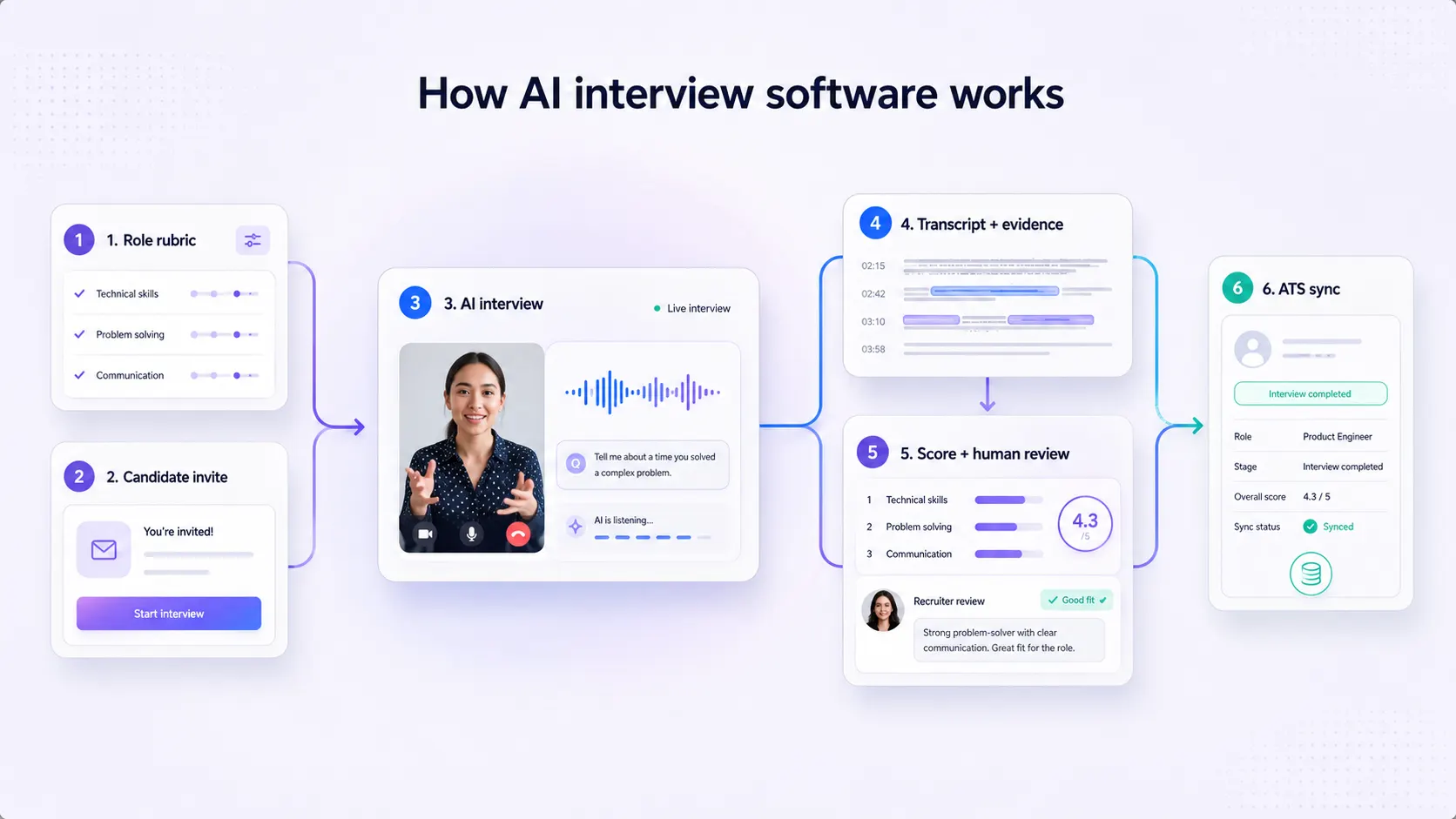
The workflow usually has six stages.
1. Define the role and scoring rubric
The recruiter identifies the competencies that matter for the job, writes job-related questions, and defines what weak, acceptable, and strong evidence looks like.
This is the foundation of the assessment. AI cannot repair a vague role profile or a rubric built around personal preference. If the criteria are not tied to the work, a consistent score can still be consistently wrong.
2. Invite the candidate and explain the process
The candidate receives an interview link or phone call. The invitation should say that AI will be used, what the interview will involve, how long it should take, what data will be recorded, and how to request an accommodation or alternate route.
Candidates should not discover that an AI system is evaluating them after the interview has already started.
3. Conduct the interview
In a one-way interview, every candidate receives the same recorded prompts. In a conversational AI interview, the platform can ask follow-up questions when an answer is vague, incomplete, or worth exploring.
The safer design has a structured core and controlled follow-ups. Every candidate is evaluated against the same competencies, while follow-up questions gather enough evidence to score those competencies. An unrestricted chatbot that improvises both the questions and the criteria creates a comparability problem.
4. Transcribe and organize the evidence
The system turns the conversation into a transcript and associates relevant passages with the rubric. Strong output lets a reviewer move from a score to the candidate’s actual answer.
A summary without source evidence is convenient, but hard to audit.
5. Score and rank for review
The platform applies the rubric and may rank candidates so recruiters know where to begin. The ranking should be a review queue, not an automatic rejection list. Recruiters need to see the criteria, supporting evidence, confidence or exception flags, and any integrity signals that affected the result.
6. Return the result to the hiring workflow
Interview status, scores, transcripts, and review notes should move into the applicant tracking system. If a recruiter has to download a PDF, rename it, and upload it to the ATS for every candidate, the platform has moved the bottleneck rather than removed it.
Which type of AI interview platform fits your workflow?
| Product type | What the candidate experiences | What the recruiter receives | Best fit | Main tradeoff |
|---|---|---|---|---|
| One-way video interview | Fixed recorded questions and timed responses | Recordings, transcripts, and sometimes scores | Repeatable, high-volume screens where basic evidence is enough | No follow-up questions and often more candidate friction |
| Conversational AI interviewer | A phone, audio, or video conversation with follow-up questions | Transcript, evidence-linked scorecard and ranked review queue | First-round screening that requires more depth than a form or resume | Needs strong rubric controls and clear disclosure |
| Interview intelligence or notetaker | A live interview with a human recruiter | Recording, transcript, notes, and scorecard draft | Teams that want better documentation without automating the conversation | Does not create more interviewer capacity |
| Skills-assessment suite | A test, work sample or simulation, sometimes combined with video | Test results plus interview evidence | Technical or regulated roles that need direct proof of a skill | More setup, cost and candidate time |
Phone interviews can reduce camera pressure and work well for high-volume or mobile-first candidates. Video can help when the role requires a presentation, demonstration or other visible work sample. The format should follow the job requirement, not the vendor’s default.
When AI interviewing software is useful
AI-led screening is usually a good fit when:
Applications arrive faster than recruiters can run first-round calls.
The same competencies must be evaluated across many candidates.
Candidates apply across time zones or outside business hours.
A recruitment agency needs comparable evidence for several client shortlists.
A team wants to give more plausible applicants a chance to speak instead of filtering only by resume keywords.
Recruiters spend a large part of the week scheduling, conducting and documenting similar screens.
It is usually a poor first choice when:
The role is senior, highly confidential, or too loosely defined for a stable rubric.
The hiring team cannot explain what the first screen is meant to measure.
Applicant volume is low, and a short human call already works.
The vendor cannot support reasonable accommodations or an alternate assessment route.
Hiring managers plan to accept the ranking without reviewing the evidence.
For scarce candidates, the calculation changes. Saving 30 minutes of recruiter time is not worth losing a candidate who expected a two-way conversation with the employer. Automation should solve a real capacity problem, not replace human contact by default.
The buyer checklist: What to inspect before choosing a vendor
A polished demo can hide weak scoring and a clumsy candidate workflow. Test each product against a real role and ask for evidence behind every claim.
| Area | Question to ask | Red flag |
|---|---|---|
| Interview design | Are competencies, core questions, and scoring anchors defined before interviews begin? | The AI invents criteria during each conversation. |
| Follow-up questions | Can the system probe an answer while keeping candidates comparable? | Follow-ups wander into unrelated or sensitive topics. |
| Explainability | Can a reviewer open the answer that supports each score? | A score appears with no transcript evidence or rationale. |
| Human oversight | Can recruiters review, override, and document a decision? | The product auto-rejects candidates with no exception workflow. |
| Candidate experience | Does the vendor report starts, completions, drop-off points, duration, and satisfaction with clear denominators? | It shares one completion percentage without defining who was counted. |
| Accessibility | Can candidates request an accommodation or another format? | Video, voice, or timed responses are mandatory for every applicant. |
| Data practices | What is stored, for how long, where, and for what purpose? Is candidate data used to train models? | The vendor cannot answer retention, deletion or model-training questions. |
| Fairness testing | What audits and outcome tests are available for the use case and population? | The vendor says AI is “bias free.” |
| Integrations | Which events and fields move both ways between the platform and your ATS? | The “integration” only pastes an interview link into a candidate record. |
| Security | Which controls, certifications, access logs, and incident processes can procurement review? | Security answers rely on marketing language rather than documentation. |
| Integrity signals | What behavior is detected, how accurate is it, and can a person review the evidence? | A trust score automatically disqualifies a candidate. |
| Commercial terms | What counts as a billable interview, what rolls over, and what costs extra? | Low headline pricing hides setup, integration, support or overage fees. |
Can AI interview software improve hiring quality or reduce bias?
It can improve consistency, but the AI label proves nothing on its own.
The US Office of Personnel Management notes that interviews with more structure tend to show better validity, rater reliability and agreement, with less adverse impact. Its guidance ties each interview question to a job-related competency and has candidates answer the same questions in the same order. Read OPM’s structured interview guidance.
AI software can help a team apply that structure at higher volume. It can also reproduce a flawed rubric, misread an answer or create new barriers for candidates with disabilities, accents, poor connectivity or unfamiliarity with the format.
Use these safeguards:
Base every scored competency on a documented job analysis.
Keep scoring focused on answer content and job-relevant evidence.
Avoid facial-expression, emotion or personality inference unless the vendor can prove job relevance and legal suitability.
Give candidates clear notice and an accommodation route.
Review selection rates and error patterns across relevant groups.
Sample both high and low scores for human review.
Retest after changing the model, rubric, questions, or candidate population.
Keep a person accountable for who advances.
Do not claim that a tool removes bias. Ask what it measures, how it was validated, which groups were tested, and what happens when the system is uncertain.
Candidate experience is part of the product test
Candidates often object to opacity and silence more than to automation itself.
Greenhouse surveyed 2,950 active job seekers across five markets in 2026. Among US respondents who had experienced AI evaluation, 70% said it was not clearly disclosed before their most recent AI interview. Thirty-eight percent said they had already withdrawn from a hiring process because it included an AI interview. Read the Greenhouse candidate report.
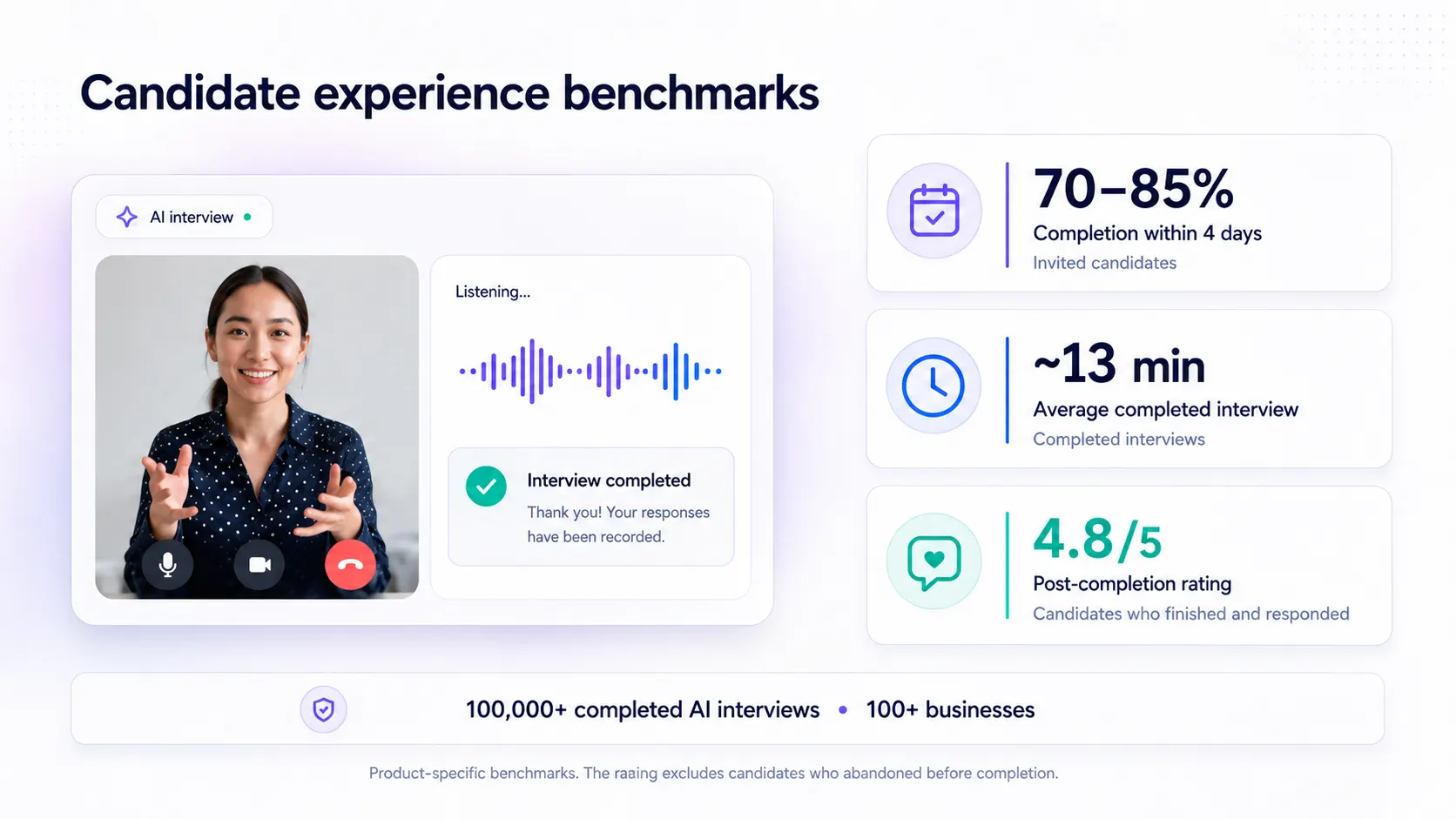
InterviewFlowAI’s first-party benchmark covers more than 100,000 completed AI interviews across 100+ businesses. It reports 70 to 85% completion within a four-day window, an average duration of about 13 minutes, and a 4.8/5 rating among candidates who completed an interview and chose to respond. These are product-specific operational benchmarks, not universal market averages. The rating does not include people who abandoned the process. Review the full methodology and limitations.
AI interview software compliance checklist
Employment law varies by location, product design, and how much the output affects a decision. The employer remains responsible for the hiring process even when a vendor supplies the tool. The points below are an operational starting place, not legal advice.
New York City Local Law 144
If a product falls within New York City’s definition of an automated employment decision tool, an employer or employment agency must meet requirements that include a recent bias audit, public disclosure of audit information, and candidate or employee notices. The city also describes notice and accommodation obligations. Review the NYC Department of Consumer and Worker Protection guidance.
Illinois Artificial Intelligence Video Interview Act
Illinois requires an employer using AI to analyze applicant-submitted video interviews to notify the applicant, explain generally how the AI works and what characteristics it uses, and obtain consent. On request, the employer must delete the interview within 30 days and instruct others holding copies to delete them. Read the Illinois statute.
European Union AI Act
The EU AI Act identifies many AI systems used for recruitment and candidate selection as high risk. Following the 2026 amendments, the rules for Annex III high-risk systems are scheduled to apply from 2 December 2027. Other provisions and enforcement powers follow different dates, so teams should verify which duties apply now and which are still approaching. Check the European Commission’s current enforcement timeline.
US federal disability obligations
The US Equal Employment Opportunity Commission warns that algorithmic tools can screen out people with disabilities even when they can perform the job. Employers may need to provide a reasonable accommodation or another assessment format. Review the EEOC’s AI and ADA resources.
Before launch, document the purpose of the tool, decision owner, data flow, retention schedule, accommodation process, audit schedule, vendor change-notification process and escalation route for disputed results.
What does AI interview software cost?
Vendors tend to use one of three pricing models:
| Pricing model | How it works | Best for | What to check |
|---|---|---|---|
| Usage or interview credits | Pay for each interview or buy a monthly credit allowance | Teams whose hiring volume changes | What triggers a charge, expiration, rollover and overage price |
| Subscription | Pay a monthly fee based on seats, jobs, features, or interview volume | Teams with predictable usage | Fair-use limits, feature gates and annual commitment |
| Enterprise contract | Annual agreement with custom volume, security, integration and support terms | Larger organizations with procurement requirements | Implementation, support, audit, integration and renewal costs |
How InterviewFlowAI fits this buying framework
InterviewFlowAI is designed for first-round candidate screening by phone, audio, or video. Its conversational AI asks follow-up questions, then produces transcripts, role-specific scorecards, and a ranked review queue for the hiring team. Integrity and cheat-detection features depend on the selected plan. The recruiter remains responsible for the decision.
InterviewFlowAI lets you run AI interviews at just $0.99/interview.
It is a practical fit for high-volume hiring teams, recruitment agencies, and growing companies that need more first-round capacity without adding another live call for every plausible applicant. ATS integrations are available on qualifying plans, and the platform also supports bulk imports, automated reminders, and multilingual interviews. See the full AI interview software feature set.
The fastest test is a real open role. Use your job description and scoring criteria, invite a small candidate cohort, then compare the output with your current screen.
Frequently asked questions
What is the difference between AI interview software and one-way video interviewing?
One-way video software records answers to fixed prompts. Conversational AI interview software can ask follow-up questions, transcribe responses and score evidence against a role-specific rubric. Some vendors offer both formats, so confirm what the product actually conducts.
Does AI interview software replace recruiters?
It can replace repetitive first-round screening calls, but it should not replace recruiter accountability or the final hiring decision. Recruiters still define the job criteria, review evidence, handle exceptions, speak with shortlisted candidates and own the decision process.
Is AI interview software legal?
AI interview software can be used legally, but obligations vary by jurisdiction and product design. Notice, consent, bias audits, accommodations, data retention and human oversight may apply. Review the laws for every location in which candidates or the employer operate, and obtain legal advice for the planned use.
Can AI interview software reduce hiring bias?
Structured questions and job-related rubrics can improve consistency, but AI does not automatically remove bias. Teams must validate the criteria, examine outcomes, support accommodations, and keep humans accountable for decisions.
Which roles are best suited to AI interviews?
The strongest fit is usually a repeatable first-round screen with more plausible applicants than recruiters can interview promptly. Common examples include customer support, sales, operations, graduate hiring, and recruitment-agency shortlisting. A well-defined technical screen can also work when the system can probe job-relevant evidence.
What integrations should an AI interview platform support?
At minimum, the platform should receive candidate and job information from the ATS and return interview status, scorecards, transcripts, and reviewer decisions. Ask which fields sync, what triggers the workflow, how errors are reported, and whether the integration is native, API-based, or built through an automation tool.
How long should an AI screening interview take?
There is no universal duration. It should be long enough to collect evidence for the rubric and short enough for an early-stage candidate commitment. InterviewFlowAI’s completed interviews average about 13 minutes, but teams should test duration and completion by role and market.
How should we compare vendors?
Use the same real role, rubric, and candidate scenarios in every product. Compare evidence quality, completion, reviewer effort, accessibility, data controls, integration depth, and total cost. Do not choose from a scripted demo alone.