When you run a specialized course or a coding bootcamp, the quality of your students decides the success of your program. But once applications reach the hundreds or thousands, a small team can't speak with every person. You either hire more staff or let good applicants slip through the cracks.
The fix is to hand the first round of admissions interviews to an AI interviewer such as InterviewFlowAI. An AI interviewer is software that holds a two-way spoken conversation with each applicant, asks follow-up questions, and scores the answers against criteria you set. Every applicant still gets a real conversation, and your team steps in only once someone has shown they are a good fit.
This guide shows you how to set it up: the rubric to score against, the questions to ask, how to invite applicants, and how to review the results.
Key takeaways
- Write a short admissions rubric first: four to six qualities, each with a strong and a weak answer described in plain words.
- Screen out true deal-breakers, such as being unable to attend live classes, with pre-interview questions before anyone uses an interview credit.
- Keep the AI interview to about 10 minutes and four or five questions, so each applicant uses one credit.
- Make the interview public, so applicants who pass your screening questions can start as soon as they apply.
- Use the scores to decide who your team meets next. A person on your team makes every admissions decision.
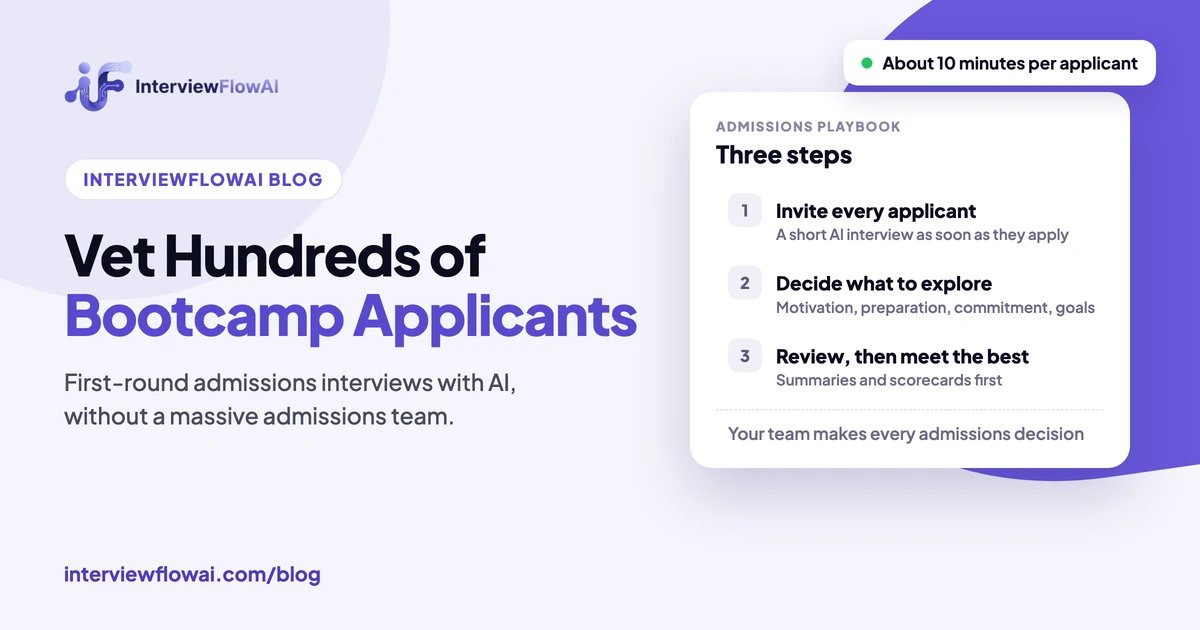
1. Invite every applicant to a short AI interview
Send each applicant an invite to a two-way AI video interview as soon as they apply (or a phone interview, on the Growth plan and above). It is a conversation, not a form: the AI interviewer asks about their motivation and background and responds to what they say.
You can bring applicants in several ways:
- A public link. Share it on your website, in emails, or on social media, or print the QR code on event flyers. Set the Interviewer to Public, so applicants who pass your screening questions go straight to the interview. New Interviewers are private by default.
- A CSV file. If you already have a list of applicants, import it and invite everyone at once (Growth plan and above).
- Your existing form or CRM. If applications arrive through another tool, you can connect it to InterviewFlowAI with Zapier so each new applicant gets an invite automatically (Growth plan and above).
Phone interviews suit applicants who are more comfortable on a call than on camera. The candidate gets an outbound call from your own connected Twilio number. If you are weighing that option, compare the best AI phone interview software first.
Applicants who haven't finished get automatic reminders. Before the interview starts, each one runs a camera, microphone and speaker check and can try a 60-second practice question. If their connection drops during the interview, they have 5 minutes to reconnect and pick up where they left off.
2. Decide what the interview should explore
Set up questions that cover what your admissions team cares about most, for example:
- Why are you choosing this specific career path right now?
- What is your level of experience with the core subject matter?
- How many hours per week can you realistically commit to the program?
- What are your professional goals after graduation?
The AI interviewer listens to each answer and asks follow-up questions to understand the applicant's level of commitment. That gives you a far more personal picture than a text-based application can.
Build a sample admissions rubric
An admissions rubric is a short list of the qualities you admit students on, with a description of what a strong and a weak answer sounds like for each. Write it before you write any questions. The US Office of Personnel Management's structured interview guide gives the core rule: use one rating scale for every candidate, with at least three labelled levels and example answers for each level.
Bootcamps publish what they look for, which is a good starting point. App Academy's non-technical interview guide lists criteria such as passion for coding, an understanding of what software engineers do, resilience and work ethic, teamwork, and professional English. Hack Reactor's admissions page asks beginners to confirm they can attend weekday classes from 9am to 5pm for 16 weeks and have a plan to cover living costs.
Here is a sample rubric for a full-time coding bootcamp. Change the criteria to match your own program.
| Criterion | Sample question | Strong answer (5) | Weak answer (1) |
|---|---|---|---|
| Motivation | Why are you choosing this career path right now? | Gives a concrete reason and shows they have looked into the day-to-day work. | Only mentions pay or that the field is "in demand". |
| Preparation | What have you done to learn the subject so far? | Names courses or projects they finished and can describe one thing they built. | Has not tried any learning yet, or cannot describe what they learned. |
| Commitment | How many hours a week can you commit, and what will you change to make room? | Gives a weekly plan that fits the schedule and has thought about work and money. | Is unsure, or plans to keep a full-time job during a full-time program. |
| Learning resilience | Tell me about a time you taught yourself something hard. What did you do when you got stuck? | Describes a real example, the steps they took, where they asked for help, and the result. | Speaks in general terms ("I'm a fast learner") with no example. |
| Goals | What are your professional goals after graduation? | Names a realistic first role and how the program gets them there. | Has no goal yet, or a goal the program does not teach. |
| Communication | Scored across the whole interview | Explains ideas clearly in the language the program is taught in. | Is hard to follow, even on simple questions. |
InterviewFlowAI asks you to describe a strong (5) and a weak (1) answer for each question. Also write down what an acceptable (3) answer sounds like, so your team agrees on the middle of the scale when it reviews borderline reports. For more question ideas you can adapt, see these 25 screening interview questions.
Screen out deal-breakers before the interview
Some facts don't need a conversation. Put them in the application form as pre-interview questions. Each one is a Yes/No, Numeric or Text question. A must-have qualification is a Yes/No or Numeric question with an ideal answer: applicants who miss it are declined automatically, before they use an interview credit.
For example, a full-time program might ask "Can you attend live classes on weekdays from 9am to 5pm for the whole program?" as a Yes/No must-have. A part-time program might ask "How many hours per week can you study?" as a Numeric question with a minimum. Mark only true deal-breakers as must-haves, because each one removes applicants without review.
Declined applicants see the same "Application Received!" screen as everyone else. Turn on the Early rejection email setting if you want them to hear back.
Set up the interview questions
InterviewFlowAI gives you three question sources. You can turn on any combination:
- Manual questions: you write the exact questions every applicant gets. Use these for your rubric, so everyone is scored on the same thing.
- Skill based: the AI asks about skills you list, such as HTML, Python or SQL, with your instructions for each one.
- Resume based: the AI asks about each applicant's own resume. Turning this on makes a resume required, which may not suit career changers.
For each manual question, fill in the evaluation criteria: what you are looking for, what a strong answer (5) and a weak answer (1) sound like, and a weight from 1 to 10. Copy these straight from your rubric. The default weight is 5. Keep every weight equal unless you can explain why one quality matters more. OPM's scoring guidance gives the same advice.
Then set the length. Each question has a maximum duration (2 minutes by default) and up to two follow-ups. The first 10 minutes of an interview use one credit, and each extra 5 minutes uses half a credit more. A 10-minute interview fits four or five questions with room for the introduction. Ask for a specific past situation, not an opinion: "Tell me about a time you got stuck while learning something new" gets better evidence than "How do you handle challenges?"
A few settings are worth checking before you go live:
- Language: run the interview in the language your program is taught in. InterviewFlowAI interviews in 16 languages.
- Retakes: the default is none. Allow one if you want applicants to have a second try, but each retake uses credits again.
- Link expiry: links last 4 days by default. Make it longer if you invite applicants long before a cohort starts.
- Desktop only: this is on by default. Turn it off if many applicants only have a phone.
3. Review summaries and scorecards, then meet the strongest applicants
After each interview, you get a report with the recording and transcript, an AI summary of strengths, risks and red flags, and a score out of 5 for each question with the reasoning behind it. The assessment signal is the applicant's overall score out of 100, shown at the top of the report. Communication is scored separately, from 1 to 5, on grammar, vocabulary, communication and conversational flow. You can rewrite that rubric to match the level your program needs.
Your admissions team then spends its time only on applicants who have already shown they are serious and qualified. A small, focused team can handle a much larger applicant pool without adding headcount.
To move fast, turn on Coordinator. It emails your booking link (from a tool such as Calendly or Cal.com) to every applicant who reaches your pass score. For example, with a pass score of 75 and a 2-hour delay, an applicant who scores 82 at 10:00 gets the booking email at about 12:00. An applicant who scores 68 gets no email, and your team reviews them by hand. Read borderline reports yourself, because a short answer is not always a weak applicant.
What it costs
Plans start at $59 a month, and on monthly Growth and Scale plans an interview costs about $0.99 ($0.83 billed yearly). A screening of up to 10 minutes uses one credit, which is far cheaper than hiring more full-time staff (prices checked 7 November 2026).
Here is a worked example. Say 500 people apply for a cohort in one month. If your must-have questions decline 100 of them, 400 take a 10-minute interview and use 400 credits. The Scale plan includes 505 credits a month for $499, so that intake fits in one month. The Growth plan includes 303 credits for $299, which suits smaller intakes.
Sources
Methodology: This guide is based on InterviewFlowAI's product documentation and pricing page, the OPM structured interview guidance, and the published admissions pages of App Academy and Hack Reactor, all checked on 7 November 2026. The rubric is a sample to adapt, not a validated test.
- InterviewFlowAI, Pricing, checked 7 November 2026.
- InterviewFlowAI Docs, Plans, credits, and billing, checked 7 November 2026.
- InterviewFlowAI Docs, What the Candidate sees, checked 7 November 2026.
- InterviewFlowAI Docs, Application form, Question settings, Questions and Interview settings, checked 7 November 2026.
- InterviewFlowAI Docs, Invite Candidates to interview, Candidate report and Coordinator, checked 7 November 2026.
- US Office of Personnel Management, Structured Interview Guide and How do I score a structured interview?, checked 7 November 2026.
- App Academy, How to prepare for the Non-Technical Interview, checked 7 November 2026.
- Hack Reactor, Beginner Coding Bootcamp Admissions Process, checked 7 November 2026.
Mukul Munjal
Founder & CEO, InterviewFlowAI
I'm Mukul Munjal, founder and CEO of InterviewFlowAI. I have 7 years of experience in engineering, 3 of them building voice agents, and I lead the team that builds our AI interviewer. Before publishing, I check competitor prices and features against each vendor's own pages.