An AI phone interview is a first-round screening call run by conversational voice software. It asks job-related questions, listens to each answer, may ask a follow-up, and turns the conversation into a transcript and scorecard. A recruiter reviews that evidence and decides what happens next.
That last sentence matters. The useful version of AI phone screening does not hand hiring decisions to a bot. It handles a repetitive part of evidence collection so a hiring team can spend more time on judgment, candidate conversations, and later-stage interviews.
AI phone interview, robocall, or one-way recording?
The terms are easy to muddle because all three formats use a phone or recorded voice. The candidate experience is different.
| Format | What the candidate experiences | What the recruiter receives |
|---|---|---|
| Robocall or phone survey | A fixed sequence of prompts with keypad or recorded responses | Basic responses or an audio file |
| One-way audio interview | Prerecorded questions with no live follow-up | Recordings that someone must review |
| Conversational AI phone interview | A two-way voice exchange that can respond to the answer | Recording, transcript, summary, and often a rubric-based scorecard |
Some AI phone interview tools place an ordinary outbound call. Others ask candidates to dial in or open a browser-based voice link. The label “phone interview” does not tell you which flow a vendor uses, so test the exact candidate journey before buying.
For a closer look at the format tradeoff, see the comparison of one-way video interviews and conversational AI.
How an AI phone interview works, step by step
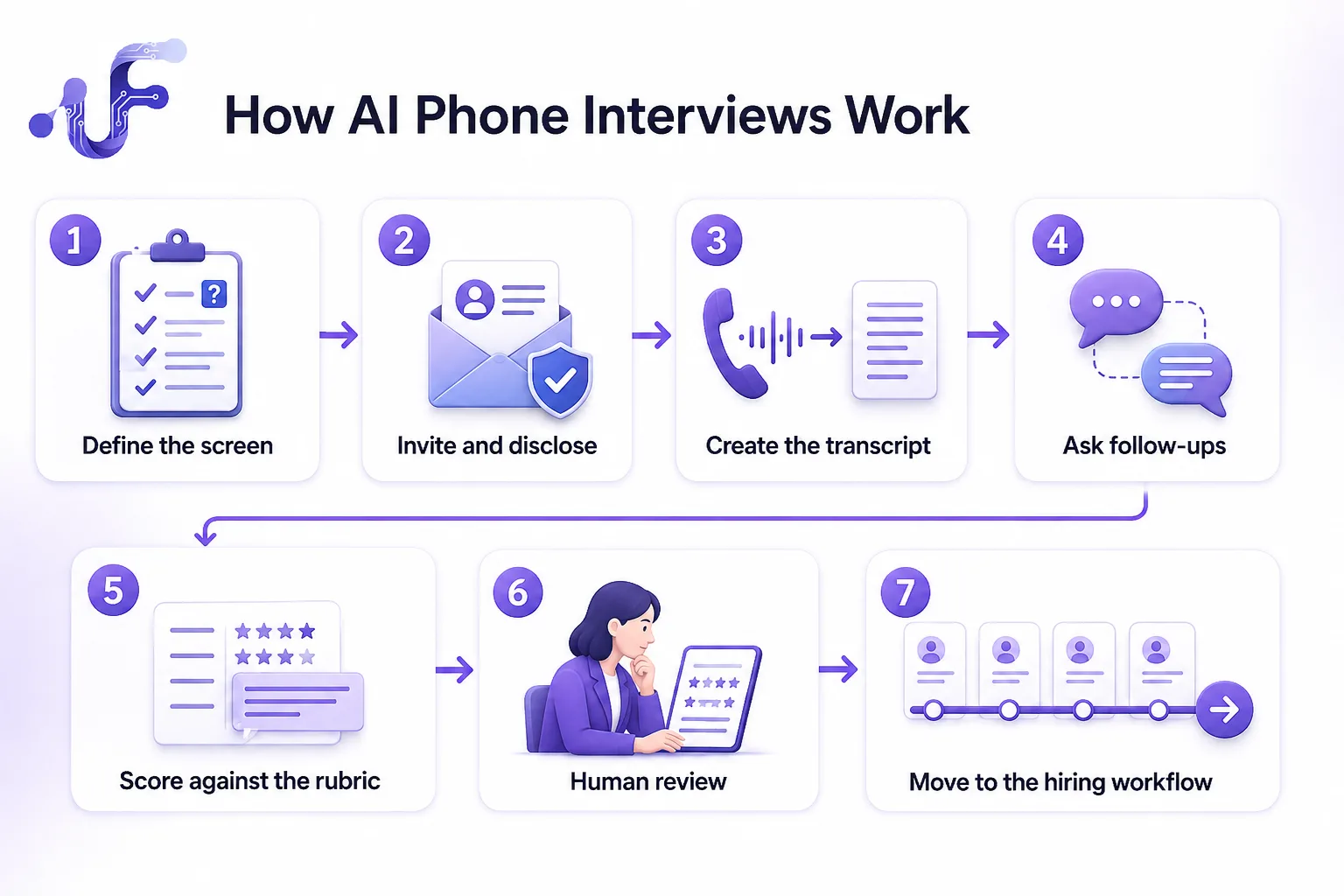
1. The hiring team defines the screen
The process begins before any candidate answers the phone. A recruiter selects the questions, the competencies to assess, and the evidence expected in a strong answer.
For a customer-support role, the rubric might cover de-escalation, problem diagnosis, ownership, and spoken communication. For a sales role, it might cover discovery, objection handling, and next-step discipline.
This setup determines the quality of the interview. A vague job description and a loose rubric do not become reliable because AI is involved.
2. The candidate receives an invitation and disclosure
The invitation should say that the first interview uses AI. It should also explain the expected length, whether the call is recorded, what will be evaluated, who reviews the result, and how to request help or another format.
This is not a minor onboarding detail. In the Greenhouse 2026 Candidate AI Interview Report, 70% of US candidates who had experienced AI evaluation said it was not clearly disclosed before their most recent AI interview. Thirty-eight percent said they had withdrawn from a process because it included one. The survey covered 2,950 job seekers across five countries, with those figures reported for the US subset.
3. Speech recognition creates a live transcript
When the candidate speaks, automatic speech recognition converts the audio into text. The transcript gives the conversation system and the later scoring step something they can analyze.
Transcription is never perfect. Accents, names, specialized terms, line quality, and background noise can all cause mistakes. A recruiter should be able to check the recording when a transcript passage affects a score.
4. The conversation engine chooses the next prompt
A basic automated screen asks the same fixed questions in order. A conversational system can use the candidate's answer to choose a relevant follow-up within rules set by the hiring team.
Suppose the AI asks, “Tell me about a time you handled an upset customer.” The candidate replies, “I stayed calm and fixed the problem.” That answer gives almost no evidence. A useful follow-up would be, “What was the customer upset about, and what did you do next?”
The goal is not free-form improvisation. It is controlled probing. The AI should know when to ask for an example, when to clarify an inconsistency, and when to move on.
5. The system compares answers with the rubric
After the call, the scoring layer evaluates the transcript against the criteria defined for the role. In the customer example, a strong answer might show that the candidate:
Identified the source of the problem;
Acknowledged the customer's concern;
Took a specific action within policy;
Explained the outcome; and
Knew when to escalate.
The score should come with a reason and a link to the supporting passage. A bare number is hard to trust and harder to challenge. InterviewFlowAI's scorecards and transcripts, for example, are designed to connect competency ratings with evidence from the conversation.
6. A recruiter reviews the evidence
The recruiter receives some combination of the recording, transcript, summary, competency ratings, and suggested follow-up areas. The exact package varies by product.
The reviewer should check more than the top-ranked candidates. During a pilot, sample interviews across the full score range. Look for transcription errors, weak score explanations, unusual backgrounds the rubric handled poorly, and candidates whose evidence does not match their rank.
Public attitudes set a clear boundary here. In a Pew Research Center survey of 11,004 US adults, 71% opposed AI making a final hiring decision. AI can organize evidence. A person should remain responsible for the employment decision.
7. The result moves into the hiring workflow
Once a person reviews the interview, the scorecard can return to the applicant tracking system or be shared with the hiring manager. The candidate should then receive a clear next step, even when that step is a rejection.
Closing the loop is part of the process. Greenhouse found that 51% of US respondents who completed an AI interview had not received an outcome at the time of the survey. Faster screening does not improve candidate experience if the process still ends in silence.
What questions do AI phone interviews ask?
The questions should match what a recruiter would reasonably cover in an initial phone screen. Common categories include:
Basic eligibility, such as work authorization or location requirements;
Availability, notice period, shift preferences, or start date;
Role motivation and relevant experience;
Short behavioral examples tied to the job;
Scenario questions that test how the candidate approaches a realistic problem; and
Spoken communication when it is genuinely relevant to the work.
A first screen should not become a personality test disguised as a conversation. Avoid questions about health, family plans, religion, age, or other protected or irrelevant information. Be careful with salary-history questions because rules vary by location.
Recruiters who need a starting point can use these phone screen interview questions, then attach a clear rubric to each question.
What should AI interview scoring measure?
Good scoring is tied to observable, job-related evidence. Risky scoring relies on vague proxies that are difficult to justify.
| Appropriate evidence | Risky or weak signals |
|---|---|
| Whether the answer addresses the question | A general “confidence” score with no definition |
| Specific actions and results in a work example | Accent similarity to a preferred speaker |
| Knowledge required for the role | Personality claims inferred from vocal style |
| Use of a required process or safety rule | Eye contact or facial analysis in a phone screen |
| Clear spoken communication when the job requires it | Pauses, filler words, or speech patterns treated as character flaws |
Consistency is useful, but it is not the same as fairness. A system can apply the same flawed criterion to everyone. Before launch, ask whether each criterion relates to the job, whether a candidate can understand it, and whether a reviewer can see the evidence behind the score.
What AI phone interviews do well, and where they struggle
AI phone screening works best in high-volume hiring when the first round is repeatable, and the rubric is clear. That often includes frontline, hourly, support, sales-development, agency, campus, and seasonal hiring.
The format can remove scheduling from the first screen and collect the same type of evidence from a larger pool. It also gives distributed candidates more choice about when to complete the call.
There are limits. A phone interview is a poor substitute for a live conversation when a senior candidate needs to evaluate the company, when the job requires written or visual work, or when the role is too unusual for a stable rubric. It also cannot answer every candidate question about the manager, team, or day-to-day work.
Candidate experience depends on the implementation
Candidates do not experience “AI” in the abstract. They experience an invitation, a voice, a set of questions, a deadline, and whatever communication follows.
A responsible invitation should answer six questions before the call:
Am I speaking with AI?
What will the interview assess?
Will the call be recorded or transcribed?
Who will review the result?
How can I request an accommodation or another format?
When will I hear what happens next?
Give candidates a contact for technical problems and corrections. If the transcript changes the meaning of an answer, the candidate should not be trapped by an error they cannot see or challenge.
Voice is not accessible to everyone. The US Equal Employment Opportunity Commission advises employers to provide a reasonable accommodation process and guard against tools that screen out people with disabilities who could do the job. A text option or recruiter-led screen may be the right alternative.
Are AI phone interviews legal?
There is no single law that makes every AI phone interview legal or illegal. The answer depends on the location, the data collected, the way scores influence decisions, and the employer's process.
At a minimum, review these areas with counsel:
Candidate notice and consent;
Recording and wiretap rules;
Disability accommodations;
Employment-discrimination and selection-procedure requirements;
Privacy, retention, deletion, and cross-border data transfer;
Bias testing and adverse-impact monitoring; and
The right to human review or an alternative process.
In New York City, a covered automated employment decision tool may require a recent bias audit, a public summary of the audit, and notices to candidates under Local Law 144 guidance. The EU AI Act classifies certain employment-related AI uses as high risk, although the relevant high-risk rules are currently scheduled to apply from December 2, 2027. Coverage and duties depend on the system and its use, so product marketing is not a substitute for legal review.
Do AI phone interviews replace recruiter phone screens?
They can replace the repetitive evidence-collection part of some first-round calls. They should not replace the human who owns the hiring decision, handles accommodations, answers candidate questions, and builds the relationship that later-stage hiring depends on.
That distinction is a useful buying test. If a product gives you a score but no transcript, no reason, and no way to override it, it has automated judgment. If it gives your team reviewable evidence and keeps a person accountable, it has automated part of the workflow.
For a feature and pricing comparison, use the separate guide to the best AI phone interview software. To see the InterviewFlowAI workflow, review the AI phone interview software page.
Frequently asked questions
Does the candidate need an app or camera?
A phone-first interview does not need a camera. Some vendors work through an ordinary call, while others require a browser. App requirements vary.
How long does an AI phone interview take?
Length depends on the role and question set. InterviewFlowAI reports about 13 minutes per completed interview in its May 2025 to July 2026 platform benchmark. Treat that as a product-specific reference, not an industry standard.
Can an AI interviewer ask follow-up questions?
Conversational systems can ask a follow-up when an answer is vague or incomplete. One-way audio tools cannot. Follow-ups should stay within job-related rules set by the hiring team.
How are AI phone interviews scored?
The transcript is compared with a role-specific rubric. A trustworthy score includes an explanation and supporting evidence from the answer, followed by human review.
Does the AI decide who gets hired?
It should not. The system can collect evidence and recommend review priority. A recruiter or hiring manager should remain responsible for advancement and hiring decisions.
Can a candidate request a human interview?
Candidates can ask for another format or a reasonable accommodation. Whether an employer must provide it depends on the location and circumstances, but every process should offer a clear human contact.
What happens if the transcript is wrong?
The reviewer should check the recording and correct the record before relying on the score. A pilot should measure transcription and correction rates alongside completion.
Are AI phone interviews legal?
They can be, but compliance depends on the workflow and jurisdiction. Employers should review employment, disability, privacy, recording, and automated-decision rules with counsel.