One-way video interviews and conversational AI interviews solve the same scheduling problem, but they do different work. A one-way format records a candidate's answers to fixed prompts for later review. A conversational AI interview responds in the moment, asks job-related follow-ups, and can return a transcript and structured scorecard. That difference matters because removing the calendar is only part of early-stage screening. A team still has to collect useful evidence, protect candidate trust, and keep a person accountable for the decision.
Neither format is automatically better. One-way video can suit short, presentation-based screens where candidates benefit from preparation and retakes. Conversational AI is stronger when the role requires reasoning, ownership, or examples that need probing. This guide compares signal, candidate experience, review time, fairness, cost, and implementation so you can choose the format that fits the work.
The short answer
In a one-way video interview vs conversational AI comparison, the deciding factor is whether you need a recorded response or an adaptive conversation.
Choose a one-way video interview when you want candidates to submit short, consistent recordings and your team is prepared to review them. It works best when the recorded response itself is useful evidence, such as a brief sales pitch, product explanation, or presentation exercise.
Choose conversational AI when you want to replace a repetitive first-round phone or video screen. It is better suited to roles where a strong answer depends on detail, reasoning, and follow-up questions.
| Decision factor | One-way video interview | Conversational AI interview |
|---|---|---|
| Interview format | Candidate records answers to fixed prompts | Candidate has a live conversation with an AI interviewer |
| Scheduling | No recruiter scheduling | No recruiter scheduling |
| Follow-up questions | Usually none; some tools use fixed branching | Generated from the candidate's answer within configured boundaries |
| Candidate control | May include preparation time, practice, and retakes | Usually a continuous, single conversation |
| Candidate questions | Requires a separate contact route | May support limited questions, but a human contact route is still needed |
| Recruiter output | Recordings, and sometimes transcripts or ratings | Transcript, scorecard, summary, recording, and supporting evidence when the platform provides them |
| Review effort | Can create a queue of recordings | Lower when reviewers can inspect summaries and cited transcript evidence |
| Best use | Short recorded responses and presentation-based screening | Structured first-round screening that needs probing and comparable evidence |
| Main risk | Candidate drop-off and shallow, polished answers | Poor disclosure, awkward conversation, weak speech recognition, or overreliance on automated scores |
The terms describe the interview flow, not who makes the hiring decision. A one-way video can be scored by AI. A conversational AI interview can still require a recruiter to review every recommendation.
What is a one-way video interview?
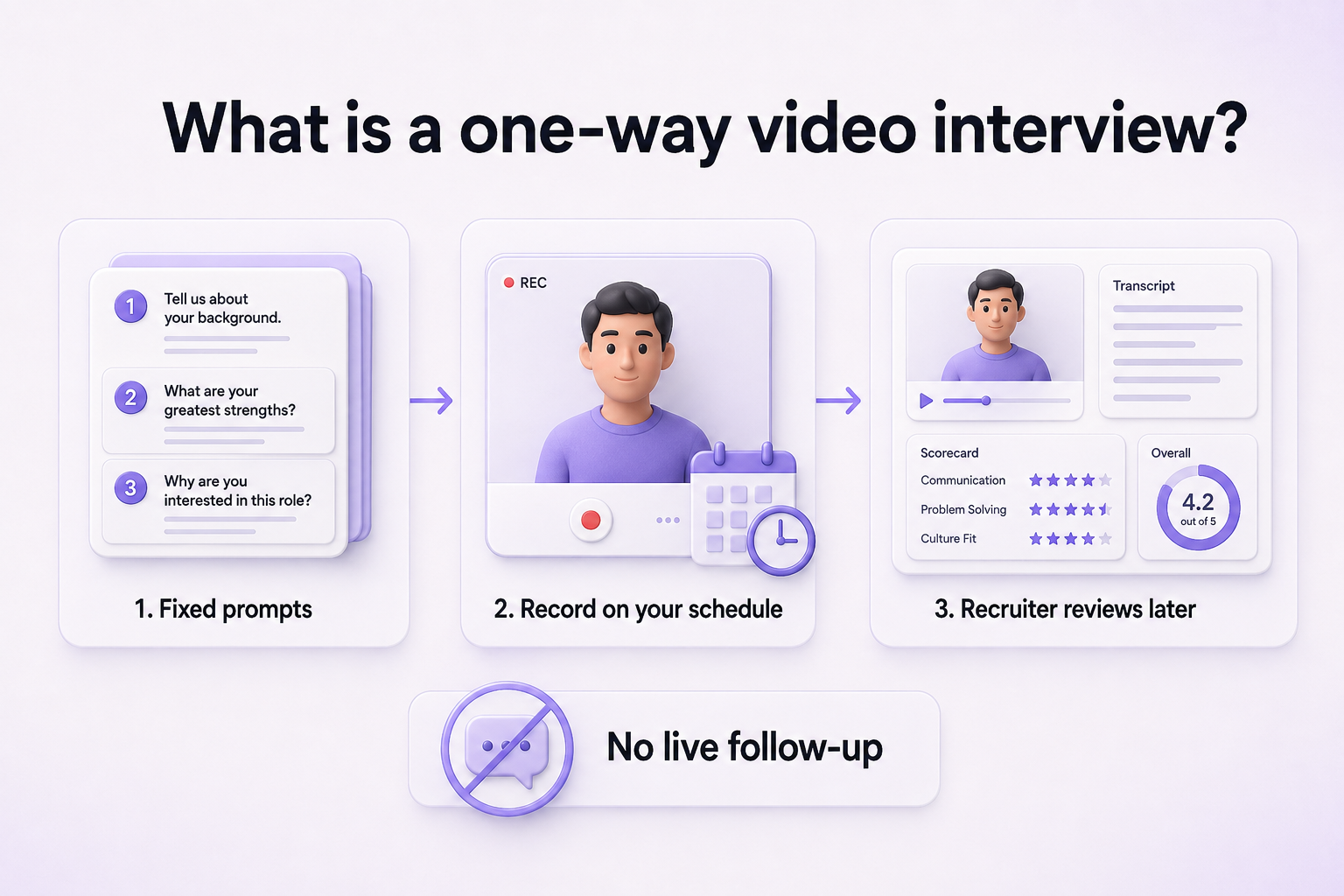
A one-way video interview, also called an asynchronous, pre-recorded, or on-demand video interview, asks candidates to answer a fixed set of prompts on camera without an interviewer present. The candidate completes it on their own schedule, and the hiring team watches the recording later.
The employer usually controls the deadline, preparation time, response length, and whether retakes are allowed. Some platforms add transcripts, side-by-side review, or automated scoring. Those are product features. They do not make the interview conversational.
One-way video is useful when the team wants the same recorded task from everyone. Its limit is equally clear: if an answer is vague or unusually strong, the system cannot ask why unless the recruiter schedules another conversation.
What is a conversational AI interview?
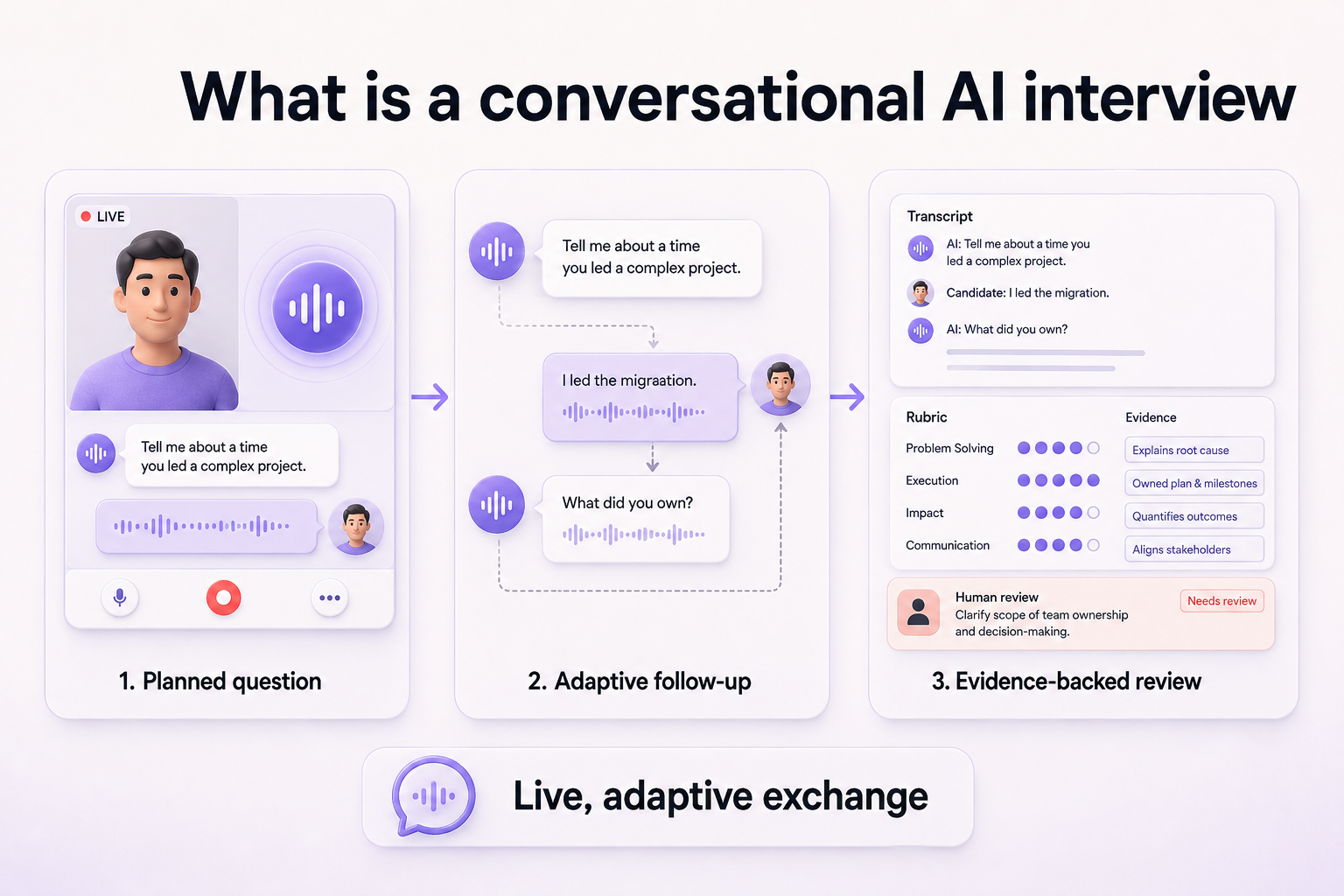
A conversational AI interview is a live exchange between the candidate and an AI interviewer, conducted by phone, audio, or video. The recruiter does not need to attend. The system asks planned questions, listens to each answer, and generates follow-ups based on what the candidate said.
The core interview can stay consistent while the probes vary. Every candidate may receive the same opening question about project ownership, for example, while one candidate is asked about a metric and another is asked to separate personal work from the team's contribution.
The output depends on the platform. A useful system should return the transcript, the assessment rubric, evidence behind each rating, and clear areas for a human reviewer to check. A score without supporting evidence hides the answer and gives the reviewer less to inspect.
The difference that matters: collecting responses or testing evidence
One-way video collects a prepared response. Conversational AI tests whether the response holds up when the next question depends on it. Consider a sales candidate who says, "I grew a territory by 30 percent."
A one-way interview records the claim. A reviewer may find it impressive, but the evidence stops there. A conversational interview can ask:
What did you change personally?
What was the starting revenue and measurement period?
Which accounts contributed most of the growth?
What trade-off did you make to protect retention?
What would your manager say you needed help with?
The follow-up does not need to be adversarial. Its job is to turn a broad result into evidence about ownership, method, judgment, and context.
This only works when the interview is structured. The US Office of Personnel Management defines a structured interview as a standardized process that measures job-related competencies and uses a consistent scoring approach. Conversational AI should preserve the same core competencies and rubric for every candidate, even when follow-ups differ.
Candidate experience: control versus interaction
Research points in the same direction, with limits. A 2025 study of 380 people found that applicants generally reacted less favorably to automated asynchronous video interviews than synchronous interviews. The study used simulated applicant conditions, so it should not be treated as a live-funnel completion benchmark. It did find that fuller explanations around the process influenced perceptions of procedural justice and interpersonal treatment. An earlier applicant-reaction study found that explaining standardization improved fairness perceptions, while explaining scheduling flexibility improved usability perceptions.
Conversational AI restores some interaction. Candidates hear a response to what they said and can clarify an answer. That does not make the experience human. Delays, interruptions, transcription mistakes, or a poorly configured avatar can be more frustrating than a simple recording tool.
Whichever format you choose, the invitation should tell candidates:
whether the interview is recorded, transcribed, or scored
who reviews the result and whether a person makes the decision
how long the process normally takes
whether practice, preparation time, or retakes are available
what happens after a browser, microphone, or connection failure
how to request an accommodation or another format
where candidates can ask questions about the role
how recordings and transcripts are stored, shared, and deleted
Transparency is part of the interview design. It is not a legal paragraph to add after the workflow is finished.
Signal quality: fixed questions can be structured, but they cannot probe
A fixed interview can produce useful signal when the question asks for concrete evidence, and reviewers use an anchored rubric. A poor conversational interview can produce noise if it asks generic follow-ups and gives high scores for confident delivery.
The format does not repair weak assessment design.
Start with four to six competencies that would change the hiring decision. Define weak, acceptable, and strong evidence before writing questions. Then decide whether each competency needs a recorded response or an adaptive probe.
| Competency | Fixed lead question | Useful follow-up | Evidence to score |
|---|---|---|---|
| Ownership | Tell me about a project you led from planning to delivery. | Which decision was yours, and where did someone else take over? | Personal responsibility is separated from team output |
| Diagnostic method | Describe a production or customer issue you investigated. | What evidence caused you to reject your first explanation? | The answer connects observations to a sequence of checks |
| Judgment | Tell me about a decision with no clearly correct option. | Which downside did you accept, and why? | The candidate names competing constraints and consequences |
| Communication | Explain a complex change to someone outside your function. | What did they misunderstand the first time? | The explanation adapts to the audience and checks understanding |
Both formats can ask the lead question. Conversational AI earns its extra complexity only when the follow-up stays relevant, and the score points back to the answer.
Recruiter workload: removing scheduling is not the same as removing work
One-way video removes calendar coordination. It can still leave recruiters with hours of recordings to watch, compare, and summarize. Playback speed and transcripts help, but the reviewer may need to find the relevant evidence manually.
Conversational AI can reduce that review load when the system produces a searchable transcript, a competency scorecard, and citations that link each rating to a candidate response. Recruiters should still inspect close calls, low-confidence outputs, integrity signals, and any recommendation that could remove a candidate from the process.
Compare total operating cost, not the subscription price alone:
Total screening cost = platform cost + setup time + candidate support + recruiter review time + integration work + governance and audit work
A low-cost recording tool can become expensive if every reviewer watches each answer end to end. An AI interview can also become expensive if the team keeps the old phone screen, adds the AI step before it, and creates more work for candidates without removing anything.
Before buying, ask to see the actual output that reaches the recruiter. A polished candidate screen matters, but the hiring team spends most of its time with the report, transcript, ATS record, and exception queue.
What the research does and does not show
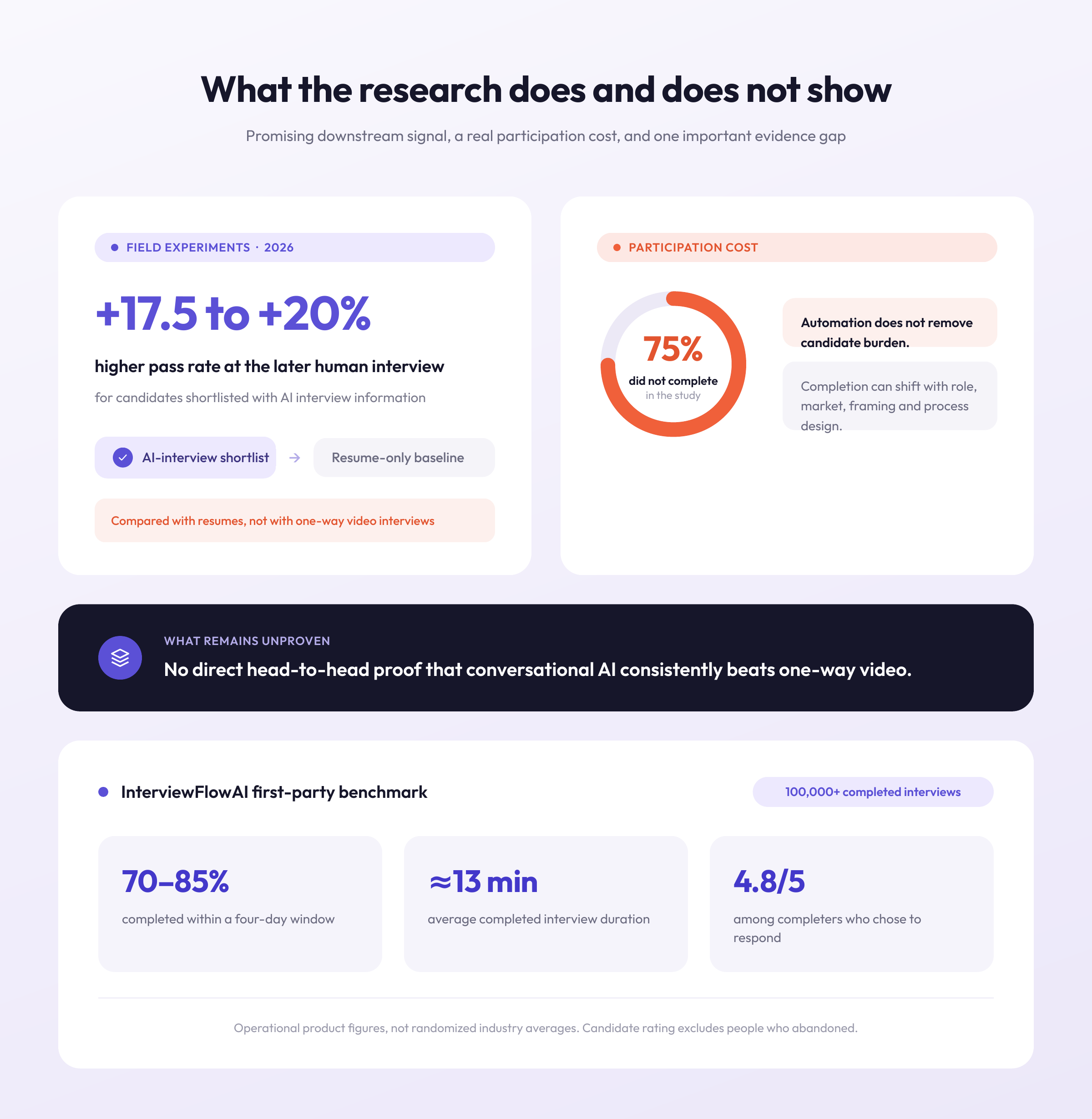
There is limited direct evidence comparing modern conversational AI interviews with one-way video interviews under the same employer, role, and applicant pool. Vendor pages often fill that gap with broad claims about engagement or signal. Treat those as hypotheses to test in your own funnel.
The strongest recent evidence supports a narrower conclusion. The 2026 revision of the preprint Better Together: Quantifying the Benefits of AI-Assisted Recruitment reports two field experiments on a recruitment platform. Candidates shortlisted with AI interview information passed a later human interview, whose interviewer was blind to the shortlisting method, at rates 17.5 to 20 percentage points higher than candidates shortlisted from resumes alone.
That is evidence that a structured AI interview can add information a resume misses. It is not evidence that every conversational AI product beats every one-way video tool.
The same study found a serious participation cost: 75 percent of invited candidates did not complete the AI interview. Role, market, invitation framing, and process design can change completion, but automation does not remove candidate burden.
InterviewFlowAI's first-party benchmark from 100,000+ completed AI interviews reports a 70 to 85 percent completion rate within a four-day window, an average completed duration of about 13 minutes, and a 4.8/5 rating among candidates who finished and chose to respond. These are product-specific operational figures, not randomized industry averages. The rating does not include people who abandoned the interview.
Fairness, accessibility, privacy, and human review
One-way video and conversational AI can both create unfair outcomes if the team scores traits unrelated to the job. Do not use accent, facial expression, eye contact, speaking speed, or a vague idea of "professional presence" as a proxy for capability. Score the content of the answer against a role-related rubric.
Accommodation is part of the workflow. EEOC and Department of Justice guidance says employers using algorithmic employment tools should have a process for reasonable accommodations and should consider how the tool may screen out people with disabilities.
Local requirements can add notice, audit, consent, and retention duties. New York City's rules for covered automated employment decision tools include bias-audit and candidate-notice requirements. Illinois law regulates covered AI analysis of video interviews, including consent, limited sharing, and deletion on request. Which rules apply depends on the employer, candidate location, product, and how the output is used. Get legal advice for the jurisdictions in your hiring program.
Operationally, a responsible screen should include:
a job analysis and a small set of role-related competencies
the same core questions and anchored rubric for every candidate
tested transcription and interview behavior across relevant accents, languages, devices, and assistive technologies
a visible accommodation and alternative-format process
clear notice about recording, scoring, reviewers, retention, and deletion
a person who can inspect evidence and override the score
no automatic rejection from integrity signals, tab switches, timing, or a low-confidence transcript
regular review of completion, advance, and selection rates across relevant groups where collection is lawful
These controls need an operating process beyond the vendor checklist.
When one-way video is the better choice
One-way video can be the simpler and more useful format when:
the recorded performance is itself relevant to the role
candidates should have preparation time or controlled retakes
the interview uses a short set of well-defined prompts
the team wants to watch every response rather than rely on generated summaries
hiring volume is manageable and manual review will not become a bottleneck
adaptive questioning would add little to the decision
For example, a one-minute product explanation for a training role may tell the team what it needs to know without an AI interviewer. The rubric should score structure, accuracy, and audience adaptation, not appearance.
When conversational AI is the better choice
Conversational AI is a stronger fit when:
recruiter phone screens are the bottleneck
the role requires judgment, ownership, or detailed examples
fixed prompts produce vague or rehearsed answers
candidate volume is too high for consistent live screening
hiring managers need transcripts and evidence-backed scorecards
the team can monitor completion and provide a human alternative
the process needs phone and video options across time zones
InterviewFlowAI runs adaptive interviews by phone or video and returns transcripts and competency scorecards with supporting evidence. Human judgment can override the score. The useful test is not the demo conversation alone. Review a completed report and check whether each rating is traceable to a job-related answer.
A practical decision framework
| Question | Choose one-way video when... | Choose conversational AI when... |
|---|---|---|
| What evidence do we need? | A short recorded performance is enough | The answer needs clarification, examples, or challenge |
| How much candidate control is appropriate? | Preparation and retakes support the task | A continuous conversation better matches the competency |
| What can the team review? | Reviewers can watch the recordings | Reviewers need summaries, transcripts, and cited evidence |
| How variable are the roles? | Questions stay stable across a narrow role family | Follow-ups need to adapt within a shared rubric |
| What is the candidate risk? | The task is brief, explained, and easy to practise | The AI experience is disclosed, tested, and supported |
| What happens after a weak score? | A recruiter reviews the recording | A recruiter reviews the transcript and score evidence |
| Can candidates ask for help? | A human contact and alternative route are available | A human contact and alternative route are available |
| How will success be measured? | Completion, review time, later-stage performance | Completion, review time, later-stage performance |
If the buying decision still depends on a vendor's adjective, such as "natural," "engaging," or "intelligent," the evaluation criteria are not ready.
Frequently asked questions
Is a one-way video interview the same as an asynchronous interview?
Usually. In recruiting, "one-way video," "asynchronous video," "pre-recorded video," and "on-demand video" generally describe a candidate recording answers without a live interviewer. Asynchronous only describes timing, so some vendors also use it for other formats.
Is a conversational AI interview asynchronous?
It is asynchronous for the recruiter because no recruiter attends or schedules the call. It is synchronous between the candidate and the AI because the system responds to answers in real time.
Can a one-way video interview ask follow-up questions?
Not in the open-ended sense. Some systems use fixed branching based on a selected response, but they do not normally generate a relevant probe from the substance of a spoken answer.
Are conversational AI interviews more expensive?
The platform fee may be higher than a basic recording tool. Total cost depends on recruiter review time, candidate support, integration, governance, and which manual step the tool replaces. Compare cost per completed, usable screen rather than cost per invitation.
Do candidates prefer conversational AI to one-way video?
There is no universal result. Research often finds weaker applicant reactions to asynchronous video than to synchronous interviews, while AI interviews can also reduce trust when disclosure or interaction is poor. Test completion and candidate feedback in the roles and markets where you hire.
Can AI make the final hiring decision?
It should not. AI can collect and organize evidence, but a person should review the answer, understand the scoring basis, consider accommodations, and remain accountable for advancing or rejecting a candidate.
Should candidates get retakes?
Allow retakes when polish and preparation are part of the task, and apply the same policy to everyone. Avoid retakes when the competency depends on spontaneous reasoning. Always allow a restart after a verified technical failure.
Are AI and one-way video interviews legal?
They can be, but obligations vary by jurisdiction and use. Covered employers may need notice, consent, accommodation, bias audits, retention disclosures, or deletion processes. Review the exact workflow with counsel rather than relying on a vendor's general compliance statement.