A screening interview has one job: decide whether there is enough evidence to move a candidate into a deeper interview. The best screening interview questions check the requirements that matter before a hiring manager spends time on the process. They verify relevant experience, uncover motivation, surface practical constraints, and show whether a candidate can explain their work clearly.
You do not need all 25 questions below in one call. For most roles, choose six to ten, ask the same core questions to every candidate, and use follow-up probes when an answer needs more detail.
Quick answer: what should you ask in a screening interview?
A good screening interview covers five areas: the candidate's recent work, evidence of the role's must-have skills, motivation for applying, one or two past-behavior examples, and practical details such as availability or work authorization. Ask six to ten questions in a 20 to 30 minute conversation. Score the evidence against criteria agreed with the hiring manager before the first call.
What is a screening interview?
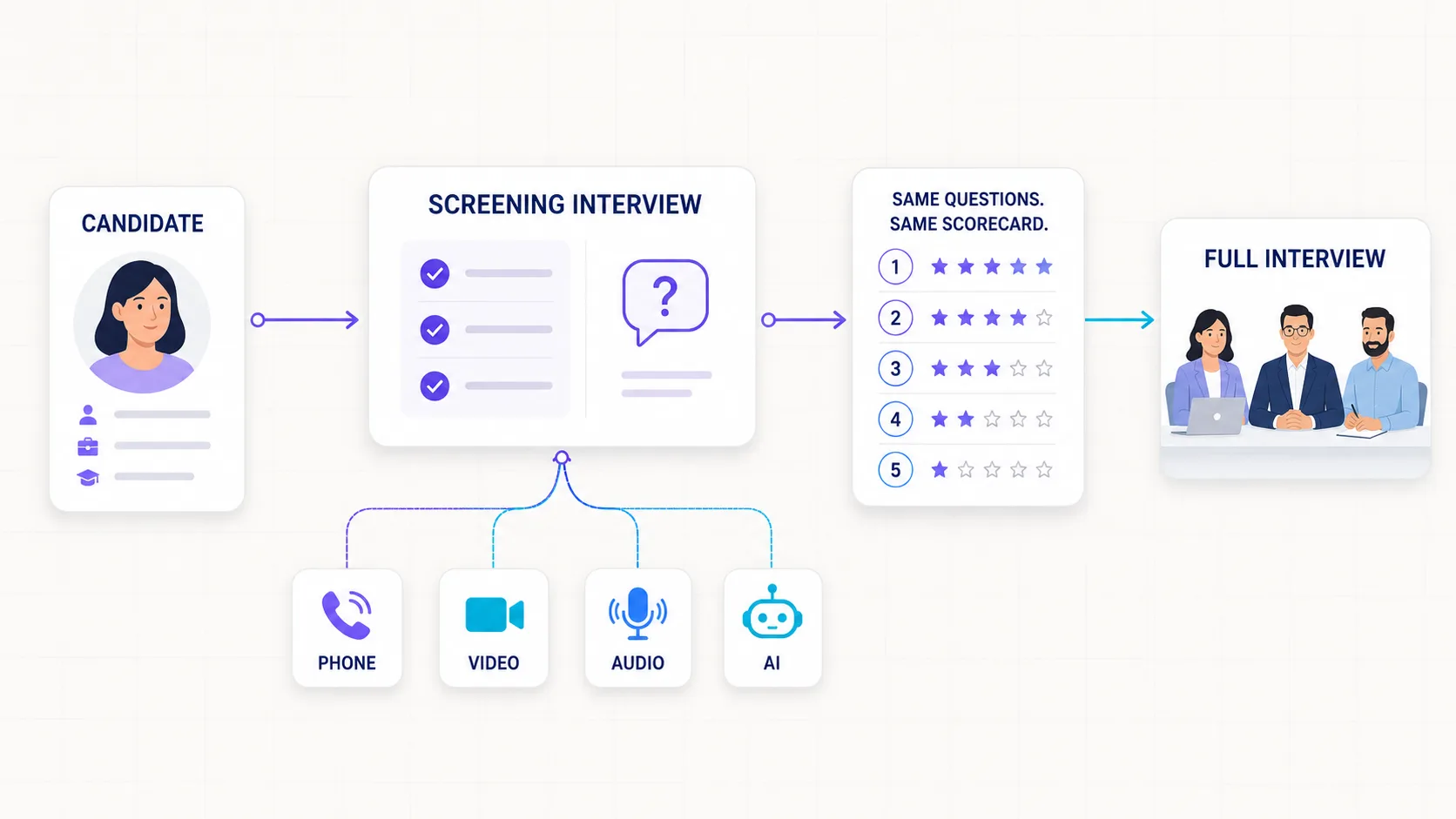
A screening interview is an early hiring-stage conversation used to confirm whether a candidate meets the baseline requirements for a role. It normally happens before a full hiring-manager or panel interview.
A phone screen is one way to conduct that conversation. Video, audio, and asynchronous AI interviews are other formats. The screening stage describes the purpose. The channel describes how the interview happens.
If you are preparing a live recruiter call, use the dedicated 20-minute recruiter phone screen guide for a format-specific script.
The most defensible screens use a common structure. The U.S. Office of Personnel Management defines a structured interview as one that uses standardized questions and scoring for all candidates. You can still ask a candidate-specific clarification, but the main evidence and decision rules should remain comparable.
How many screening questions should you ask?
Six to ten questions are enough for most 20 to 30 minute screens. The exact number depends on how much evidence each answer requires.
A question such as “When can you start?” takes seconds. A past-behavior question with two follow-ups may take four minutes. Count the evidence you need, not the number of lines in a script.
Here is a practical 20-minute structure:
| Time | What to cover |
|---|---|
| 0 to 2 minutes | Explain the role, the purpose of the screen, and what happens next. |
| 2 to 6 minutes | Confirm recent experience and motivation. |
| 6 to 14 minutes | Test two or three must-have capabilities with specific examples. |
| 14 to 17 minutes | Confirm availability, location, schedule, or work authorization requirements. |
| 17 to 20 minutes | Let the candidate ask questions and explain the next step. |
If every candidate needs a 45-minute conversation before you can decide, the screen may be trying to do the full interview's job.
How to choose the right questions
Start with the hiring decision, not a generic question bank. Write down the four to six things a candidate must demonstrate before advancing. For a customer support role, that could include written clarity, de-escalation, product troubleshooting, shift availability, and recent customer-facing experience. For a backend engineer, it could include ownership of production systems, debugging, API design, and experience with the required stack.
For each requirement, decide what a strong answer must contain. The OPM guidance on interview-question design recommends questions that are job-related, tied to competencies, open-ended, and clear. Past-behavior questions should elicit the situation, the candidate's action, and the result.
That preparation stops the screen from becoming a friendly chat followed by an unexplained gut decision.
25 screening interview questions for recruiters
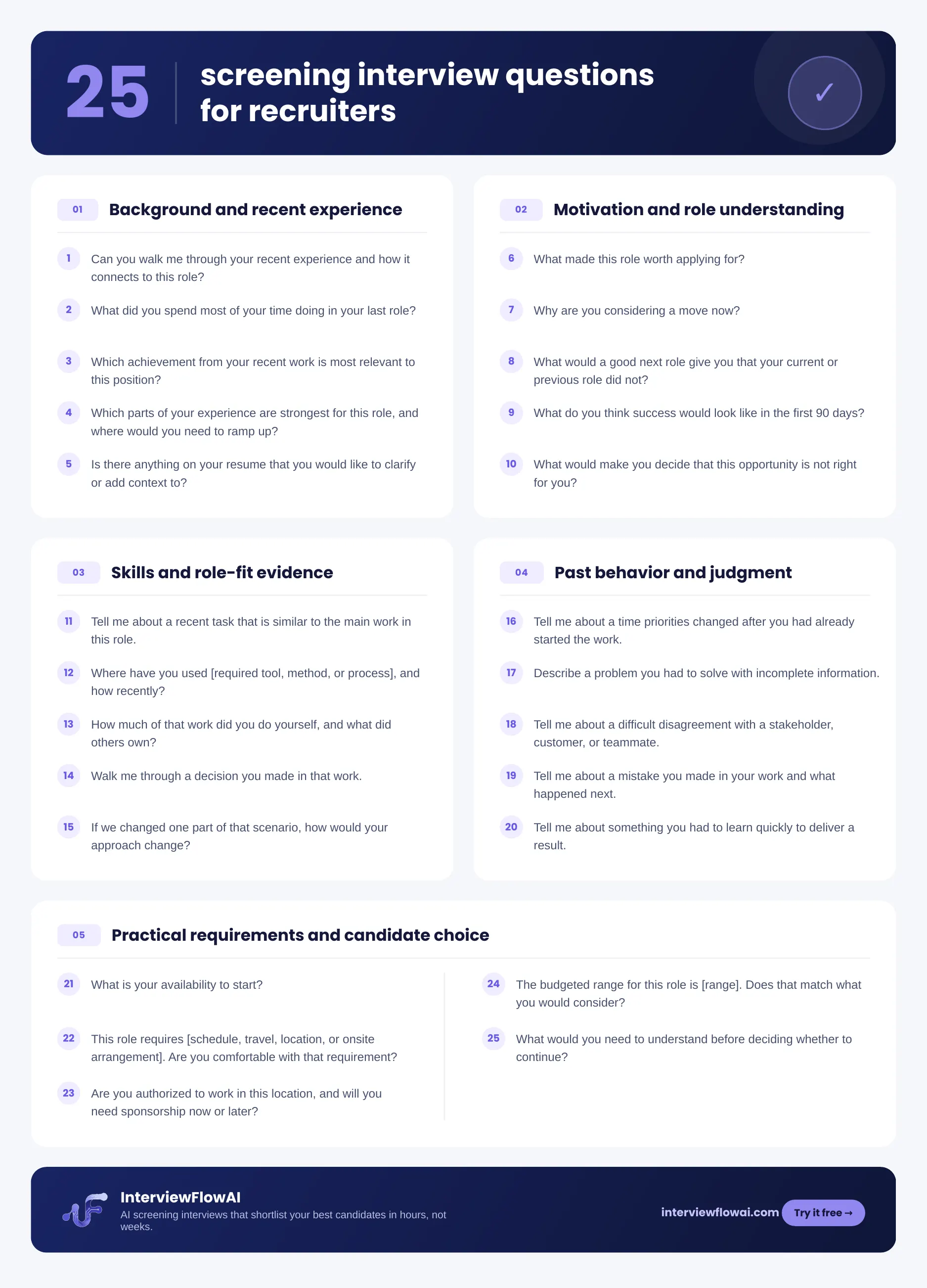
Background and recent experience
1. Can you walk me through your recent experience and how it connects to this role?
Listen for a focused explanation of the work most relevant to the opening. A chronological retelling of the entire resume is less useful.
Follow-up: “Which part of that experience would help you contribute fastest here?”
2. What did you spend most of your time doing in your last role?
Job titles hide a lot. This question reveals the candidate's actual responsibilities, the balance between execution and oversight, and the work they performed regularly.
Follow-up: “What did you own personally?”
3. Which achievement from your recent work is most relevant to this position?
Look for a clear problem, a specific contribution, and a result. Be cautious when every achievement belongs to “we,” and the candidate cannot explain their own part.
Follow-up: “How did you measure the outcome?”
4. Which parts of your experience are strongest for this role, and where would you need to ramp up?
Strong candidates can describe both. A gap is not automatically a problem if the person understands it and has a credible learning plan.
Follow-up: “How have you closed a similar gap before?”
5. Is there anything on your resume that you would like to clarify or add context to?
This gives the candidate room to explain a short tenure, title mismatch, unusual career move, or project scope without forcing you to make assumptions.
Motivation and role understanding
6. What made this role worth applying for?
Listen for something specific about the work, team, customer, or problem. Generic enthusiasm proves very little.
Follow-up: “Which responsibility in the job description interested you most?”
7. Why are you considering a move now?
The aim is to understand timing and priorities, not invite complaints about a current employer. Listen for what the candidate wants next and whether the role can realistically provide it.
8. What would a good next role give you that your current or previous role did not?
This surfaces expectations about scope, learning, management, flexibility, and progression before they become late-stage surprises.
9. What do you think success would look like in the first 90 days?
The answer shows whether the candidate understands the role and can translate a job description into outcomes.
Follow-up: “What would you need from the manager to reach that point?”
10. What would make you decide that this opportunity is not right for you?
Candidates also screen employers. An honest answer can reveal a mismatch in working conditions, compensation, role scope, or career direction while there is still time to address it.
Skills and role-fit evidence
11. Tell me about a recent task that is similar to the main work in this role.
Replace “main work” with a real outcome from the job. Ask a salesperson about qualifying a difficult opportunity, not whether they have “strong communication skills.”
Follow-up: “What was your first step, and why?”
12. Where have you used [required tool, method, or process], and how recently?
This separates current hands-on experience from a keyword that appeared once on a project several years ago.
Follow-up: “What could go wrong when using it, and how did you handle that?”
13. How much of that work did you do yourself, and what did others own?
Team achievements matter, but recruiters still need to understand individual contribution. A good answer credits other people without becoming vague about personal ownership.
14. Walk me through a decision you made in that work.
Ask what options the candidate considered, what information they used, and which trade-offs mattered. This reveals judgment more reliably than asking whether someone is a “good problem solver.”
15. If we changed one part of that scenario, how would your approach change?
Use one realistic variation. For example, reduce the budget, shorten the deadline, remove a tool, or add a difficult stakeholder. The goal is to see whether the candidate can adapt their reasoning rather than repeat a prepared answer.
Past behavior and judgment
16. Tell me about a time priorities changed after you had already started the work.
Listen for how the candidate reassessed the plan, communicated the change, and protected the most important outcome.
Follow-up: “What did you stop doing?”
17. Describe a problem you had to solve with incomplete information.
Strong answers explain what was known, what was uncertain, and how the candidate reduced risk before acting.
Follow-up: “What information would have changed your decision?”
18. Tell me about a difficult disagreement with a stakeholder, customer, or teammate.
Do not score whether you agree with the candidate's position. Score how they listened, explained their reasoning, handled tension, and reached a workable outcome.
19. Tell me about a mistake you made in your work and what happened next.
Look for ownership, repair, and a concrete change in behavior or process. A disguised strength or a story with no real consequence is weak evidence.
Follow-up: “What do you do differently now?”
20. Tell me about something you had to learn quickly to deliver a result.
The useful part is the learning process. Ask how the candidate found reliable information, tested their understanding, and knew they were ready to use it.
Practical requirements and candidate choice
21. What is your availability to start?
If notice periods vary in your hiring market, ask for the actual timeline rather than making assumptions from employment status.
22. This role requires [schedule, travel, location, or onsite arrangement]. Are you comfortable with that requirement?
State the job requirement first and ask the same question consistently. Do not ask about childcare, family plans, religion, health, or other personal circumstances.
23. Are you authorized to work in this location, and will you need sponsorship now or later?
Use wording approved for the country in which you are hiring. Do not ask about birthplace, ancestry, or where someone is “really from.”
24. The budgeted range for this role is [range]. Does that match what you would consider?
Sharing the range creates a clearer conversation and avoids anchoring the discussion on salary history. Check local pay-transparency and salary-history rules before standardizing the question.
25. What would you need to understand before deciding whether to continue?
Leave room for the candidate to evaluate the role. Their questions can reveal what matters to them, but do not treat one particular style of questioning as a personality test.
Five follow-up probes that improve almost any screen
Prepared candidates know the common questions. Useful evidence often appears one layer deeper. Use these probes when an answer is relevant but too broad:
“What was your part?”
“What did you do first?”
“How did you know it worked?”
“What trade-off did you make?”
“What would you do differently now?”
Do not improvise a completely different interview for every person. Give all candidates the same chance to provide evidence. Candidate-specific follow-ups should clarify a claim or test the same competency, not introduce a new standard midway through the process.
What strong and weak screening answers look like
Strong answers tend to contain:
A specific situation rather than a general opinion
A clear account of the candidate's contribution
A decision, action, or trade-off
A result or a sensible way of measuring progress
An honest boundary around what the candidate did not own or does not know
Weak answers tend to stay broad, repeat language from the job description, or attribute every result to an unnamed team. Contradictions between the resume and the conversation deserve clarification. They are not proof of dishonesty on their own.
Avoid scoring accent, eye contact, charm, similarity to the interviewer, or a vague sense of “culture fit.” The evidence should connect to the job.
A simple screening interview scorecard
Score each category from 1 to 5 immediately after the screen. Write short behavioral anchors before interviews begin so a “4” means roughly the same thing across recruiters.
| Category | 1: weak evidence | 3: acceptable evidence | 5: strong evidence |
|---|---|---|---|
| Must-have capability | Cannot show the required experience or skill | Meets the baseline with a relevant example | Shows recent depth, sound judgment, and clear ownership |
| Evidence quality | Vague, contradictory, or unsupported | Provides a plausible example with some detail | Explains context, action, trade-offs, and outcome clearly |
| Motivation and role understanding | Cannot explain why the role fits | Gives a reasonable role-specific reason | Connects the work to clear priorities and realistic expectations |
| Communication for the role | Answer is hard to follow or misses the question | Communicates adequately for the job | Explains complex work with the level of clarity the role requires |
| Practical fit | A confirmed requirement cannot be met | Requirements appear workable | Availability and working requirements are clearly aligned |
Set the decision rule with the hiring manager. Some requirements are pass or fail, such as a mandatory licence or work schedule. Other categories should contribute to an overall judgment. Do not hide a failed must-have behind a high average score.
The case for structure is practical as well as procedural. OPM's review of structured interviews reports higher rater agreement, reliability, and validity when interviewers use clearer rules for questions and evaluation. You can review structured interview evidence in one place instead of relying on scattered notes.
Screening interview questions recruiters should not ask
Keep screening questions tied to the job. In the United States, the EEOC recommends limiting pre-employment inquiries to information needed to determine whether a person is qualified. It also restricts disability-related questions before an offer.
Avoid questions about:
Age, date of birth, or graduation year
Marital status, pregnancy, children, or childcare plans
Disability, medical history, medication, or workers' compensation claims
Religion or religious practices
Race, ethnicity, ancestry, or national origin
Personal financial information unless it is lawful and directly justified for the role
Ask about the job requirement instead. Replace “Do you have children who would make travel difficult?” with “This role requires overnight travel twice a month. Are you able to meet that requirement?”
This is general hiring guidance, not legal advice. Employment rules differ by country, state, and role. Have local counsel review a standard screening script before rolling it out widely.
When should you automate screening interviews?
Automation makes sense when the questions and evaluation criteria repeat, but recruiter calendars do not scale. Consider it when:
One role attracts more qualified applicants than recruiters can call promptly.
Candidates wait several days for a basic screen.
Recruiters repeat the same six to ten questions across locations or time zones.
Hiring managers receive inconsistent notes from different screeners.
The team needs transcripts and scorecards for review or audit.
Automation should standardize evidence collection, not make the final decision in isolation. Recruiters still need to review the transcript, scorecard, resume, practical constraints, and any flagged inconsistencies before advancing or rejecting a candidate.
InterviewFlowAI runs two-way phone and video interviews, asks adaptive follow-up questions, and returns transcripts, scorecards, and ranked results for recruiter review. The platform has completed more than 100,000 AI interviews across 100+ businesses and reports a 4.8/5 candidate experience rating.
Use fewer questions and demand better evidence
A screen does not need to predict the final hire. It needs to answer a smaller question with enough evidence: should this candidate move forward?
Choose six to ten questions that reflect the role's must-have requirements. Ask the same core questions to everyone. Probe broad answers once or twice, score the evidence while it is fresh, and leave the final-stage competencies for later interviews.
That gives candidates a fairer conversation and gives hiring managers a shortlist they can trust.
Frequently asked questions
What are the best screening interview questions?
The best screening interview questions test job-related experience, must-have skills, motivation, past behavior, and practical requirements. They also give the recruiter a clear standard for what a strong answer should contain.
How many questions should a recruiter ask in a screening interview?
Ask six to ten questions in most 20- to 30-minute screens. Use fewer questions when each one requires detailed examples and follow-ups. Do not ask all 25 questions in this guide during one call.
Should every candidate receive the same screening questions?
Use the same core questions and scoring criteria for every candidate applying to the same role. You can add limited follow-ups to clarify a resume claim or incomplete answer, provided the follow-up tests the same competency and does not introduce a new standard.
Should recruiters ask technical questions during screening?
Recruiters can ask high-level, job-related technical questions when the hiring manager has defined what acceptable evidence looks like. Deep technical assessment usually belongs in a later interview or work sample.
What is the difference between a screening interview and a phone interview?
A screening interview is a stage in the hiring process. A phone interview is a format. Screening can happen by phone, video, audio, or an asynchronous AI-led interview.
How should recruiters score screening interviews?
Use a small set of job-related categories with anchored 1 to 5 ratings. Define weak, acceptable, and strong evidence before the first interview. Record short evidence notes and apply the same decision rule to every candidate.