AI phone interview software can run repetitive first screens without adding another call to a recruiter's calendar. The useful products do more than play recorded questions. They hold a two-way voice conversation, ask relevant follow-ups, and return a transcript and scorecard that a person can review.
The hard part is choosing the right phone interview software. Some products place real phone calls. Others run browser-based voice interviews. This guide compares eight current options using official product and pricing information. It also explains what to test before signing a contract.
Best AI phone interview software: quick answer
InterviewFlowAI is the best fit for lean recruiting teams and agencies that want two-way phone and video interviews, structured reports, a self-serve trial, and published usage-based pricing. Hyring is the strongest low-cost suite for teams that also need coding, English, resume, and video assessments. PhoneScreen AI is a focused choice for outbound phone-screening campaigns. Ribbon, HeyMilo, Alex, Talkpush, and Humanly suit companies that need broader automation, more channels, or enterprise implementation support.
The right choice still depends on one operational question: what should happen between an application arriving and a recruiter deciding who receives a human interview?
Comparison of the eight best AI phone interview tools
Prices and public plan details were checked on August 26, 2026. Confirm current terms with each vendor before buying.
| Tool | Best for | Interview format | Published pricing | Main tradeoff |
|---|---|---|---|---|
| InterviewFlowAI | Lean TA teams, agencies, and growing high-volume programs | Two-way AI phone and video interviews | Phone interviews start on Growth at $299 monthly for 303 credits, or $250 monthly billed yearly | Phone is not included on Pilot; cheat detection starts on Scale |
| Hyring | Teams wanting several screening and assessment products in one credit pool | AI phone screener plus one-way and two-way video | Free plan with 50 monthly credits; Pro starts at $79 monthly | Credit use, active-role limits, and seats need careful comparison |
| PhoneScreen AI | Focused outbound phone-screening campaigns | Conversational AI phone calls | First 100 screens free; then $4 per completed screen | Narrower hiring suite than broader recruiting platforms |
| Ribbon | Multichannel interviewing with public packages | Voice and video interviews plus email and SMS outreach | Starts at $499 monthly billed annually for 100 interviews | Packages include seat, active-role, and overage limits |
| HeyMilo | High-volume enterprise, staffing, BPO, and multilingual workflows | Voice, video, SMS, and forms | Custom | Requires a sales process and scope-specific quote |
| Alex | Companies wanting an AI recruiter across several candidate channels | Phone, video, SMS, and WhatsApp | Custom | Best value depends on broader automation needs, not phone screening alone |
| Talkpush | BPO and frontline teams already using a high-volume recruiting platform | Phone and web-based Voice AI | Custom | Works best as part of the Talkpush ecosystem |
| Humanly | Enterprise frontline and hourly hiring | Chat, phone, voice, and video | Custom | Broader implementation than a lightweight phone-screen tool |
How we compared the tools
We included products that publicly describe AI-led voice or phone screening for employers. A one-way video recorder, interview notetaker, or candidate coaching tool did not qualify.
Each product was reviewed against seven buying questions:
Does it conduct a two-way conversation or only collect recorded answers?
Can candidates use a normal phone, or must they open a browser or app?
Can the interviewer ask follow-up questions that make sense in context?
Does the recruiter receive a transcript, recording, scorecard, and reviewable evidence?
Can results return to the ATS without manual copying?
Does the vendor publish pricing, and what counts as a billable interview?
What controls exist for disclosure, human review, accommodations, data retention, and auditing?
1. InterviewFlowAI: best overall for flexible phone and video screening
InterviewFlowAI runs two-way AI phone and video interviews. Recruiters set the questions and criteria, candidates complete the interview on their schedule, and the platform returns the recording, transcript, scorecard, summary, and ranked shortlist.
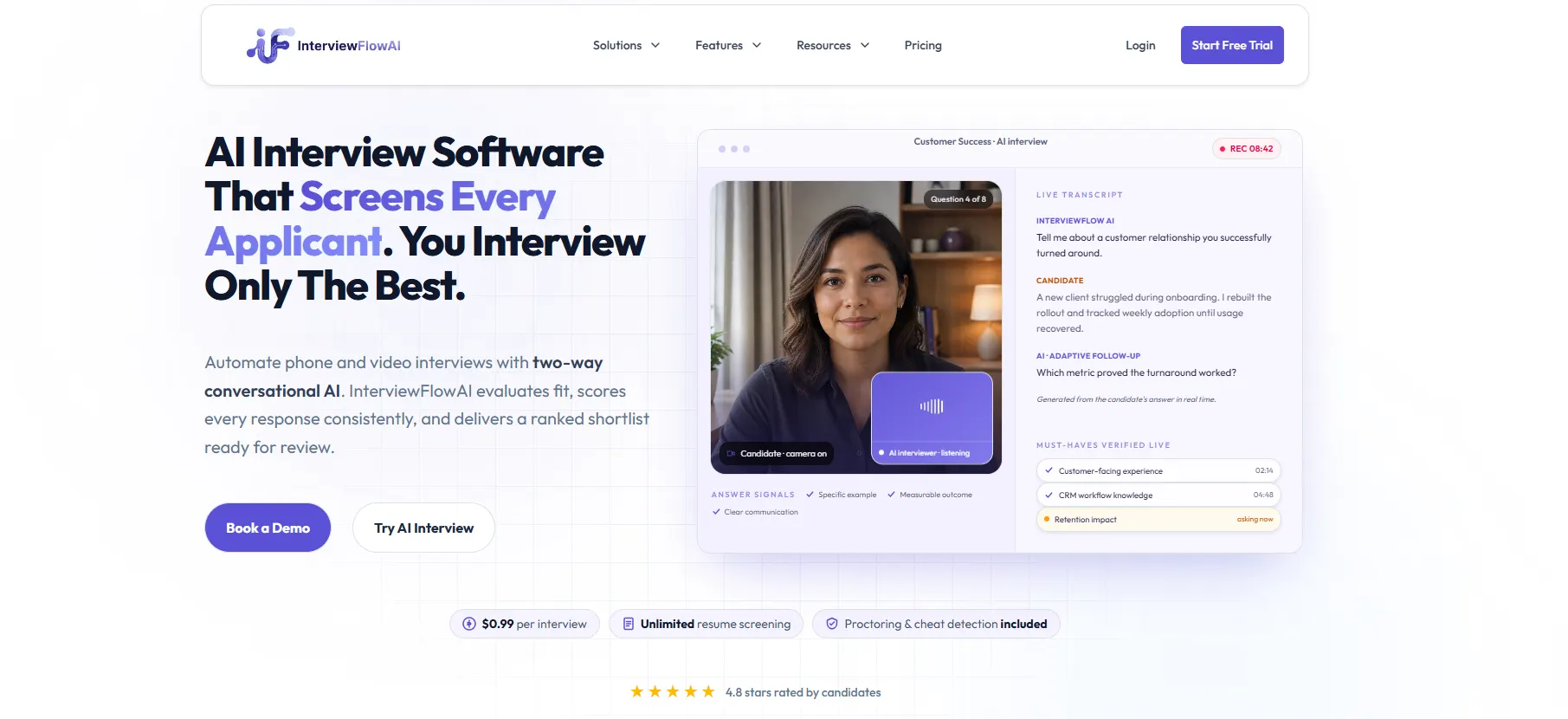
Its main advantage is the combination of conversational screening and published pricing. The monthly Growth plan costs $299 for 303 interview credits, which works out to $0.99 per credit. Annual Growth costs $250 per month and reduces the effective credit price to $0.83. The Scale plan adds team management, branded communication, APIs, webhooks, and cheat detection. Eligible business-email users can start a seven-day trial with 10 credits. See the current pricing page before comparing costs.
InterviewFlowAI has completed more than 100,000 AI interviews across 100+ businesses. Its first-party benchmark reports that 70 to 85% of invited candidates completed within a four-day window, completed interviews averaged about 13 minutes, and post-completion respondents rated the experience 4.8/5. These figures describe InterviewFlowAI customers and should not be treated as universal category benchmarks.
Best for: Startups, agencies, and talent teams that want phone and video screening without an enterprise rollout.
Watch before buying: Phone interviews require Growth or a higher plan. Cheat detection is available on Scale and Enterprise, not Pilot or Growth.
2. Hyring: best low-cost multi-assessment suite
Hyring combines an AI phone screener with resume screening, coding tests, English testing, and one-way or two-way video interviews. Recruiters can generate questions from a job description, edit the script, set qualification criteria, and receive transcripts and scores.
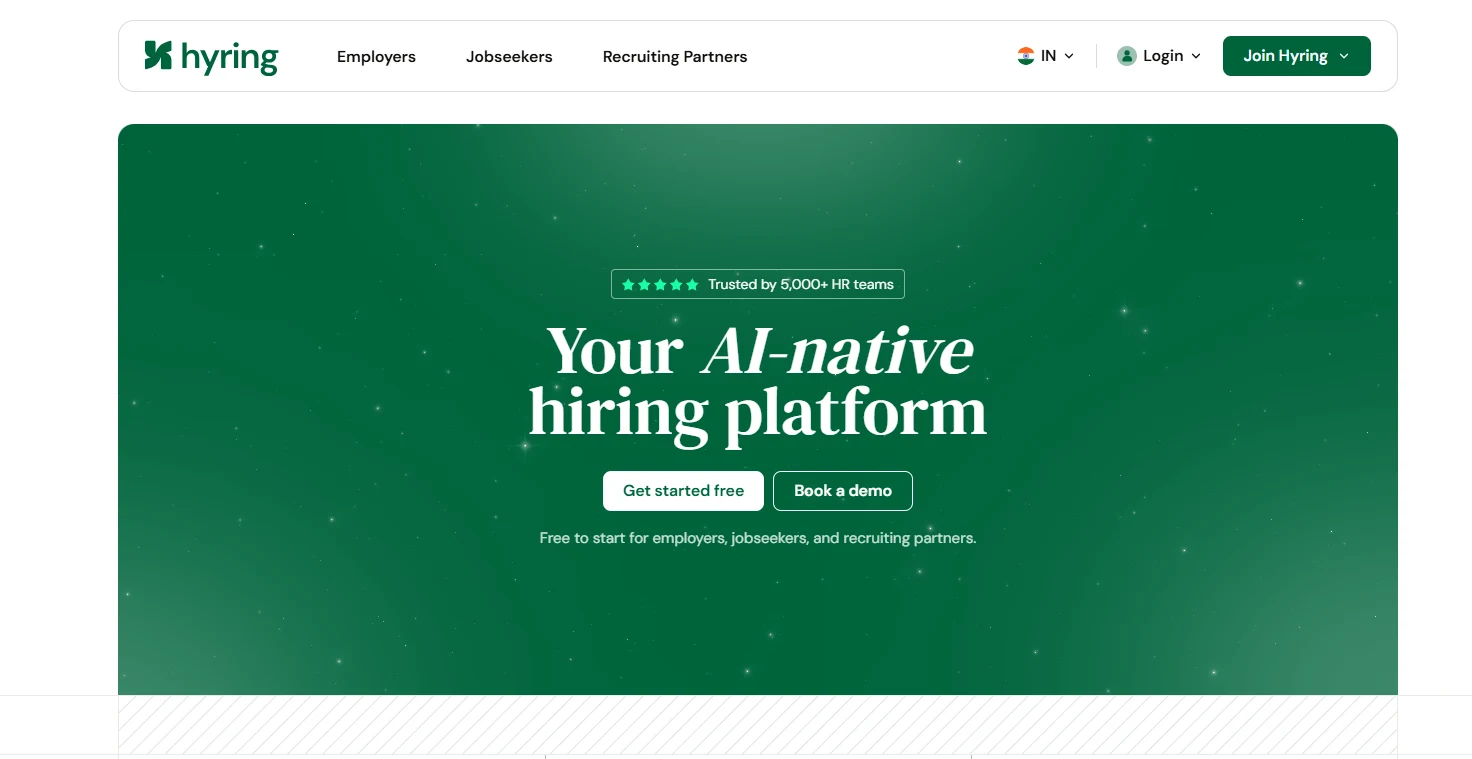
The official pricing page advertises a free employer plan with 50 monthly credits and a Pro plan starting at $79 per month. All six AI products share the same credit pool, which is useful if one hiring team wants several assessment types. It also means buyers need to model credit consumption rather than compare the subscription headline alone.
Best for: Small teams that want to test several hiring assessments in one account.
Watch before buying: Compare active-role limits, seats, credit consumption per product, languages, and rollover rules. Confirm whether your expected phone-screen volume fits the plan rather than assuming 50 credits equal 50 full interviews.
3. PhoneScreen AI: best for outbound screening campaigns
PhoneScreen AI is built around automated phone outreach. Recruiters create role-specific scripts, call candidates in bulk, and review audio, transcripts, scoring, and reasoning after completed screens. Its campaign mode is positioned for lists of up to 1,000 candidates.
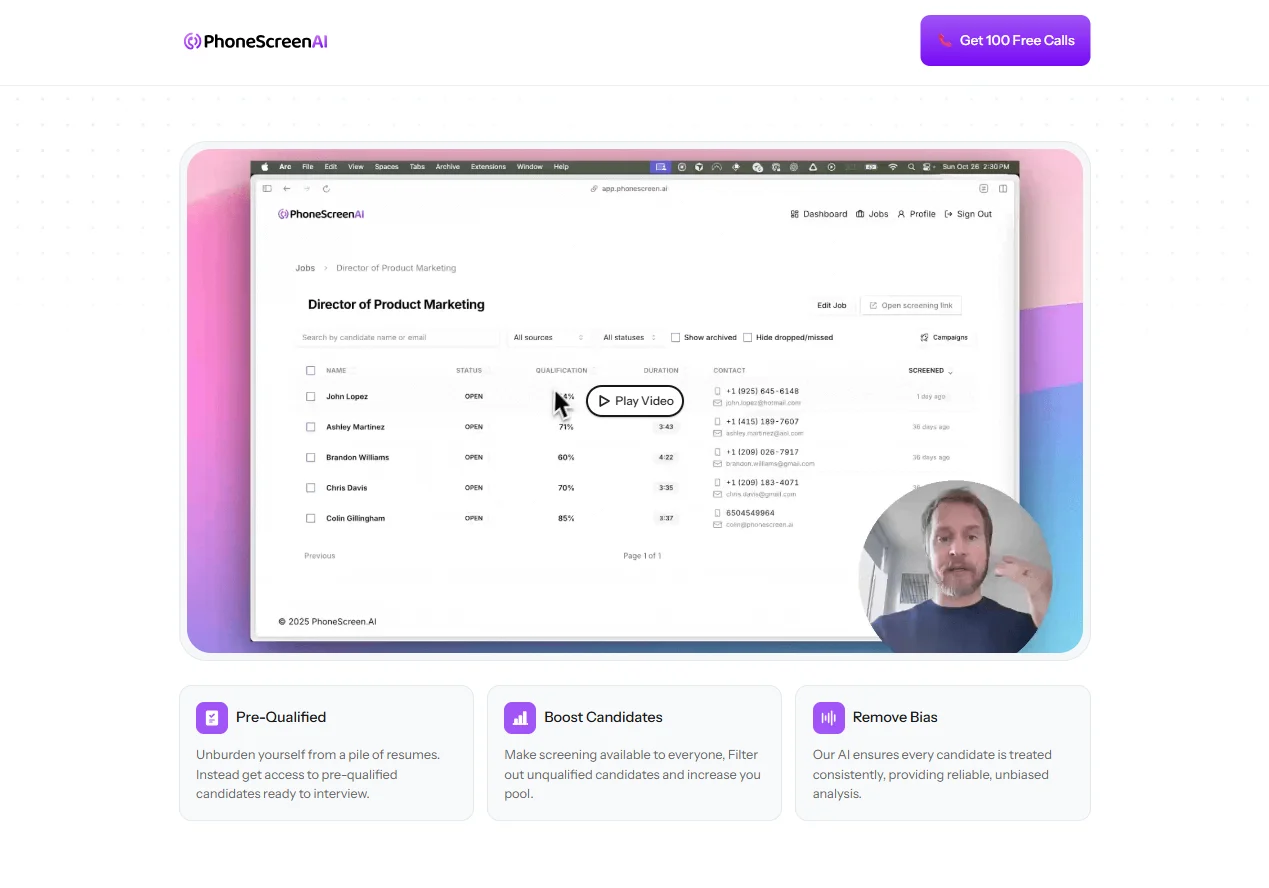
The pricing is unusually simple. The vendor currently advertises the first 100 screens free and charges $4 per completed call afterward. It also says missed calls and incomplete screens are not charged. That makes the product easy to pilot when the main bottleneck is dialing and completing first-round calls.
Best for: Staffing firms, RPOs, and high-volume teams that need outbound calling more than a broad assessment platform.
Watch before buying: Validate ATS writeback for your system, interview depth, language coverage, data-retention settings, and how the free-screen offer applies to your account.
4. Ribbon: best for multichannel screening with public packages
Ribbon conducts two-way voice and video interviews and combines them with email and SMS outreach. The vendor says its voice interviews work on any phone, support more than 10 languages, adapt in real time, and produce recordings, captions, scores, and analytics. Its integration pages describe writing summaries, transcripts, scores, and recording links back to supported ATS records.
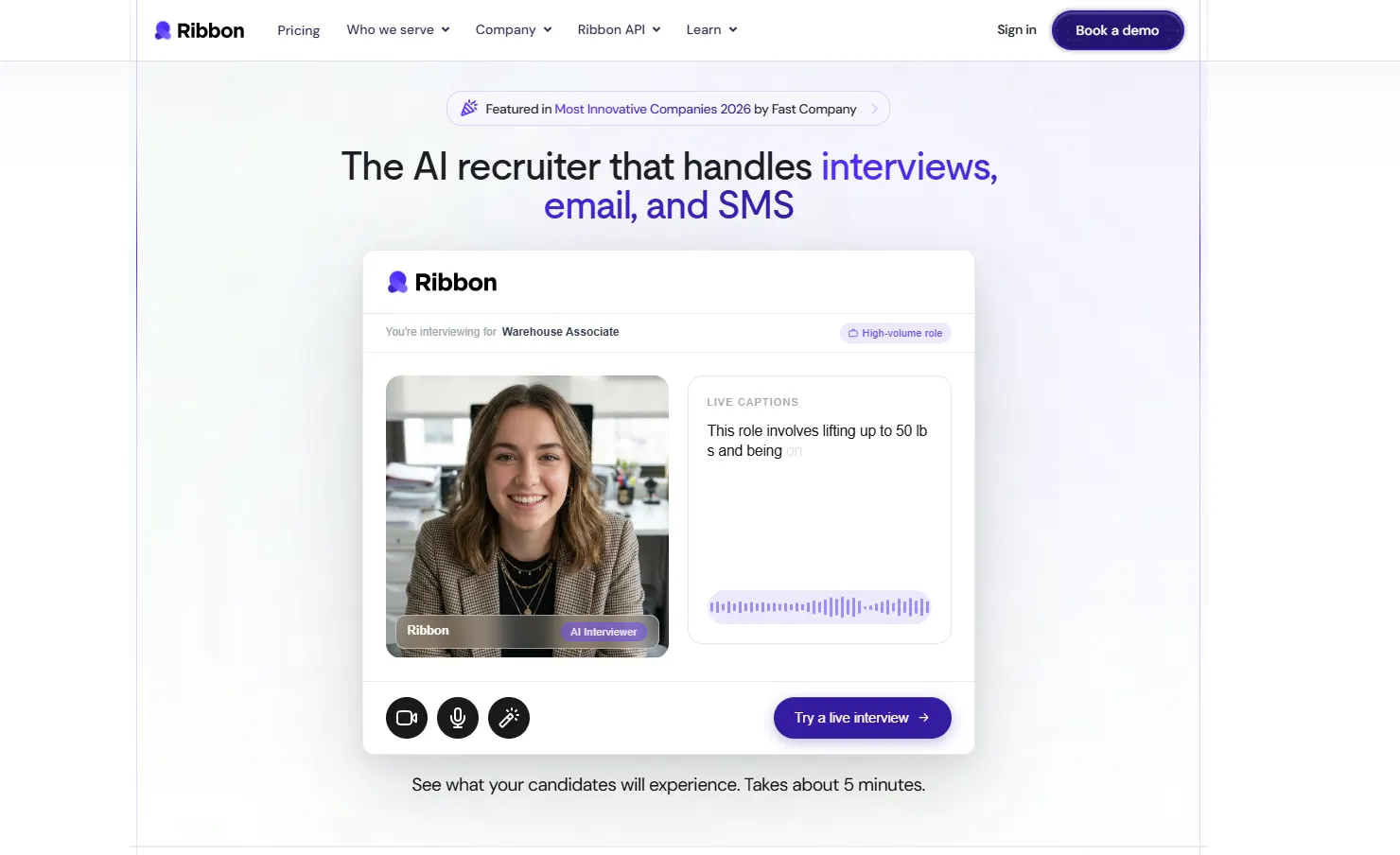
Ribbon pricing starts at $499 per month billed annually for 100 interviews. Higher packages add more seats, active roles, interviews, white-label branding, API access, and lower overage rates.
Best for: Teams that want interview automation and candidate outreach in the same product, with a public starting price.
Watch before buying: Model annual cost with expected overages. Check seat and active-role limits, plus the exact fields written back to your ATS.
5. HeyMilo: best for complex high-volume operations
HeyMilo offers structured AI screening through voice, video, SMS, and forms. The company positions the platform for enterprise hiring teams, staffing agencies, BPOs, franchises, and data-annotation work. Its public site describes 20+ languages, scored candidate reports, competency breakdowns, shareable PDFs, analytics, and ATS-connected workflows.
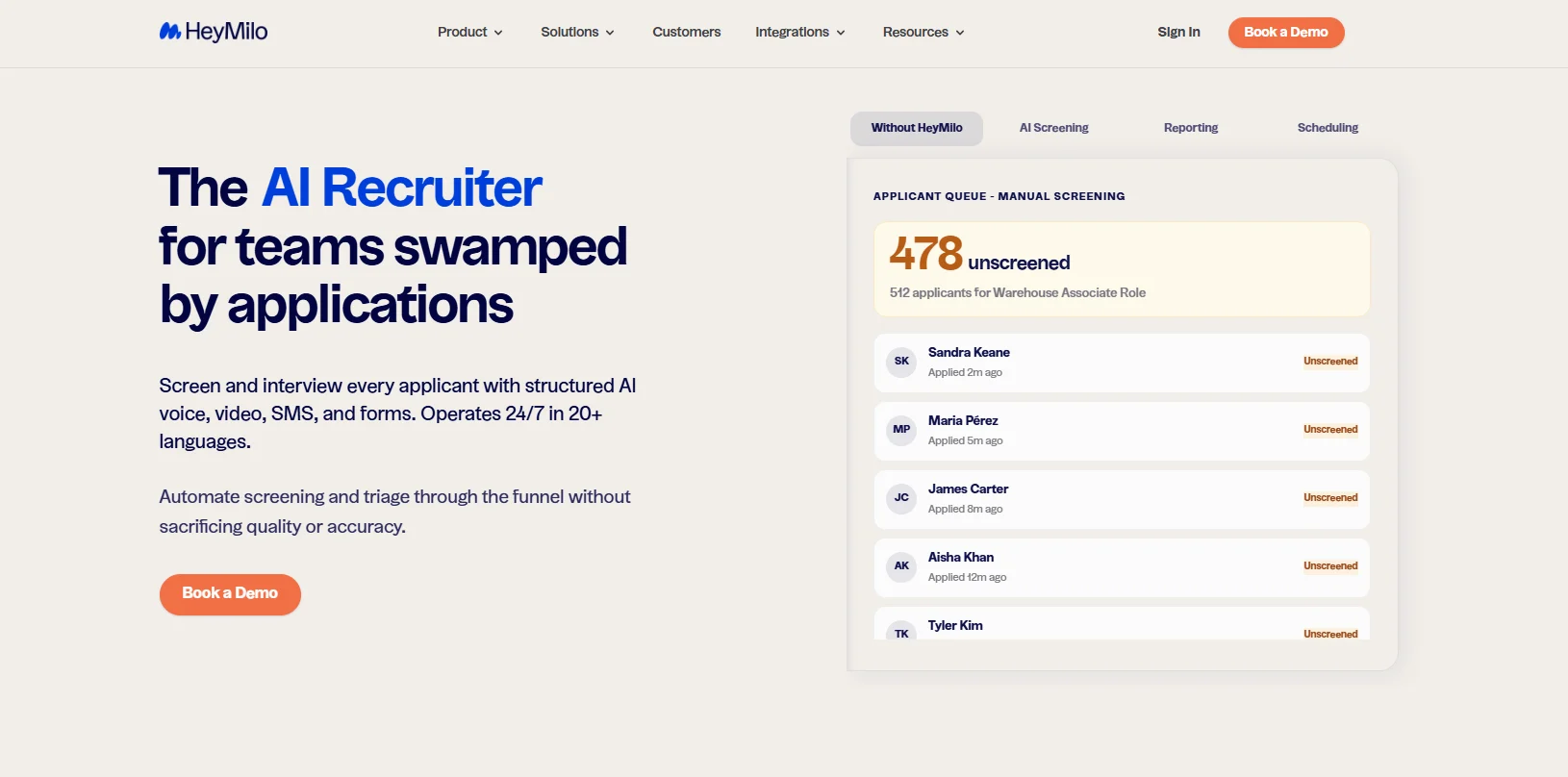
This is a broader operational product than a simple phone screener. That can be an advantage for teams that need sourcing, outreach, interviewing, and reporting under one vendor. It can be unnecessary complexity when the only goal is to replace 20-minute recruiter calls.
Best for: High-volume organizations that need several candidate channels and deeper workflow control.
Watch before buying: Pricing is not public. Ask for a written quote that separates interview usage, screening add-ons, integrations, implementation, support, and any integrity features.
6. Alex: best for an enterprise AI recruiter across channels
Alex conducts personalized two-way interviews by phone, video, SMS, and WhatsApp. Its public platform page states that interviews adapt with follow-up questions in 26+ languages and sit within a wider workflow that also covers screening and scheduling.
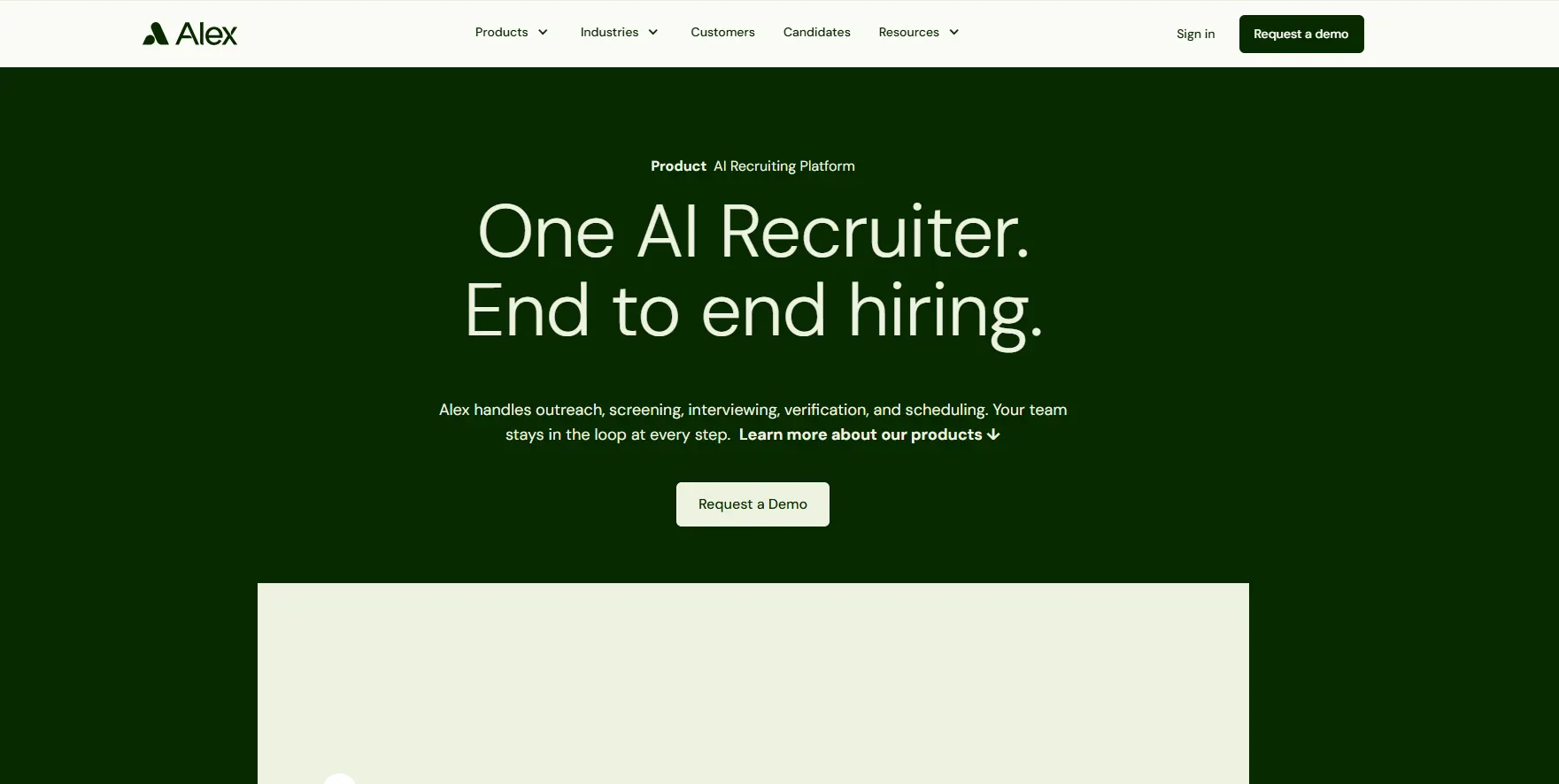
Alex is a better comparison for companies replacing several early-funnel tasks than for teams buying phone interviews alone. The broad channel coverage may help distributed or global organizations reach candidates where they already respond.
Best for: Mid-market and enterprise teams evaluating an AI recruiter instead of a single interview point solution.
Watch before buying: Pricing is custom. Ask whether phone usage, messaging, ATS integration, implementation, and support are included in the quoted scope. Run a live test with ambiguous answers and candidate questions to check whether the conversation adapts as promised.
7. Talkpush: best for BPO and frontline workflows
Talkpush Voice AI sits inside a high-volume recruitment platform. It can call candidates, conduct AI voice interviews, generate reports and job-match insights, and continue into reminders, follow-up, and scheduling. Talkpush also offers web-based Voice AI within its application flow.
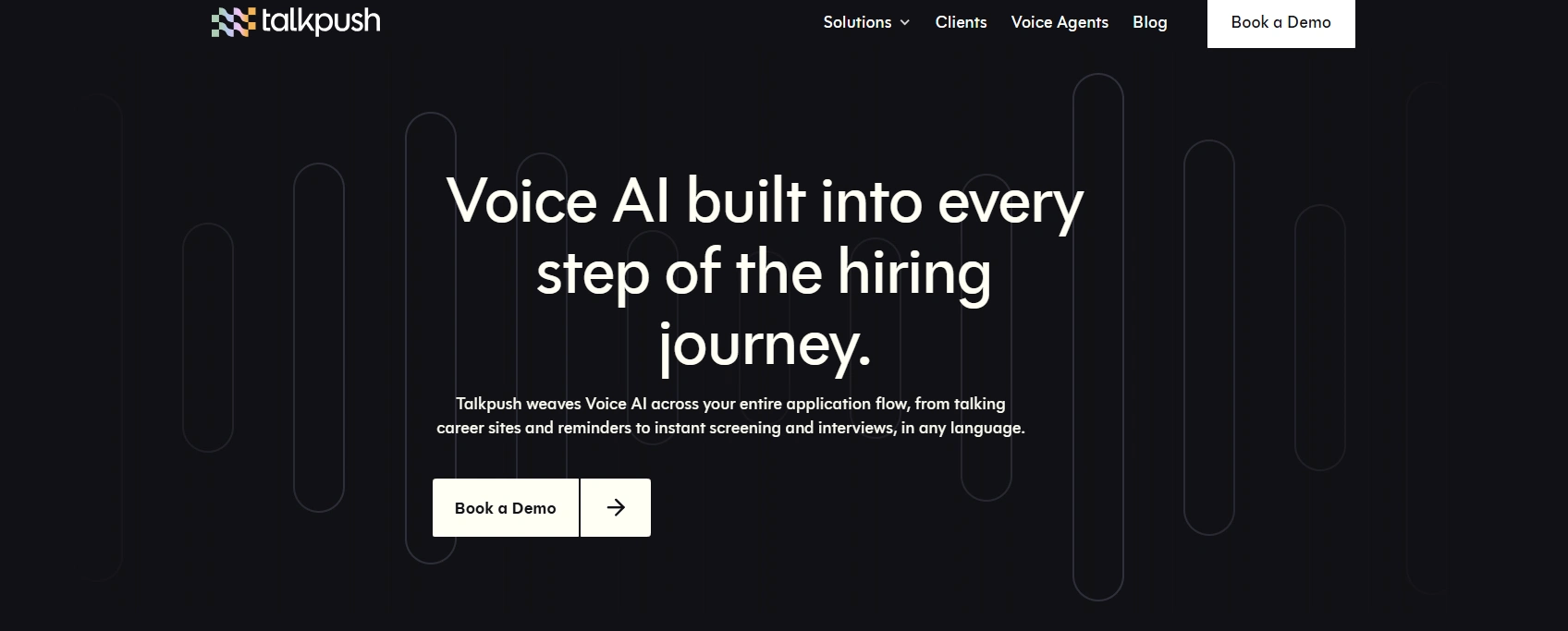
This design suits BPO, call center, retail, and other frontline programs where candidate engagement spans several steps. Talkpush has also published an Oracle-connected case study in which recruiters can review reports and override scores, a useful pattern for human oversight.
Best for: Large frontline or BPO hiring programs that need screening inside a wider candidate-engagement system.
Watch before buying: Pricing is custom. Confirm whether your candidates receive a phone call, use web voice, or can choose between formats. Review integration scope and the human override process.
8. Humanly: best for enterprise frontline hiring across chat and voice
Humanly provides structured AI interviews across chat, voice, and video. Its screening product also describes phone-based and AI-driven calls. The wider platform adds candidate engagement, screening, scheduling, and high-volume workflow support for hourly and frontline employers.
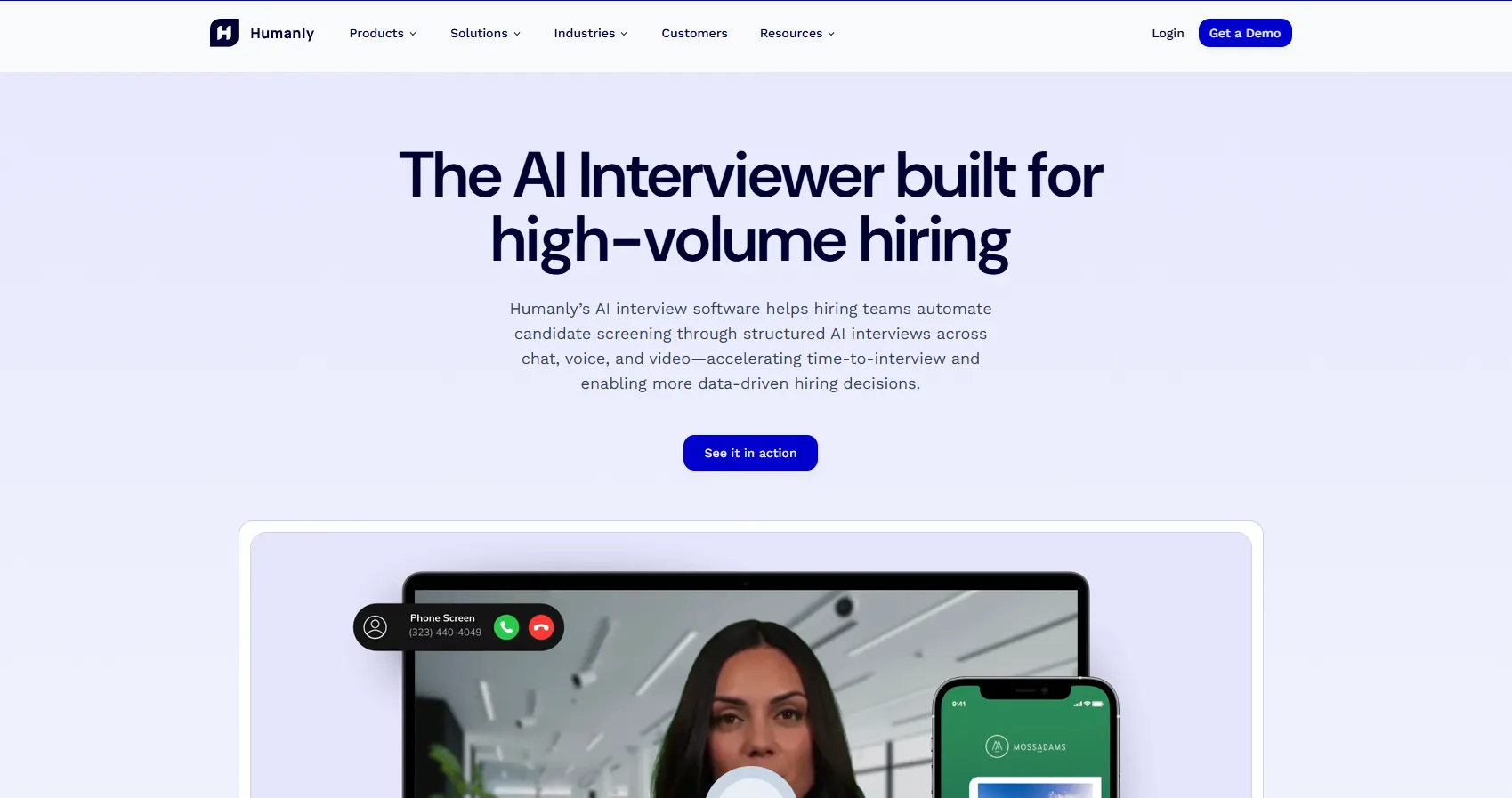
Humanly belongs on the shortlist when phone screening is one part of a larger hiring redesign. Teams that already have an ATS and only need a self-serve voice interviewer may find the scope broader than necessary.
Best for: Enterprise frontline and hourly hiring teams that want multiple screening channels and implementation support.
Watch before buying: Pricing is custom. Ask which interview modes are live for your region, what candidates experience on a phone call, and how human review, bias audits, retention, and accommodations work in practice.
What to look for in AI phone interview software
A real phone call or a browser voice interview
“Voice interview” does not always mean that the platform places or receives a normal phone call. Some products send a link that opens a voice session in the browser. Others call the candidate, let the candidate dial in, or support both.
Test the exact flow on an older phone and a weak connection. Ask what happens after a missed call, whether the system leaves a voicemail, how retries work, and whether candidates can switch to text, video, or a human process.
Follow-up questions that respond to the answer
A script that records six answers is a one-way audio assessment. A conversational interviewer should recognize when an answer is incomplete, ask for a relevant example, and handle a reasonable request for clarification.
This needs a live test. Give the AI a vague answer, correct an earlier statement, say you have no previous employment, and ask it to clarify the question. A polished demo voice means little if the dialogue ignores context.
Evidence a recruiter can inspect
Automated ranking should never be the only output. Look for a complete transcript, recording, question-level score, scoring reason, and link between the evidence and the role rubric. Recruiters should be able to correct or override the result.
This matters because structured AI interviews can add information beyond resumes, but the evidence does not support treating an AI score as a final hiring decision. In two field experiments, adding an AI interview report improved later human-interview pass rates for shortlisted candidates, while completion also created a participation cost for applicants. The authors describe both the gain and the tradeoff in Better Together: Quantifying the Benefits of AI-Assisted Recruitment.
ATS writeback, not a second inbox
Ask the vendor to show the complete workflow for your ATS:
What triggers the interview invitation?
Which candidate and job fields are read?
Where are the transcript, recording, scores, and status written?
Can a recruiter change the status without leaving the ATS?
What happens when the same candidate applies to two roles?
Are failed syncs visible and retryable?
An integration logo is not enough. Manual copying can return the time that automation was supposed to save.
Cost per completed and reviewed interview
Compare vendors at your expected monthly volume. Include the subscription, included interviews, overages, seats, active roles, onboarding, integration fees, and recruiter review time.
Use this calculation:
True cost per usable screen = total monthly software and operating cost / completed interviews with reviewable reports
Do not divide by invitations. A low price per invite is irrelevant if candidates do not complete or recruiters must repair the output.
Candidate disclosure and a human route
Tell candidates before the call that they will speak with an AI interviewer, what information will be recorded or assessed, who will review it, and how to request an alternative. Give them a contact for role questions and technical problems.
Candidate discussions repeatedly surface the same failures: irrelevant questions, no useful response to clarification, uncertainty about who reviews the result, and no way to ask a recruiter about the role. Those are workflow problems, not cosmetic ones.
Security, privacy, and compliance controls
The employer remains responsible for how a hiring tool is used. In New York City, Local Law 144 can require a recent bias audit, public audit information, and candidate notice when a covered automated employment decision tool is used. The Illinois Artificial Intelligence Video Interview Act requires notice, an explanation, and consent for covered AI analysis of video interviews. The EEOC warns that algorithmic hiring tools can create disability discrimination when employers do not provide appropriate safeguards and accommodations.
Rules vary by location, interview format, and how much the system influences a decision. Ask counsel to review the actual workflow. At minimum, verify notice, consent, retention, deletion, accommodation, audit, appeal, and human-review controls.
When AI phone screening is a good fit
AI phone interviews work best when a team has more credible applicants than recruiter calendar capacity and when a short spoken conversation can collect useful job evidence.
Common fits include customer support, sales development, call centers, staffing, logistics, hospitality, retail, campus hiring, and other roles with repeatable first-round criteria. They can also help global teams avoid time-zone delays.
They are a weaker fit for executive hiring, sensitive internal moves, roles where candidates need a consultative first conversation, or decisions that depend on a deep portfolio or work sample. In those cases, a human screen, structured work sample, or both may be more appropriate.
How to pilot an AI phone interviewer
1. Choose one repeatable role
Start with a role that has enough applicant volume to measure a result and a clear first-round rubric. Avoid starting with an executive or highly unusual position.
2. Set the decision boundary
Decide what the AI may do. A responsible first pilot collects evidence and recommends review priority. A person decides who advances. Document this before the first candidate is invited.
3. Build a short, job-related script
Use six to ten core questions with scoring guidance. Add follow-ups for weak, vague, or contradictory answers. The free Interview Script Generator can create a starting structure from a job description.
4. Test difficult conversations
Ask internal testers to request clarification, change an answer, speak with different accents, pause, use background noise, disconnect, ask about the job, and request a human. Record what the system does in each case.
5. Give candidates clear notice and an alternative
Explain the AI interview before it starts. State the approximate length, recording and evaluation process, recruiter review, data handling, and accommodation route. Do not surprise candidates with an automated call.
6. Measure the whole funnel
Track invitation-to-start, start-to-completion, time to first screen, recruiter review minutes, qualified-candidate rate, ATS correction work, candidate feedback, adverse-impact indicators, and later-stage outcomes. Compare them with the same role's previous process.
7. Audit misses before scaling
Review samples across the full score range. Look for transcript errors, weak scoring reasons, group differences, and strong candidates the model missed. Change the questions or rubric before increasing volume.
Frequently asked questions
What is AI phone interview software?
AI phone interview software uses conversational voice AI to conduct a structured first-round screening call. It asks job-related questions, listens to the candidate, can ask follow-ups, and produces a recording, transcript, summary, or scorecard for a recruiter. It is different from a one-way audio tool that only records fixed answers.
Does AI phone interview software call candidates?
Some products place outbound phone calls, some let candidates dial in, and others send a link to a browser-based voice interview. Ask the vendor to demonstrate the exact candidate flow in every country where you hire.
How much does AI phone interview software cost?
Public prices in this comparison range from free trial capacity to $4 per completed screen and monthly packages starting at $79 or $299. Multichannel and enterprise platforms often use custom pricing. Compare the total monthly cost at your volume, including overages, seats, active roles, integration, and review time.
Can AI phone interviews replace recruiter phone screens?
They can replace repetitive evidence collection for many first-round roles. They should not replace the human hiring decision, candidate relationship, accommodation process, or later interviews where judgment and two-way discussion matter.
Are AI phone interviews legal?
No single rule covers every AI phone interview. Applicable requirements depend on location, data collected, interview format, and how the output affects hiring. Employers may need candidate notice, consent, accommodation, data-retention controls, bias audits, and human oversight. Get legal advice for the workflow and jurisdictions you use.
Do candidates complete AI phone interviews?
Completion depends on the role, invitation, timing, trust, call flow, and alternative offered. InterviewFlowAI reports 70 to 85% completion within four days across its customer cohorts, but another platform or candidate population may perform differently. Measure your own pilot rather than applying a vendor benchmark to every role.
Can AI phone interview software detect fake candidates or AI-assisted answers?
Some tools provide identity, consistency, or cheat-detection signals. These are flags for human review, not proof of fraud. Ask what is detected, how often false positives occur, what evidence a recruiter sees, and what candidates can do if a flag is wrong.
What should happen after an AI phone interview?
A recruiter should review the transcript, recording, scorecard, and evidence against the role criteria. The candidate should receive a clear next step or closure message. The system should not leave candidates unsure whether a person ever saw their interview.