AI Recruitment Statistics 2026 Key takeaways
AI in recruiting is now majority behavior. 51% of US organizations use AI to support recruiting, and 89% of those cite time and efficiency as the reason (SHRM, 2,040 HR professionals, Feb 2025).
Volume is the trigger. Applications per job rose 239% on the Greenhouse platform between 2021 and 2025, from 28 to 95, turning recruiting into a screening problem.
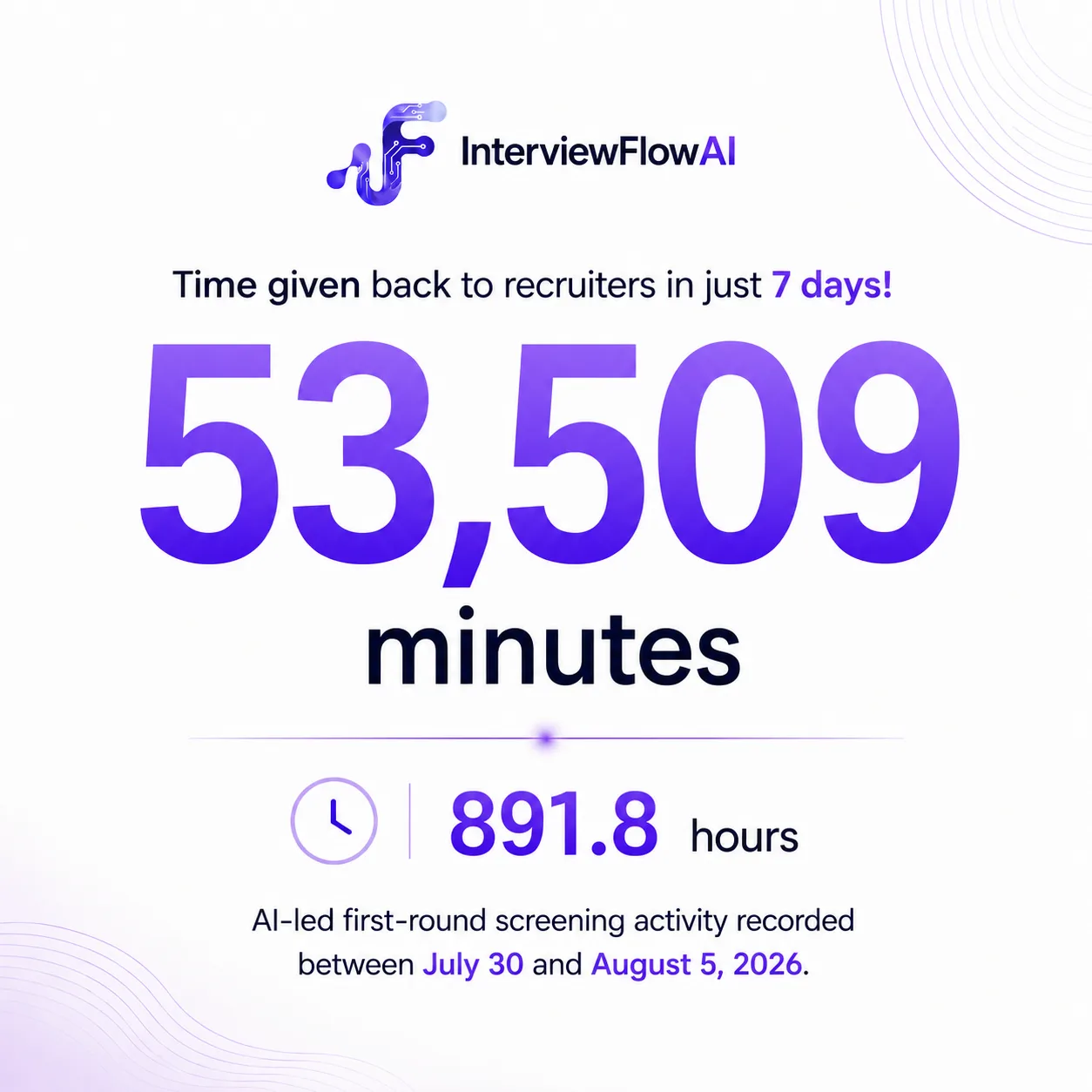
The capacity returned adds up quickly. Between July 30 and August 5, 2026, InterviewFlowAI recorded 53,509 minutes, approximately 891.8 hours, of AI-led first-round screening activity.
Candidates judge implementation, not technology. Disclosed, conversational, human-accountable AI interviews complete at 70–85% in our benchmark and average 4.8/5 among post-completion respondents, while 38% of US candidates in Greenhouse’s survey have withdrawn from opaque ones.
The evidence supports AI as structured evidence collection, not an autonomous judge. The strongest field experiments keep humans accountable for decisions.
Recruiting in 2026 has a capacity problem and a trust problem. The capacity problem is visible in the pipeline: the average job on the Greenhouse platform received 28 applications in 2021 and 95 in 2025, while recruiters cover fewer roles with roughly three times the applications. The trust problem is visible in candidate surveys: 38% of US job seekers say they have withdrawn from a process because of an AI interview, and 70% say AI was not clearly disclosed before their most recent one.
This page combines three kinds of evidence that usually never appear together: (1) a first-party benchmark from 100,000+ completed AI interviews across 100+ businesses on InterviewFlowAI, (2) current industry surveys from SHRM, LinkedIn, Greenhouse, and Pew Research Center, and (3) two large field experiments on structured AI interviews. Every figure below carries its source, sample, and scope, and we state plainly what the data does not prove.
Definition: What is an AI interview? A structured first-round conversation conducted by conversational AI that asks job-related questions, probes for evidence, and produces a scored scorecard for a human reviewer. It is not the same as one-way recorded video, nor does it make hiring decisions.
Need a practical walkthrough? Try a free AI interview yourself.
Takeaway: AI recruitment is growing because teams need capacity, but candidates evaluate automation by disclosure, fairness, human accountability and follow-up, not by speed alone.
AI Recruitment Statistics at a Glance (2026)
Twelve numbers that define the current state of AI in recruiting. Surveys below use different populations and denominators; read each row’s scope before comparing.
| # | Statistic | Source | Sample & scope | Fielded / published |
|---|---|---|---|---|
| 1 | 51% of US organizations use AI to support recruiting | SHRM 2025 Talent Trends: AI in HR | 2,040 US HR professionals | Feb 2025 |
| 2 | 89% of AI-using recruiting organizations cite time/efficiency | SHRM (same survey) | Subset using AI in recruiting | Feb 2025 |
| 3 | 37% of recruiting organizations integrating or experimenting with GenAI (up from 27%) | LinkedIn Future of Recruiting 2025 | 1,271 recruiting leaders, 23 countries | Sept 2024 |
| 4 | Applications per job up 239%: 28 (2021) → 95 (2025) | Greenhouse platform analysis | Greenhouse customers | Pulled Aug 2025 |
| 5 | 63% of US candidates have experienced an AI interview | Greenhouse 2026 Candidate AI Interview Report | 2,950 job seekers, 5 markets (US figure) | 2026 |
| 6 | 70% say AI was not clearly disclosed before their most recent AI interview | Greenhouse (same survey) | Same as above | 2026 |
| 7 | 38% have withdrawn from a process over an AI interview (+12% would) | Greenhouse (same survey) | Same as above | 2026 |
| 8 | 71% of US adults oppose AI making a final hiring decision | Pew Research Center | 11,004 US adults, weighted (±1.4 pts) | Dec 2022 |
| 9 | 47% think AI could outperform humans at treating applicants consistently | Pew (same survey) | Same as above | Dec 2022 |
| 10 | AI voice interviews: +12% offers, +18% job starts, ~+17% 30-day retention | Jabarian & Henkel, field experiment | 70,884 applications; 48 postings; Philippines | 2025 working paper |
| 11 | 54% vs 34% passed a later human interview (AI-structured screen vs resume screening) | Aka et al., “Better Together” | 37,000 junior-developer applicants | 2025 preprint |
| 12 | 100,000+ completed AI interviews; 70 avg. invitations per job; 70–85% completion within 4 days; ~13-min on average; 4.8/5 post-completion rating | InterviewFlowAI platform stats | 100+ businesses (see Methodology) | From May 2025 to July 2026 |
Latest platform activity snapshot: Between July 30 and August 5, 2026, InterviewFlowAI recorded 53,509 minutes, approximately 891.8 hours, of AI-led first-round screening activity.
Takeaway: Adoption is driven by efficiency, candidate acceptance is driven by transparency, and the two move independently. That gap is where AI hiring projects succeed or fail.
What 100,000+ Completed AI Interviews Reveal
Dataset scale and definition
The benchmark aggregates completed AI interviews conducted on InterviewFlowAI across 100+ businesses, excluding demos, internal tests, and duplicate invitations under the rules documented in the Methodology section. “Completed” means the candidate finished the structured conversation and a scorecard was generated.
Invitations per job: 70
Hiring teams using conversational AI screening invite an average of 70 candidates per job to a first-round interview, a workload no human panel can absorb without weeks of phone screens. Note this is invitations, not applications: it already reflects each team’s upstream filtering.
Completion: 70–85% within a four-day deadline
Across cohorts, 70–85% of invited candidates complete the interview within the four-day window. Completion varies by role family, market, and invitation framing, which is exactly why we publish it as a range with cohort definitions rather than a single hero number.
Duration: about 13 minutes
The average completed interview runs around 13 minutes, long enough to collect structured, job-relevant evidence, short enough that candidates finish on a phone during a lunch break. Great for first-screening interviews.
Scorecards: available immediately
Structured scorecards are available to the hiring team as soon as the interview completes. We report this as a workflow capability, not an outcome claim.
Candidate rating: 4.8/5
Candidates who complete an interview can rate the experience; among post-completion respondents, the average is 4.8/5. This figure describes people who finished and chose to respond: it does not represent candidates who abandoned earlier, and we say so because that distinction is the difference between a benchmark and a brochure.
The honest time math behind InterviewFlowAI’s candidate screening
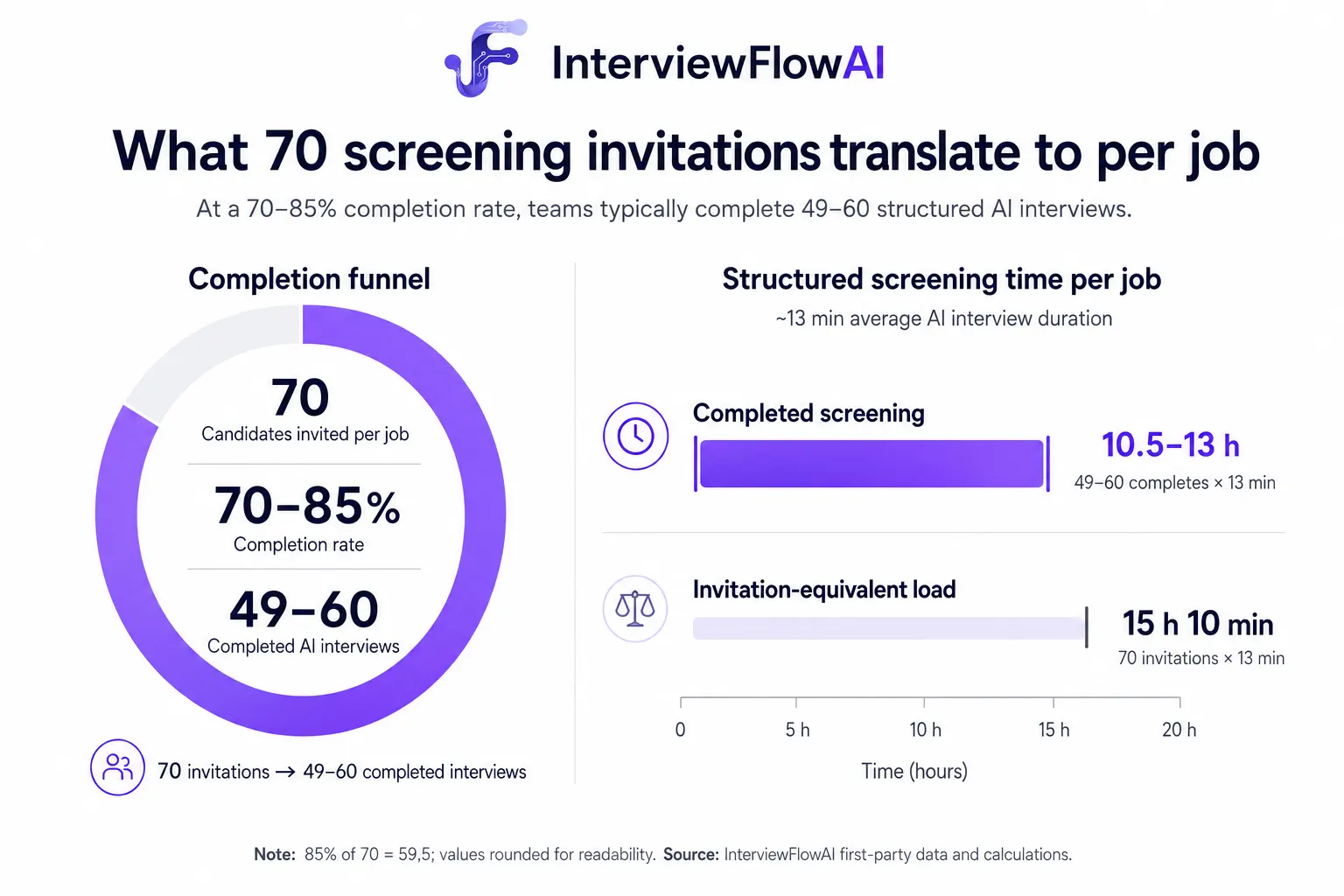
InterviewFlowAI is helping recruiters save 15+ hours (on average) with AI-led first-round candidate screening. But in high-volume candidate roles, it can scale your recruitment team’s time as per the interviews scheduled and completed.
Recruiting’s Volume Problem Is Now a Screening Problem
Greenhouse’s customer data shows the inflection: 28 applications per job in 2021, 95 in 2025, a 239% increase, while recruiters handle fewer roles and about three times the applications. On InterviewFlowAI, teams respond by inviting an average of 70 candidates per job to structured screens, with clearly labelled invitations, followed by thorough candidate reporting.
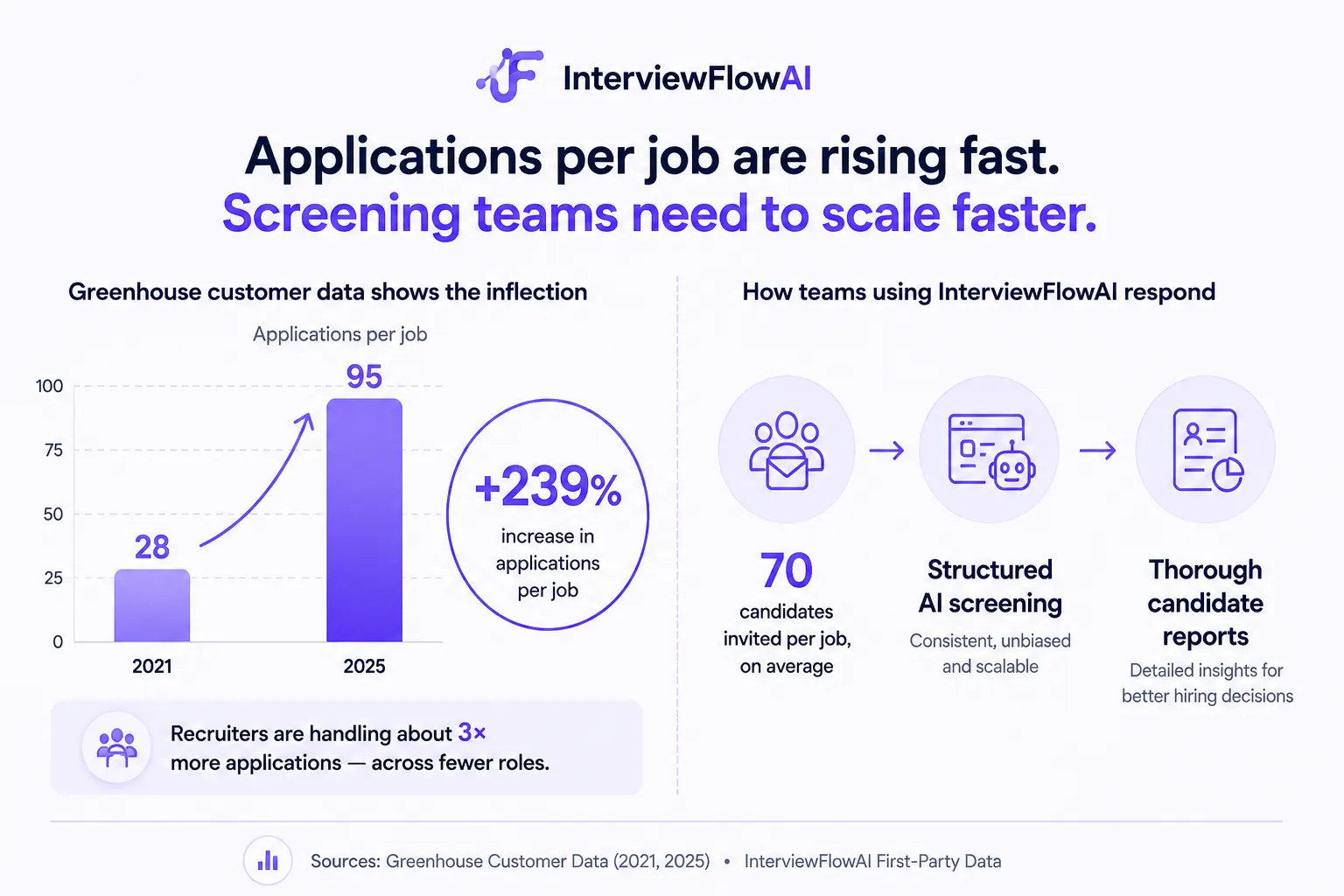
Recruiters describe “drowning” in 100+ applications per role, and keyword filters and binary knockouts that discard credible candidates on formatting quirks. The bottleneck is no longer finding applicants. It is collecting enough job-relevant evidence to distinguish credible candidates without making every recruiter repeat the same first-round call.
Our AI candidate screening guide covers the stage-by-stage process.
Takeaway: In high-volume hiring, the scarce resource is structured evidence per candidate, not candidates.
Where AI Creates Measurable Recruiter Capacity
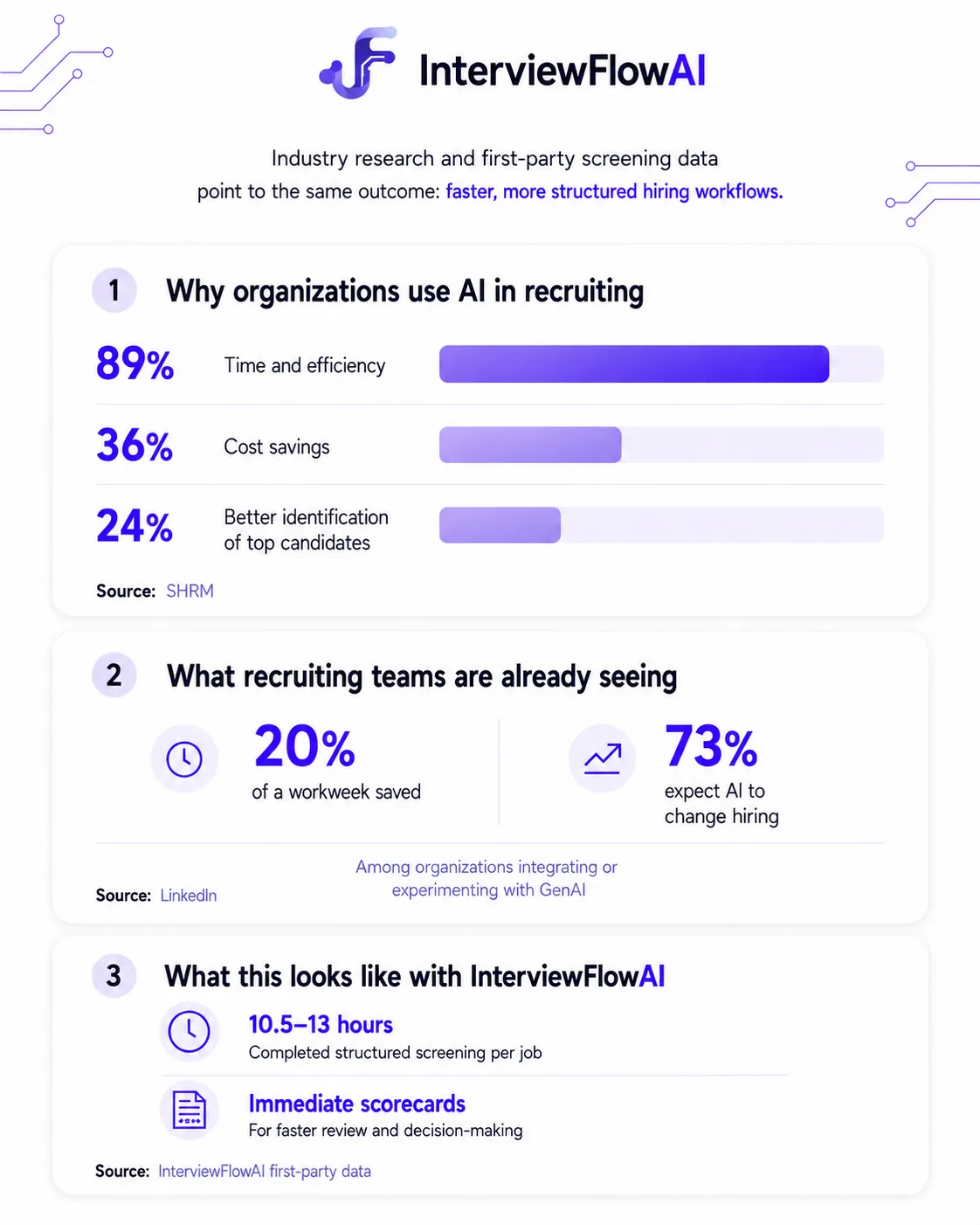
SHRM: 89% of organizations using AI in recruiting cite time/efficiency, the dominant business case, ahead of cost (36%) and better identification of top candidates (24%).
LinkedIn: recruiting organizations integrating or experimenting with GenAI report saving about 20% of a workweek; 73% expect AI to change hiring.
InterviewFlowAI: ~10.5–13 hours of completed structured screening per job, plus immediate scorecards.
Use this reproducible formula instead of vendor promises:
Potential recruiter time reallocated per job =
(completed AI interviews per job × median interview duration)
+ documented admin time replaced (scheduling, note-write-ups, status updates)
Two cautions. First, not every AI-interview minute equals a labor minute saved: manual screens may run longer, shorter, or only selectively. Second, immediate scorecards are a workflow fact, not an outcome claim; the outcome is what your team does with the hours returned. If time-to-hire is your constraint, learn how to tackle it with our guide on how to reduce time to hire.
Compare your screening funnel with the benchmark. Plug your invitations, completion rate, and duration into the formula above, or run the comparison on InterviewFlowAI.
Candidate Experience Statistics: Why High Satisfaction and High Skepticism Coexist
This is the section most roundups get wrong, because they average incomparable datasets. Read below how the evidence says candidate response to AI interviews is not uniform; it varies by format and implementation.
| Format | What candidates experience | Where trust breaks | What good implementation looks like |
|---|---|---|---|
| One-way recorded video | Solo recording into a camera, no interaction | Feels like surveillance; no questions answered; unclear who watches | Disclose usage, state who reviews, offer a live alternative |
| Conversational voice AI | Two-way conversation, consistent questions, ~13 min | Undisclosed AI; no accommodation path; no follow-up | Disclose before the invite, human accountability visible, close the loop |
| Chatbot scheduling/FAQs | Transactional automation | Dead ends, no escalation | Easy human escalation |
| Autonomous decision-making | AI as judge | Opposed by 71% of US adults (Pew) | Keep humans accountable — always |
The apparent contradiction resolves when you respect the denominators. Greenhouse surveyed 2,950 active job seekers across five markets, including people who withdrew: 70% say AI wasn’t clearly disclosed, 38% have withdrawn because of an AI interview, and only 19% want less AI; the dominant preferences are transparency and human oversight.
Pew’s weighted survey of 11,004 US adults adds the boundary condition: 71% oppose AI making final decisions, yet 47% see AI’s potential to treat applicants more consistently. InterviewFlowAI’s 4.8/5, by contrast, measures product-specific reactions among candidates who finished and reached an optional rating prompt.
Different populations, different questions: the credible conclusion is that opaque, impersonal implementations create distrust, while disclosed conversational screening with visible human accountability can earn high satisfaction.
Takeaway: Candidates don’t reject AI interviews; they reject being processed without proper implementation. Disclosure, consistency, and a human in accountability are the experience.
What the Strongest Field Evidence Says About Structured AI Interviews
Philippines customer-service field experiment (Jabarian & Henkel)
Across 70,884 applications and 48 entry-level postings, AI voice interviews were associated with 12% more offers, 18% more job starts, and about 17% higher 30-day retention, with humans making final decisions. When given a choice, 78% of candidates selected the AI interview. Strong emerging evidence for structured voice screening in high-volume hiring; one country and occupation family, so do not generalize. Read the field experiment.
Junior-developer randomized study (Aka et al.)
Among 37,000 applicants, 54% of candidates selected via an AI-assisted structured video pipeline passed a later human interview, versus 34% from resume screening, and the AI track surfaced younger, less credentialed candidates. Promising evidence that structured interviews surface different pools than resume filters. Read “Better Together”.
Both experiments operationalize what the US Office of Personnel Management has long documented: higher interview structure, consistent job-related questions, anchored rating, documented evidence, improves validity, reliability, and fairness. The active ingredient is structure; AI is the delivery mechanism.
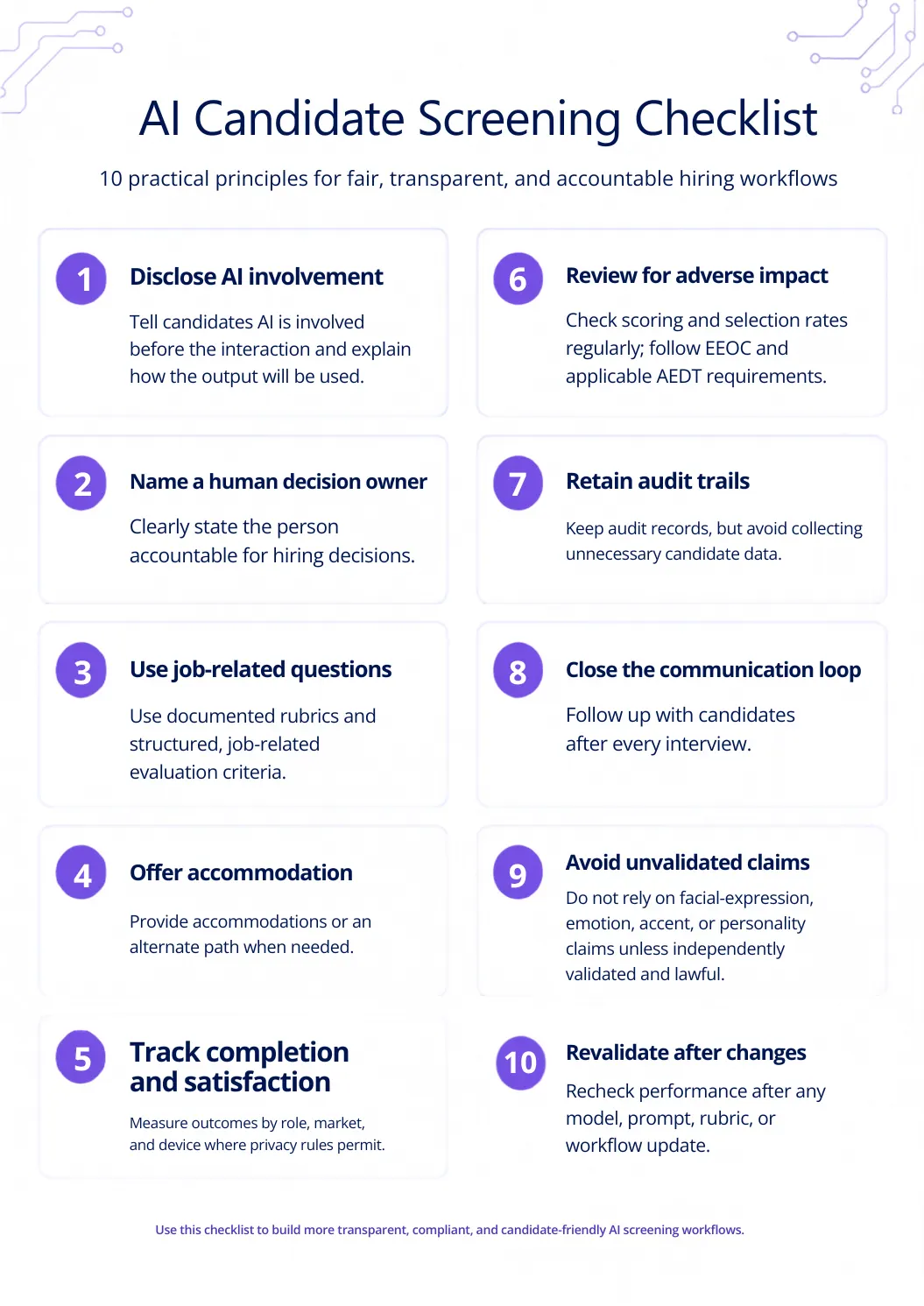
Responsible Implementation Checklist for Hiring with AI
FAQ
How common is AI in recruiting in 2026?
SHRM’s survey of 2,040 US HR professionals found 51% of organizations use AI to support recruiting, mainly job descriptions (66%) and resume screening (44%); among users, 89% cite time/efficiency. LinkedIn reports 37% of recruiting organizations integrating or experimenting with GenAI. Adoption is mainstream for early-stage work; final decisions usually remain human.
How much time can AI save recruiting teams?
LinkedIn’s 2025 survey reports GenAI users save about 20% of a workweek. In InterviewFlowAI telemetry, 49–60 completed 13-minute screens per job, roughly 10.5–13 hours of structured interviewing, run without recruiter time. Real savings depend on which manual work is replaced; measure before/after with the formula above, not vendor promises.
For example, in InterviewFlowAI platform usage, approximately 49–60 candidates complete an interview for an average job. At about 13 minutes per completed interview, this represents approximately 10.5–13 hours of structured interviewing handled by the platform. Across InterviewFlowAI as a whole, the platform recorded 53,509 minutes, approximately 891.8 hours, of time given back to recruiters between July 30 and August 5, 2026.
Do candidates complete AI interviews?
In our benchmark, 70–85% of invited candidates complete within a four-day window, at about 13 minutes median duration. Completion varies by role, market, and invitation framing. Published candidate surveys show disclosed, conversational formats with a visible human next step outperform undisclosed one-way video.
Do candidates trust AI interviews?
It depends on transparency. Greenhouse’s survey of 2,950 job seekers found 70% of US candidates say AI wasn’t clearly disclosed and 38% have withdrawn over an AI interview; Pew found 71% oppose AI final decisions. With disclosure, human oversight and follow-up, our post-completion rating averages 4.8/5. Different populations, read together.
Can AI make the final hiring decision?
The evidence says keep humans accountable: 71% of US adults oppose AI final decisions (Pew, n=11,004), and EEOC guidance plus NYC’s AEDT rules keep employers responsible for automated tool outcomes. The strongest field experiments pair structured AI interviews with human decision-makers. AI collects evidence; people decide.
Are structured AI interviews better than resume screening?
Early experimental evidence says they can add signal: in a 37,000-applicant preprint, 54% of AI-structured selects passed later human interviews vs 34% from resumes; a 70,884-application field experiment found more offers, starts and better retention. Both are preliminary. Structure and job-relatedness drive gains, not the AI label.
Which metrics should high-volume hiring teams track?
The full funnel: invitation delivery, start rate, completion rate (both denominators), median invite-to-complete, duration, scorecard latency, advance rate, evidence completeness, rating with response rate, and selection rates by group for adverse-impact review. Baseline 4–8 weeks pre-rollout so improvement is measured, not assumed.
Source, Methodology, & Limitations
Internal sources & methodology
First-party figures come from aggregated InterviewFlowAI platform records and use different units, including completed interviews, invitations, completion rates, interview duration and voluntary post-interview ratings. These are operational benchmarks, not universal industry averages or randomized-study results. The 4.8/5 rating excludes candidates who abandoned the process and may not include every completer. The seven-day snapshot covers July 30–August 5, 2026, when the platform recorded 53,509 minutes, or approximately 891.8 hours, of estimated screening capacity. External statistics retain the scope and limitations reported by their own sources.
External sources and methodology
SHRM 2025 Talent Trends: AI in HR. Survey of 2,040 US HR professionals, fielded Feb. 3–12, 2025; unweighted.
LinkedIn Future of Recruiting 2025. Survey of 1,271 management-level recruiting professionals in 23 countries, Sept. 2024, plus platform data.
SHRM 2026 Recruiting Executives Benchmarking, data from 4,600+ organizations.
Greenhouse pipeline-overload analysis, customer data pulled August 2025.
Greenhouse 2026 Candidate AI Interview Report, survey of 2,950 job seekers in the US, UK, Ireland, Germany and Australia.
Pew Research Center, AI in Hiring and Evaluating Workers. Weighted survey of 11,004 US adults, Dec. 12–18, 2022; margin of error ±1.4 points.
Jabarian & Henkel, Voice AI in Firms; author study page. Natural field experiment across 48 entry-level customer-service postings and 43 client firms in the Philippines.
Aka et al., Better Together, 2025 preprint.