If your stomach drops every time you picture the interviewer saying “tell me about yourself,” you are not alone. Interview nerves are normal, and they are not a sign you are unqualified.
Here is the part most people skip: reading about interviews does not make you better at them. Practicing out loud does. The only way to find the rambling answer, the missing result, or the vague example is to say it and hear it.
The fastest way to start is a free AI interview simulator. It asks you realistic questions, listens to your spoken answers, asks follow-ups, and gives you coaching feedback when you finish. Below, you will learn how to practice for a job interview three ways, how to prepare your answers, and why the way you practice matters more than ever.
What is a mock interview?
A mock interview is a practice job interview that copies the real one as closely as possible. Someone asks the questions you are likely to face, you answer out loud in full, and you get feedback before anything is at stake.
For years, that meant sitting awkwardly across the kitchen table from a friend. Today it also includes AI-driven roleplay: an AI interviewer that asks questions tailored to the role, reacts to what you actually say, and mimics real hiring conditions.
| Mock interview | Real interview | |
|---|---|---|
| Purpose | Find and fix weak answers | Decide whether you advance |
| Stakes | None | The job |
| Feedback | Detailed, right afterward | Usually none, or a yes or no weeks later |
| Retakes | As many as you want | One attempt |
That last row is the whole point. A mock interview lets you fail cheaply, so you do not fail when it counts.
How to practice for a job interview (3 proven methods)
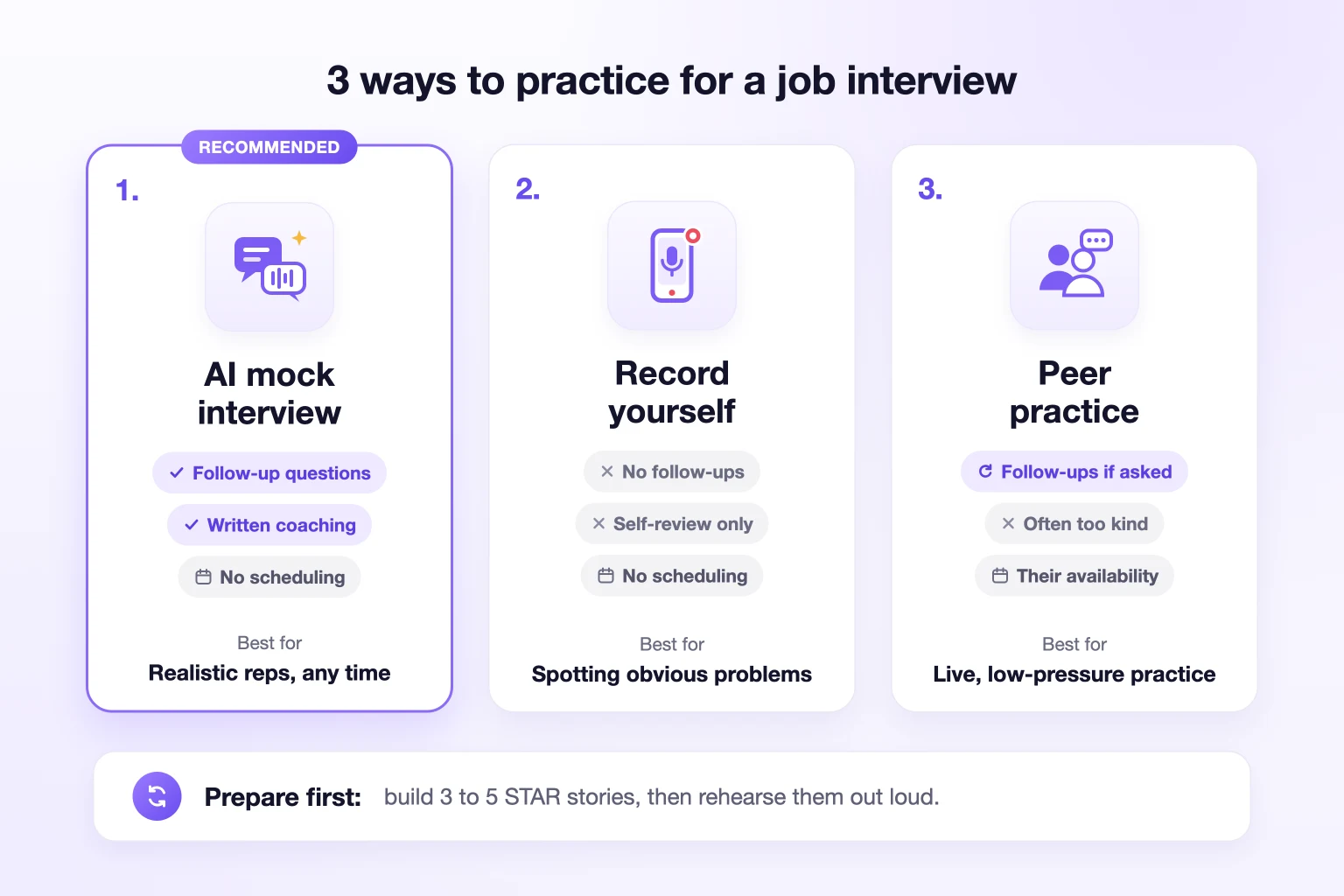
Job interview practice comes down to one question: who gives you honest feedback? Each method below answers it differently.
Method 1: The AI mock interview (highly recommended)
An AI mock interview gives you a realistic interviewer on demand, with no scheduling and no awkwardness. Here is how it works on InterviewFlowAI:
Set up in a few minutes. Create a free job seeker account, add your resume, and enter the role or job you are preparing for.
Answer out loud. The AI interviewer asks questions built around that role and your experience, one at a time, just like a real interviewer.
Handle follow-ups. If an answer is vague or skips the result, the AI can ask a follow-up question based on what you said.
Read your coaching feedback. When the session ends, you get question-by-question guidance, communication notes on structure, clarity, and pace, and a short checklist to prepare.
The feedback is coaching, not a score: no grade and no pass or fail, just specific guidance on what to change next time. Rework the answers it flags and run it again as often as you like.
Method 2: The “record yourself” technique
Write likely questions on cards, shuffle them, and answer each one out loud while recording on your phone. Then play it back.
This is a solid backup, and the evidence supports it. In a randomized study of medical students published in MedEdPublish, the group that reviewed a video of their mock interview reported a larger gain in preparedness than the group that did not (a median of 3 points versus 1).
The limits are real, though:
No follow-up questions. A recording never pushes you with “what did you do specifically?”
No objective feedback. You are grading your own work, and most people are either too harsh or too forgiving.
Easy to cheat. You can stop, restart, and polish until it sounds nothing like a live answer.
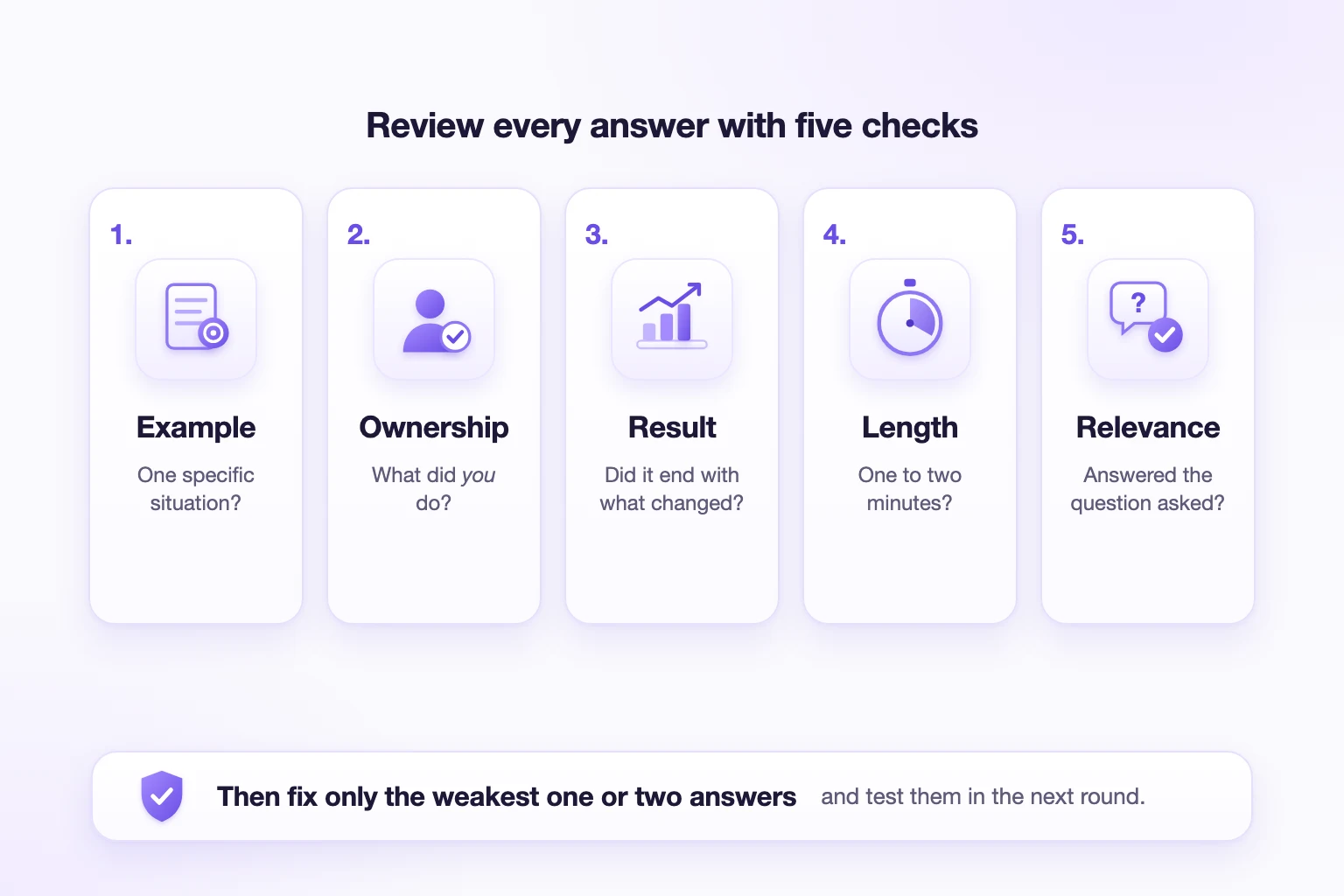
If you record yourself, review each answer against five checks:
Method 3: Peer practice
Practicing with a friend, family member, or mentor adds a live human and real-time reactions. A mentor in your field can also offer industry context no tool can match.
| Pros | Cons |
|---|---|
| A real person reacting in real time | Friends are often too nice to give harsh feedback |
| Mentors bring industry judgment | Scheduling around someone else's calendar |
| Good for rehearsing small talk and rapport | Feedback quality depends entirely on their experience |
If you go this route, give your partner a follow-up script and ask them to use it after every answer, even good ones:
“What did you personally do?” · “What was the result?” · “Can you give me a specific example?” · “What would you do differently?”
| Method | Follow-up questions | Objective feedback | Scheduling | Cost |
|---|---|---|---|---|
| AI mock interview | Yes | Yes, written coaching | None | Free |
| Record yourself | No | Self-review only | None | Free |
| Peer practice | If you ask for them | Varies, often too kind | Their availability | Free (coaches usually paid) |
How to prepare your answers before practicing
Practice works best when you walk in with raw material. You do not need fifty scripted answers. You need a structure and a few strong stories.
Use the STAR method for behavioral questions
Behavioral questions (“tell me about a time when…”) are where most candidates ramble. The STAR method keeps you on track:
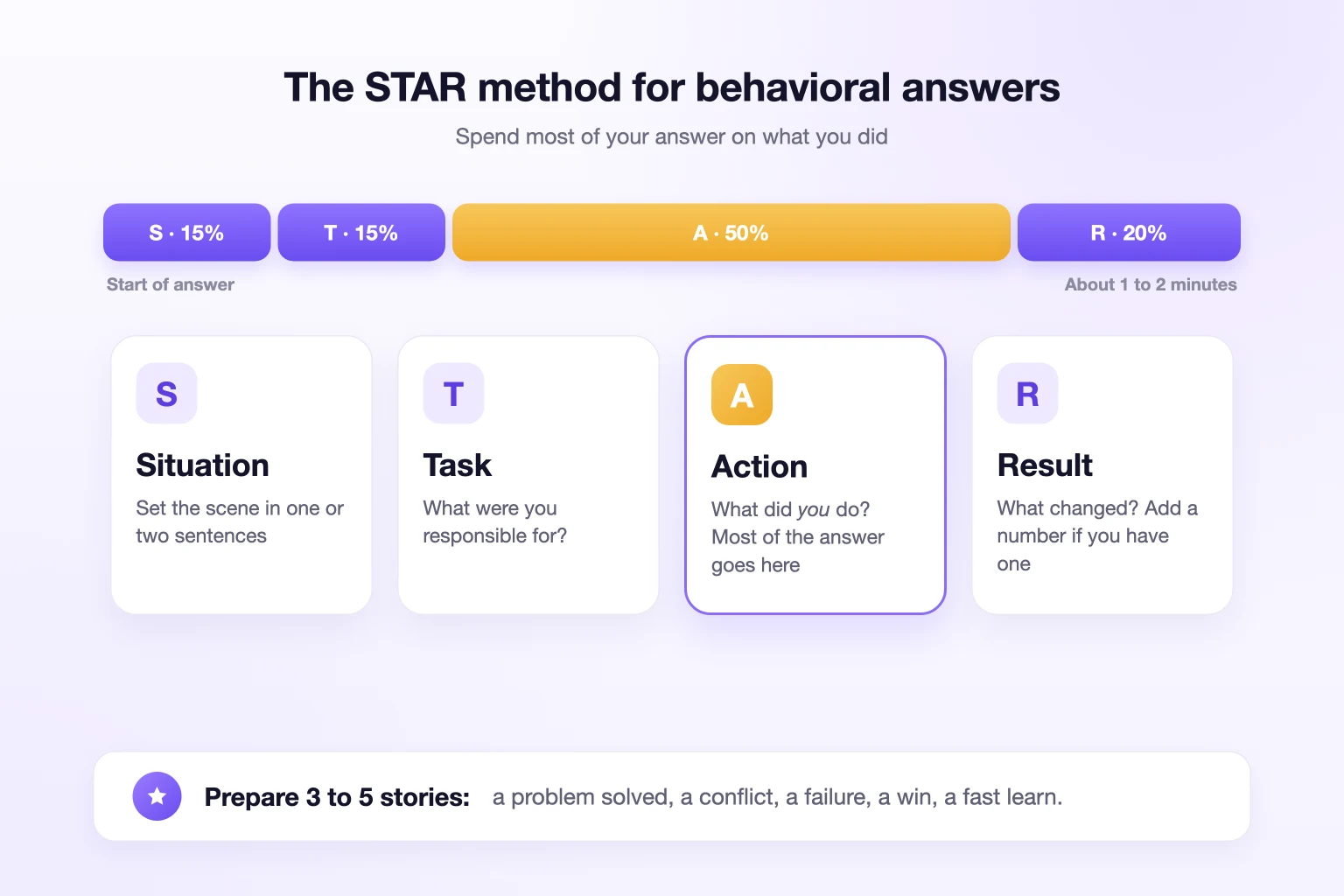
Situation: Set the scene in one or two sentences.
Task: Say what you were responsible for.
Action: Spend most of your answer here. What did you do?
Result: Finish with what changed, using a number if you have one.
Example: “Last spring our biggest client moved their launch up by three weeks (Situation). I owned delivery of our integration (Task). I cut the scope to the two features they needed for launch, got their sign-off to ship the rest later, and moved a second developer onto the build (Action). We shipped the core integration in nine days, and their launch went out on the new date (Result).”
Prepare 3 to 5 core stories
Most behavioral questions are variations on a handful of themes. Prepare 3 to 5 real stories you can adapt, such as:
A hard problem you solved
A conflict or disagreement you handled
A failure and what you learned from it
A result you are proud of (with numbers)
A time you learned something new quickly
Look up the real figures now, because you will not remember them under pressure. Then match your stories to the three or four skills the job description repeats most.
Need a starting point? The free AI interview answer generator drafts a STAR-structured answer you can rewrite in your own words, and the screening questions by role library shows what employers ask for more than 120 roles.
Why traditional practice is failing modern candidates
We build AI interview software for recruiters, so we see the hiring side up close. Here is what many candidates miss: your first interview may not be with a human at all.
A growing number of employers use AI and on-demand video screening, through platforms like HireVue or our own InterviewFlowAI, to run early-round interviews at scale. You talk to a camera and an AI interviewer, not a smiling person across the table.
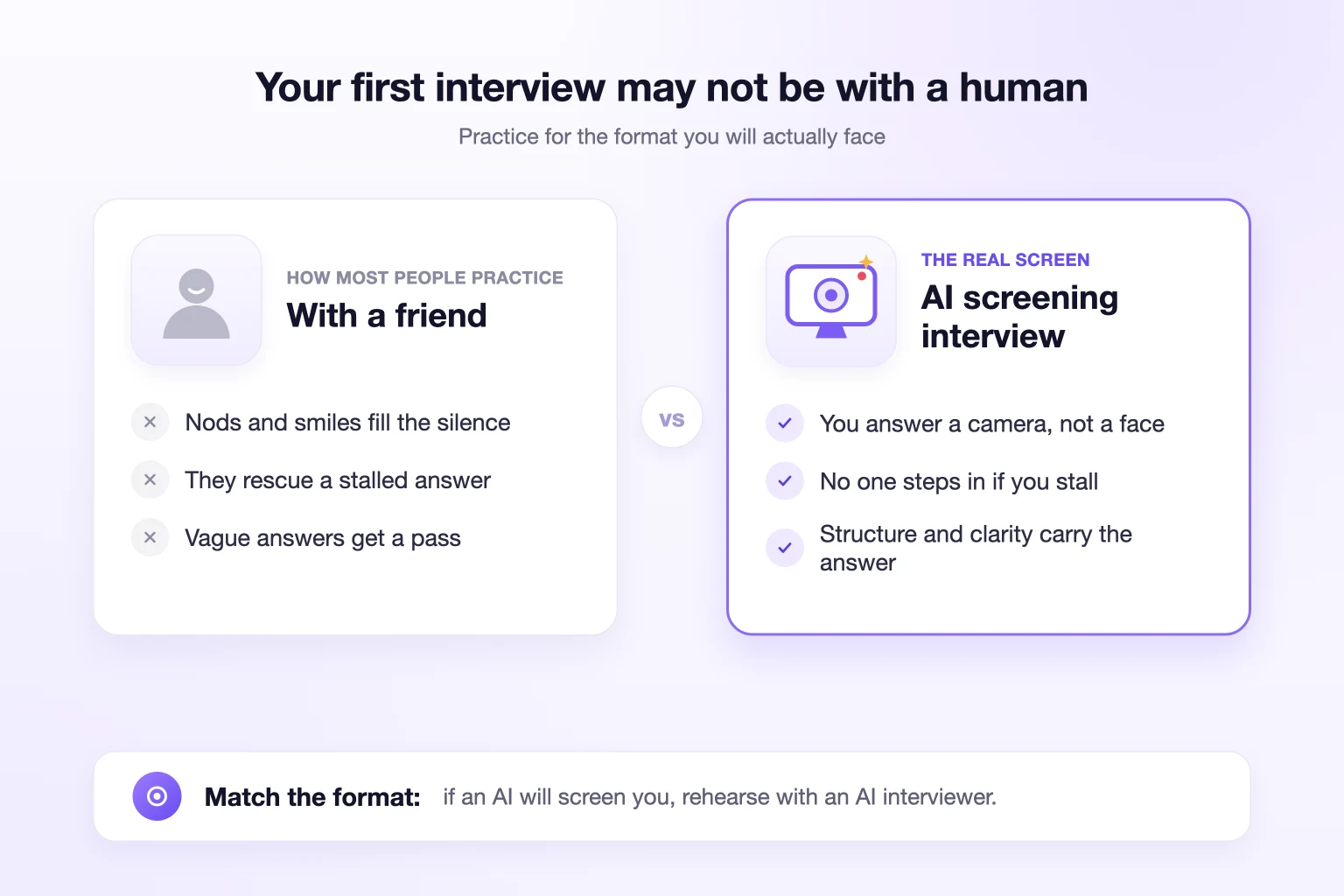
Practicing with a friend does not prepare you for that. There are no nods, no encouraging smiles, and no one to rescue a stalled answer. Practicing with AI trains the skills that format rewards:
Speaking clearly without visual cues. You get used to answering a screen and keeping your pace steady.
Using the language of the role. Screening questions are typically built from the job description, so rehearsing against the role trains you to name the skills it asks for.
Structuring your thoughts under pressure. Follow-up questions force you to give a specific example, your own action, and a result every time.
Why the pressure matters. A meta-analysis in the Canadian Journal of Behavioural Science found a negative correlation of .19 between interview anxiety and interview performance. Realistic rehearsal is one of the most direct ways to make the format feel familiar instead of frightening.
Expecting an AI interview? Read our guide on how to prepare for an AI interview, then practice in the same format for free.
Conclusion: confidence comes from reps
Confidence in an interview is not a personality trait. It is what happens when you have already said your answers out loud, heard the follow-up, and fixed what did not work.
Prepare your 3 to 5 STAR stories, pick a practice method, and do at least one full run before the real thing. If your interview is tomorrow, one realistic session tonight beats another hour of reading questions.
Frequently asked questions
How do I practice for a job interview?
Pick the three or four skills the job description repeats, prepare three to five real stories from your experience, and answer likely questions out loud. Then run a full practice interview in the same format as the real one, review the feedback, fix your weakest answer, and run it again.
What is a mock interview?
A mock interview is a practice job interview that copies the format of the real one. A friend, a coach, or an AI interviewer asks realistic questions, you answer out loud in full, and you get feedback afterward so you can improve before the interview that counts.
How do I practice for a job interview by myself?
Record yourself answering likely questions out loud, then play it back and check each answer for a specific example, your own actions, and a result. For follow-up questions and outside feedback without a partner, use a free AI practice interview.
What is the STAR method?
STAR stands for Situation, Task, Action, Result. It is a simple structure for behavioral questions: set the scene briefly, say what you were responsible for, spend most of the answer on what you did, and finish with what changed.
How many times should I practice before an interview?
There is no fixed number, but three rounds work well: one to find your weak answers, one after you rework them, and a final run in the real format. Keep going while each round still shows you something new to fix.
Is InterviewFlowAI's interview practice free?
Yes. Create a free job seeker account, add your resume, enter the role you are preparing for, and take a practice interview at no cost. You can run another session whenever you want.
Do practice interviews really help?
Research links interview anxiety with lower interview performance, and rehearsal reduces the unfamiliarity behind that anxiety. In a randomized study of medical students, mock interviews improved self-rated preparedness, and reviewing a recording of the session improved it further.