InterviewFlowAI lets you hire AI trainers and domain experts the way Mercor and micro1 do. Every applicant takes a spoken AI interview built from the skills your project needs, with follow-up questions and integrity checks. You get a scored pool of experts to staff projects from, with a recording and transcript for every interview.
200+ businesses trust InterviewFlowAI · 150,000+ AI interviews completed · 4.8/5 average candidate experience rating
Why hiring AI trainers and domain experts is hard
AI training work needs real experts, often hundreds at a time, and projects can start on short notice. The usual hiring process can't keep up.
- Resumes don't prove expertise. A degree and a job title don't show whether a physician can spot a subtle error in a model's diagnosis.
- Applicant volume is huge. One listing for remote, well-paid AI training work can bring in thousands of applicants from many countries.
- Every project needs different skills. One legal project might need US contract law, and the next one EU data protection.
- Projects start fast. Clients want experts in days, not after weeks of scheduling calls.
- AI can answer for the applicant. A chatbot can finish a written screening test, so you need to hear people reason out loud.
- Quality has to hold up. The same standard has to apply to every applicant, across every reviewer and time zone.
How Mercor and micro1 hire experts with AI interviews
Mercor and micro1 are two of the best-known AI training data companies. Both recruit domain experts to train and evaluate AI models for frontier labs. Both screen every applicant with an AI interview first.
| Area | Mercor | micro1 |
|---|---|---|
| Who they hire | Physicians, lawyers, engineers, consultants, finance analysts and linguists | Experts in law, healthcare, finance, engineering and science, plus language experts |
| The AI interview | About 20 minutes, with questions that adapt to the applicant's field and background | 20 to 40 minutes. Zara covers each skill the role needs, about 7 minutes per skill |
| Reusing results | A completed interview carries over to other roles that need the same one | Certified skills carry over, so a later role can skip all or part of the interview |
| Human review | Mercor staff review results before experts are matched to projects | Human recruiters review the recordings and match candidates to roles |
| Applicant support | A free practice interview, and up to three retakes of the official one | Detailed feedback for applicants who don't qualify |
| Pay and terms | Remote contract work, with an average contracted rate of $90 an hour | Remote contract work, typically $50 to $200 an hour |
What makes their model work
- One standard interview for everyone. Every applicant gets a structured, role-specific interview, so scores compare fairly across thousands of people.
- Depth over keywords. The AI asks follow-up questions about the applicant's own field. That shows how they think, which a resume can't.
- Interview once, staff many projects. Results are reused, so a strong expert isn't screened again for every project.
- Always-open pools. Mercor keeps a standing listing for each field and invites people from it when a project starts.
- No scheduling. Applicants interview at any hour, in any time zone.
- AI first, people last. The AI runs the first screen, and people review the results and make the match.
micro1 now uses Zara for its own expert network and no longer sells it to employers. If you run your own expert network, you need your own AI interviewer. See how InterviewFlowAI compares with micro1.
What kind of hiring this is
AI trainer hiring is recruiting people who improve AI models with their expertise. They write prompts and reference answers, grade model output against rubrics, and flag where a model is confidently wrong. The work is usually:
- Remote and global. Experts work from anywhere, on their own schedule.
- Contract and hourly. Pay is set per project, by the depth of expertise it needs.
- Project-based. Projects last weeks to months and can be extended or ended early.
- Credential-heavy. Many projects need years of professional experience or an advanced degree.
- Bursty. Projects start on short notice, so you need a pool of vetted experts ready.
| Role | Typical work | What to test in the AI interview |
|---|---|---|
| Generalist AI trainer | Writes prompts and reference answers, and grades model output | Reasoning, attention to detail and clear explanations |
| Medical expert | Reviews clinical answers and writes grading rubrics | Clinical reasoning on a realistic case and spotting unsafe advice |
| Legal expert | Evaluates legal drafts and research | Jurisdiction knowledge, issue spotting and citing the right rule |
| Finance expert | Builds and grades financial analysis tasks | Modeling logic, accounting judgment and stated assumptions |
| Software engineer | Writes coding tasks and reviews model-written code | Debugging approach, code review reasoning and trade-offs |
| Language expert | Writes and rates content in a target language | Fluency, register and cultural nuance in that language |
| QA reviewer or project lead | Checks other experts' work and keeps quality consistent | Rubric consistency, clear feedback and managing a team |
How to hire AI trainers, step by step
The same steps work for an AI data company, an expert network, or a team hiring its own evaluators.
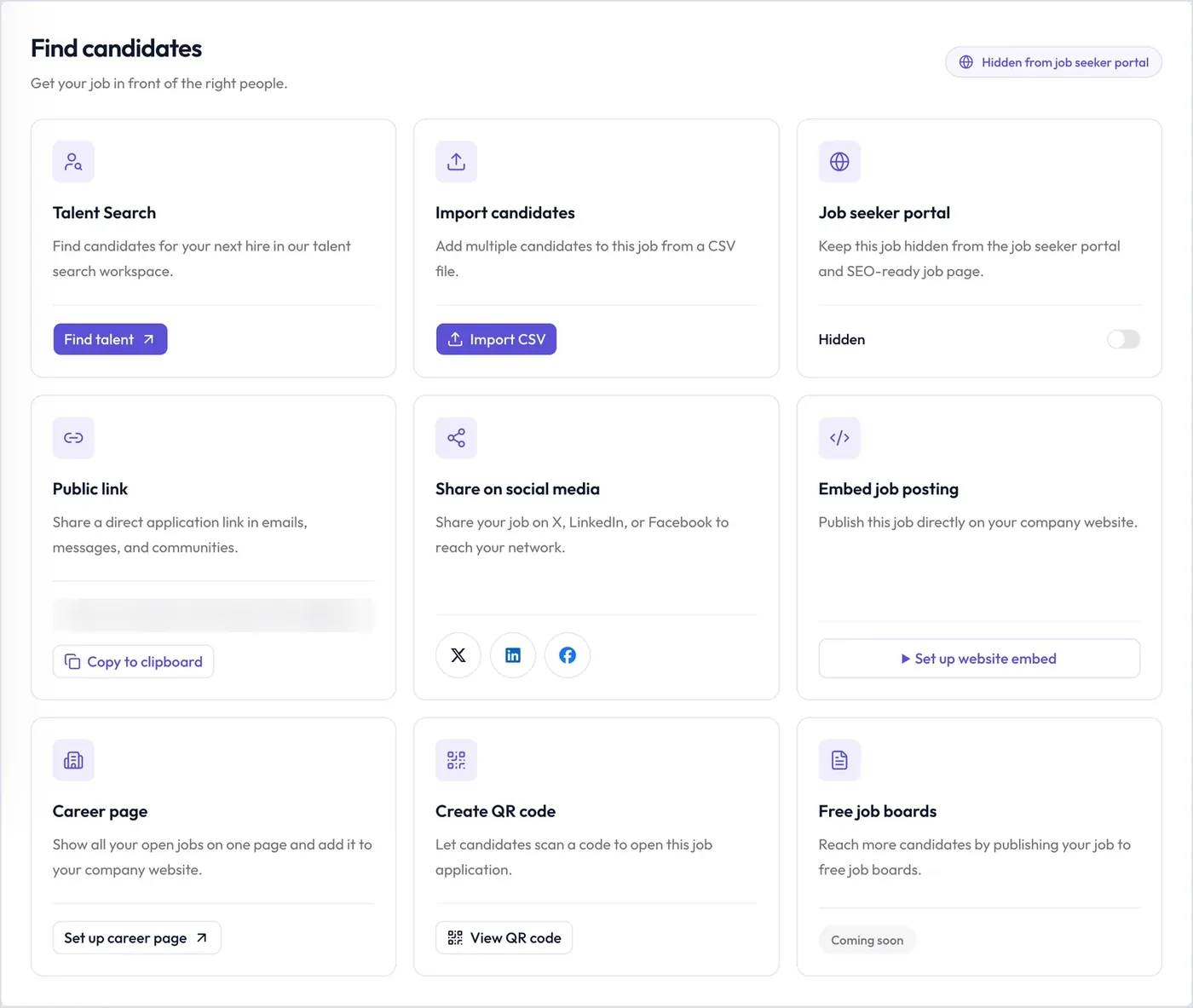
- Open one Interviewer per domain. Create an Interviewer for each expert pool, such as physicians or US lawyers. Keep its link open for up to 365 days and share it in job ads and on your careers page.
- Find experts. Talent Search finds and ranks candidates for an Interviewer, each with an AI fit score out of 100. Add the best ones to the Interviewer.
- Screen the must-haves. Ask on the application form about degrees, years of practice and weekly hours. Applicants who miss a must-have are declined automatically. You can also require a portfolio link, such as a GitHub profile or a publication list.
- Interview everyone who qualifies. Applicants who pass go straight to the AI interview. Skill-based questions cover the skills you list, and resume-based questions probe their own work.
- Add a written test if you need one. A skill assessment can ask for a long written answer, such as grading a model's answer against a rubric. Your team reads long answers.
- Staff projects from the pool. When a project starts, filter by score, tags and key questions. Then move the chosen experts to a custom stage or export them.
What the AI interview checks for experts
An AI interview is a two-way spoken conversation between an applicant and an AI interviewer, by video in the browser or by phone. For expert hiring, set it up like this:
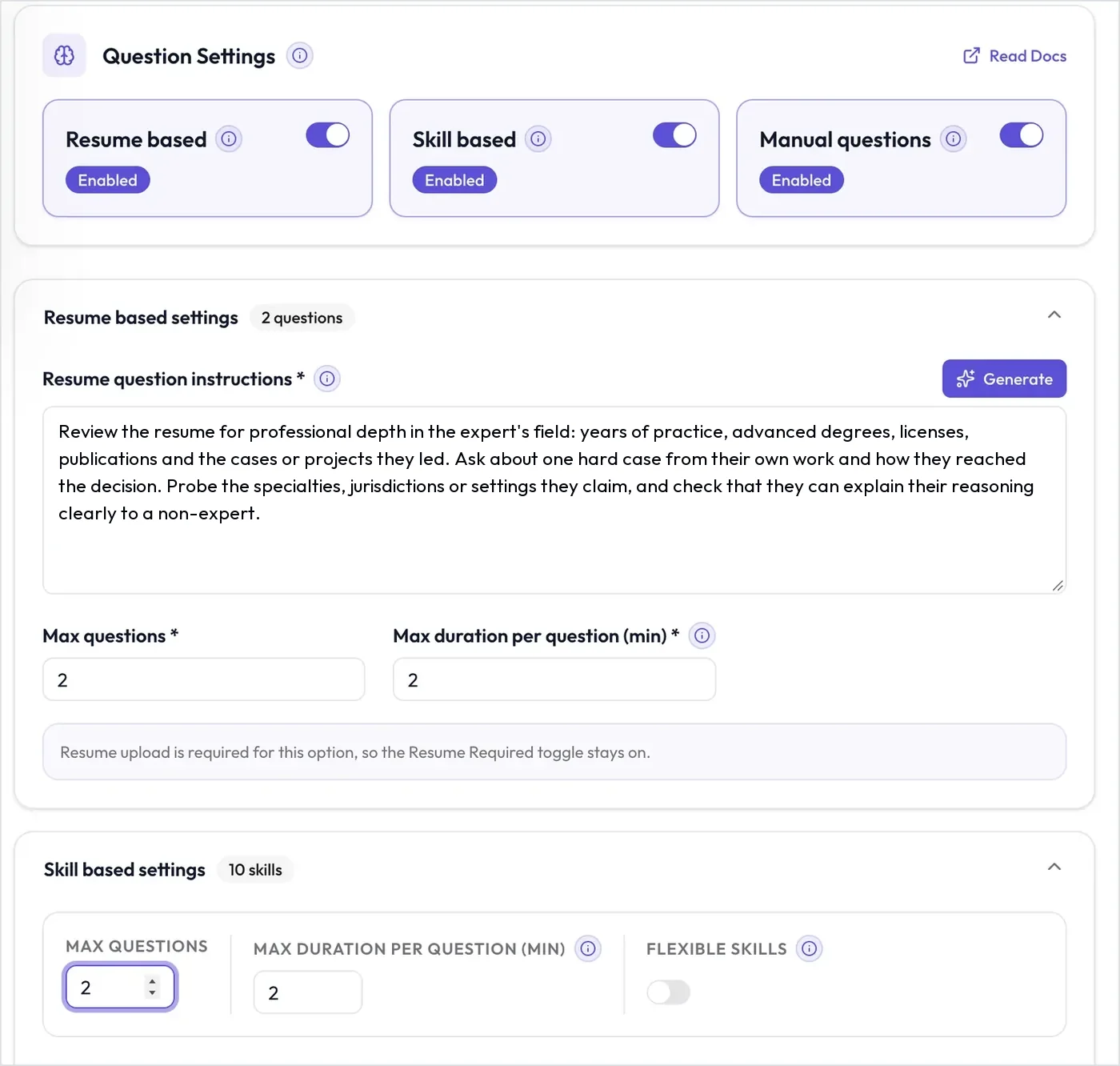
- Domain depth. Add skill-based questions for up to 25 skills, with instructions on what to probe. The AI follows up when an answer stays general.
- Their own work. Resume-based questions ask about the applicant's actual cases, deals or code, which is hard to bluff.
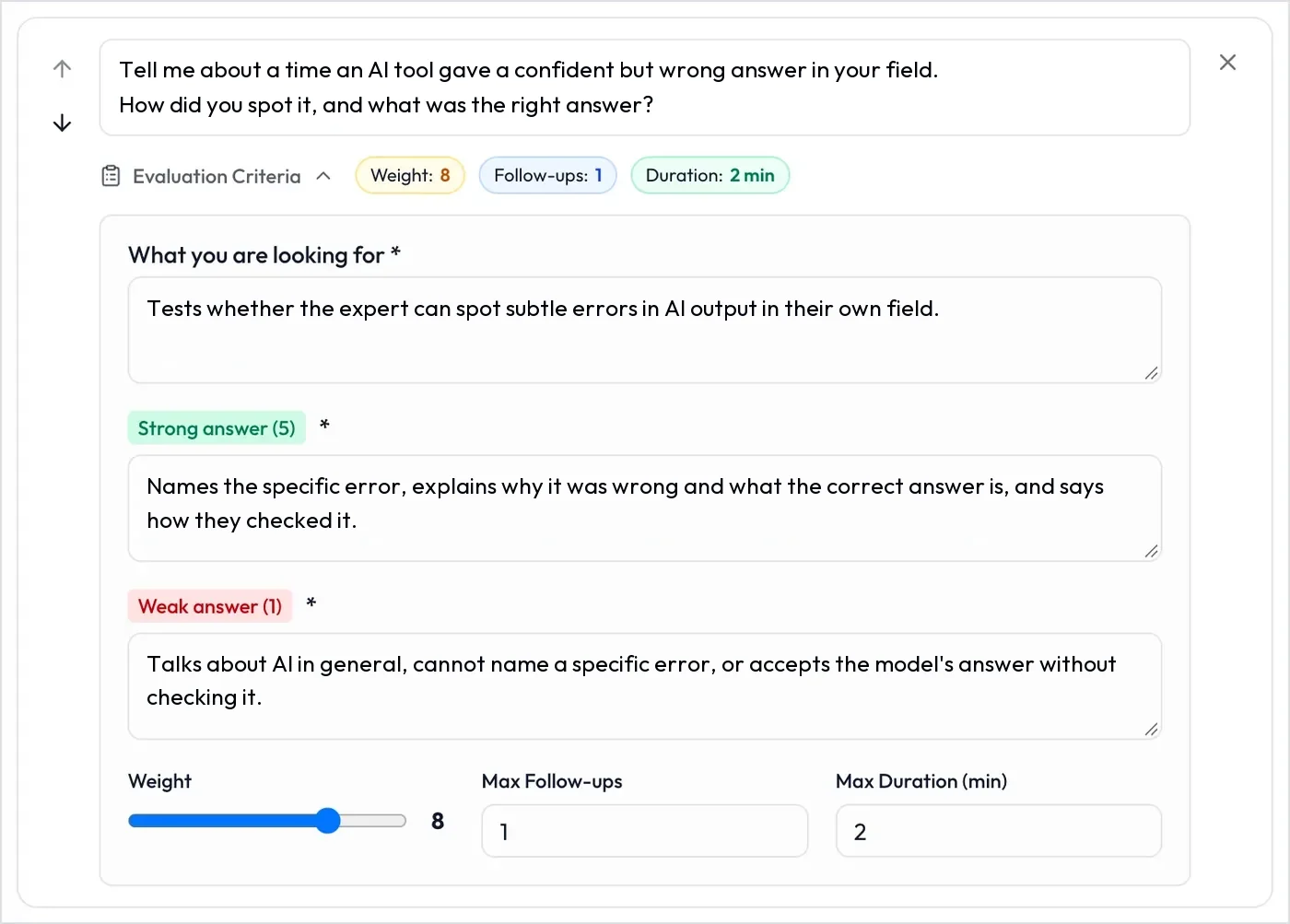
- Your own rubric. Manual questions get what you are looking for, a strong and a weak answer, a weight from 1 to 10, and up to two follow-ups.
- A length that fits. Interviews run 10 to 60 minutes. About seven questions fit in 15 minutes.
- Language roles. Set the interview language for each Interviewer. The AI scores language proficiency on grammar, vocabulary, communication effectiveness and conversational flow, from 1 to 5.
- Integrity. Require video and turn on a trust score that combines answer-authenticity checks, tab switching, and eye and face detection. You can also block second screens. Integrity signals are for review, not proof.
- A practice run first. An equipment check tests the camera, microphone and speaker, and offers a 60-second practice.
Each report includes the recording, a searchable transcript, an AI summary with strengths and red flags, and every question's score with the AI's reasoning. See the AI interviewer.
AI trainer interview questions to ask
These questions ask applicants to reason through real work. That shows expertise better than a list of credentials. Pick five or six for a 15-minute interview, and add skill-based questions for the domain.
| Question to ask | What it tests | A strong answer includes |
|---|---|---|
| Tell me about a time an AI tool gave a confident but wrong answer in your field. How did you spot it? | Error spotting | A specific error, why it mattered, and what the right answer was |
| How would you write a rubric to grade answers to a common task in your field? What separates a 5 from a 3? | Rubric thinking | Clear criteria someone else could check, and the details an expert weighs most |
| Walk me through a hard case from your own work. What did you need to know that wasn't given at first? | Real expertise | A specific case, the missing information, and how it changed the decision |
| Two experts grade the same answer differently. How do you settle it? | Calibration | Goes back to the rubric and the evidence, and asks when the guidelines are unclear |
| Describe a question in your field that a strong AI model would still get wrong. Why would it fail? | Task design | A realistic question, a clear reason, and the correct answer |
| How do you stay consistent after grading 50 similar answers in a row? | Attention to detail | Breaks, a checklist, and spot checks of their own earlier work |
| The guidelines don't cover the case in front of you. What do you do? | Judgment | Makes a reasoned call, notes why, and asks for the guideline to be clarified |
| Which parts of your field change by country or jurisdiction, and which have you worked in? | Scope of expertise | Specific settings or jurisdictions, and honest limits |
| How many hours a week can you commit, and in which time zone? | Availability | Exact hours, with other commitments stated openly |
| What do you never paste into an AI tool at work? | Confidentiality | Client data, patient details and anything under a confidentiality agreement |
Hiring entry-level annotators instead? See data annotation hiring, which pairs a guideline test with a shorter interview. To use these questions in InterviewFlowAI, add each one as a manual question. Put "What it tests" into What you are looking for and the strong answer into Strong answer (5), then describe a weak answer.
Review the pool and staff projects
- Sort and filter. Filter by overall score, completion date, tags and a minimum score on any question, such as 4 on clinical reasoning. Filters also apply to CSV exports.
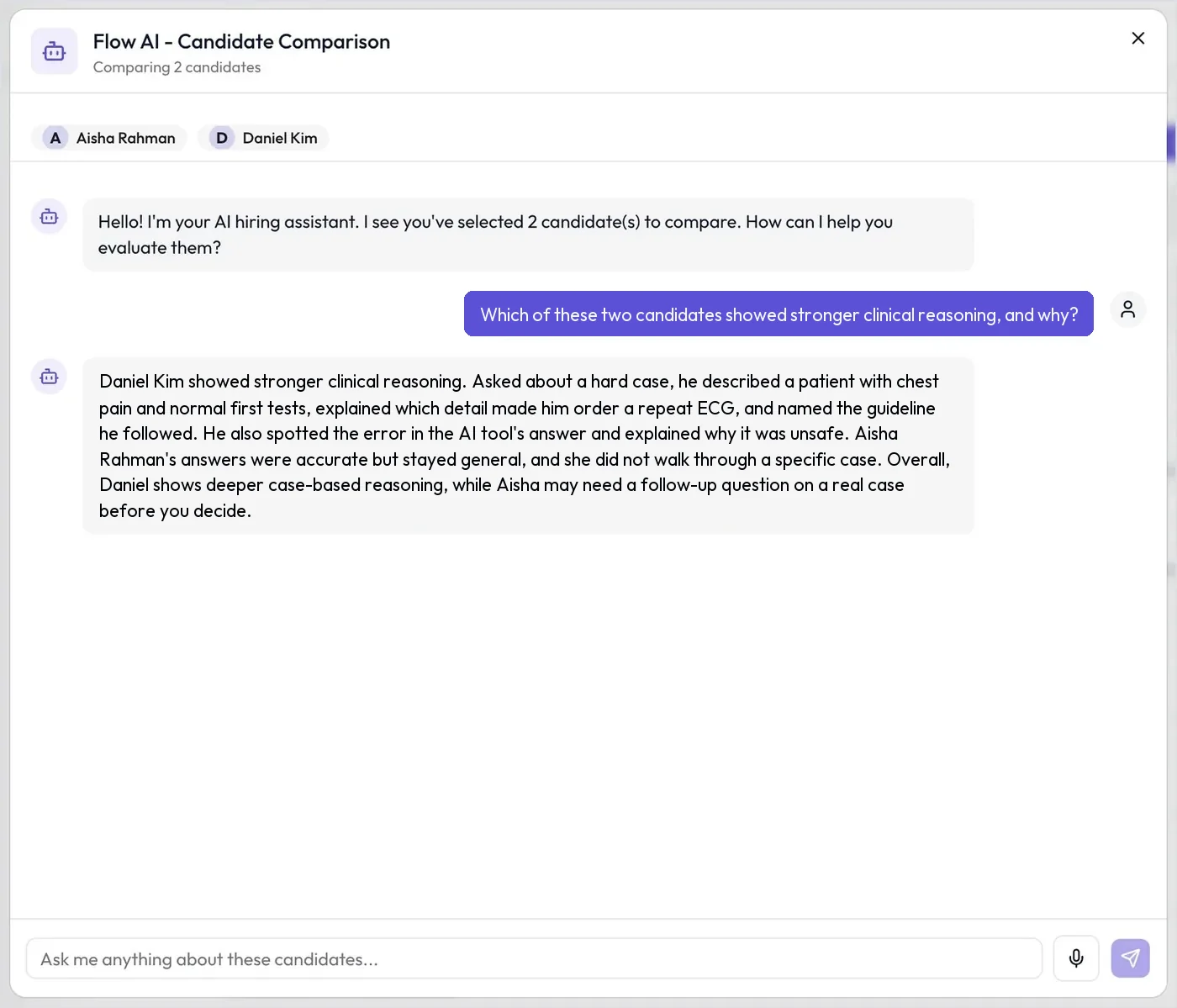
- Compare finalists. Ask FlowAI compares up to 10 candidates side by side. It never shortlists or rejects anyone.
- Tags from the conversation. The AI fills in candidate tags from each interview, such as specialty or time zone, so you can filter by them.
- Your pipeline. Add custom stages such as "Project ready" or "Onboarding", each with an approved email. Coordinator sends your booking link to anyone who reaches your pass score.
- Your own platform. Use the API and webhooks to bring scores and reports into your own system, or connect Greenhouse, Ashby, Teamtailor, Workable, Recruit CRM or Zapier.
Example: building a physician pool for a model evaluation project
An AI data company needs 40 US-licensed physicians to grade a medical model's answers for six weeks. It expects more medical projects after that.
| Stage | Example settings |
|---|---|
| Application | Must-have questions: licensed to practice in the US (yes/no), years in clinical practice (numeric, minimum 3) and can commit 15 hours a week (yes/no). Portfolio link required for a profile or publication list. |
| Resume screening | Must-haves for a medical degree and current clinical practice, with automatic decline when one is missing. |
| Written test (optional) | A timed skill assessment with one long answer: grade a sample model answer against a five-point rubric. Your team reads it. |
| AI interview | English, 25 minutes, video required, one retake, link open for 90 days. Skill-based questions on clinical reasoning, medication safety and triage, plus five manual questions from the list above. |
| Proctoring | Trust score with answer authenticity, tab switching, and eye and face detection. Second screens blocked. |
| Staffing | Filter for an overall score of 80 or above and at least 4 out of 5 on clinical reasoning. Compare borderline candidates with Ask FlowAI, then move the 40 chosen physicians to a "Project ready" stage. The rest stay in the pool for the next project. |
Frequently asked questions
Can we run AI interviews the way Mercor and micro1 do?
Yes, for your own applicants. Create an Interviewer for each expert pool, list the skills to test and share one link. Every applicant gets the same structured interview with follow-up questions, and you review the scores, recordings and transcripts.
How long should an AI interview for experts be?
Long enough to cover each skill. Mercor's interview takes about 20 minutes, and micro1's takes 20 to 40 minutes, depending on how many skills it covers. In InterviewFlowAI you set 10 to 60 minutes. About seven questions fit in 15 minutes.
How do we test real expertise instead of a good resume?
Ask about their own work and make them reason. Resume-based questions probe their actual cases or code. Skill-based questions follow your instructions for each domain, and the AI follows up when an answer stays general. Add a written test if the project needs one.
How do we stop applicants from using ChatGPT during the interview?
The interview is spoken, so applicants have to reason out loud. Turn on proctoring for a trust score from answer-authenticity checks, tab switching, and eye and face detection. You can also require video and block second screens. These are signals to review, not proof. Availability varies by plan.
Can one interview link stay open for a standing talent pool?
Yes. A link can stay open for up to 365 days. Keep one Interviewer open for each domain. When a project starts, filter the pool by score, tags and key questions instead of interviewing everyone again.
Can applicants retake the interview?
Only if you allow it. Retakes are off by default, and you can allow one to three.
Can we hire experts in other countries and languages?
Yes. Applicants take the interview whenever it suits them, in any time zone. You set the interview language for each Interviewer, and reports include an English transcript for reviewers.
Can InterviewFlowAI verify an expert's identity or license?
No. InterviewFlowAI doesn't verify identity documents or professional licenses. Require video so every interview is recorded, and check IDs and licenses during onboarding.
Can results go into our own expert platform?
Yes. The API and webhooks bring scores, reports and candidate progress into your own system. You can also export filtered candidates as a CSV or connect Zapier. Feature availability varies by plan.
Is InterviewFlowAI a marketplace like Mercor?
No. Mercor and micro1 find, vet and manage experts for AI labs. InterviewFlowAI is software for your own hiring. You bring or source the applicants, run the interviews and keep the expert pool.
Related use cases
Build your expert pool before the next project starts
Set up one Interviewer per domain, share one link, and staff each project from a scored pool. Feature availability varies by plan, so see the pricing page. For role-specific questions, see AI interviews for software engineers, data scientists and financial analysts. Hiring across countries? Read about global hiring.