AI assistants can now listen to an interview question, draft an answer, and place it on a candidate's screen within seconds. That creates a genuine verification problem for remote hiring. It does not permit recruiters to treat every pause or off-screen glance as proof of dishonesty. Effective AI interview cheating detection combines platform activity, consistency across answers, adaptive follow-up questions, and human review.
The goal is to find interviews that need a closer look, then verify whether the candidate can explain and apply the knowledge they presented.
That distinction matters. A detection system should produce evidence for review, not a verdict. This guide explains what counts as unauthorized AI assistance, which signals are useful, how to reduce false accusations, and how InterviewFlowAI's Trust Score fits into a practical hiring workflow.
Quick answer: how do companies detect AI interview cheating?
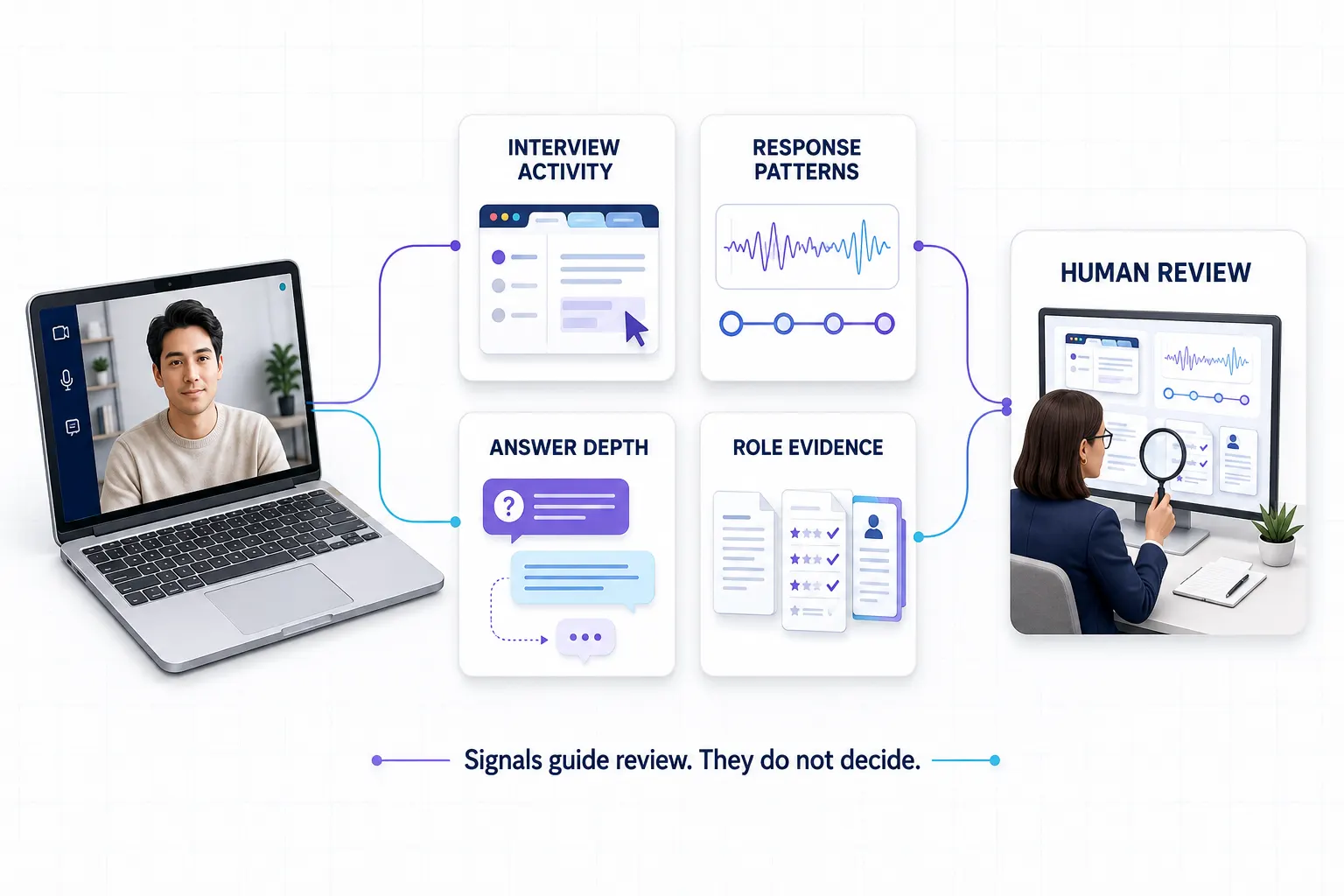
Companies look for a pattern across several kinds of evidence:
Interview activity, such as repeated tab changes or copy-paste events
Response patterns, including unusual timing or contradictions across related questions
Answer depth, especially whether a candidate can explain a choice when the interviewer changes the scenario
Role evidence from the transcript, recording, scorecard, resume, and a follow-up assessment
One signal is rarely enough. A flagged event should tell a recruiter where to look, not whom to reject.
What counts as AI interview cheating?
Using AI before an interview is not automatically dishonest. Candidates routinely use it to research an employer, practise likely questions, translate their experience, or turn real examples into clearer notes.
The boundary depends on what the interview is meant to measure and what the employer has allowed.
| Candidate behavior | Usually acceptable? | What the employer should clarify |
|---|---|---|
| Practising with AI before the interview | Yes | Preparation is different from receiving live answers. |
| Using notes that the employer has allowed | Yes | State whether notes can be digital, handwritten, or both. |
| Using an approved accessibility tool or accommodation | Yes | Give candidates a clear way to request an accommodation before the interview. |
| Using AI during an open-book or AI-enabled assessment | Yes, when permitted | Assess how the candidate prompts, checks, and improves the output. |
| Secretly reading answers generated during the interview | Usually no | State that real-time external answer generation is not permitted for an independent screen. |
| Claiming experience or results the candidate cannot explain | No | Evaluate the underlying evidence, not whether the language merely sounds polished. |
Clear rules are still missing from many hiring processes. In Greenhouse's 2025 survey of 2,200 active job seekers in the US, UK, and Ireland, 45% said they used AI to prepare for interviews, while 27% said they had never seen an employer policy on AI use in hiring. The same research found that 28% admitted using AI to generate fake work samples. Those are different behaviors, and a useful policy should treat them differently. Read the Greenhouse survey summary.
Seven signals that warrant a closer look
A signal is a reason to inspect the evidence. It is not proof on its own.
| Signal | Why it may matter | Innocent explanation to check | Useful next step |
|---|---|---|---|
| Repeated tab or window focus changes before substantive answers | The candidate may be searching for or receiving an answer. | A notification, technical issue, or permitted reference material caused the switch. | Review the timing and frequency. Ask what resources were used. |
| Copy-paste activity in a response field | The answer may have come from an external source. | The candidate pasted a permitted code snippet, accessibility aid, or prepared detail. | Compare the pasted material with the rules given before the interview. |
| The same delay before almost every answer | A tool may be transcribing the question and generating a reply. | Audio lag, interpretation time, anxiety, or a second-language response can create a pause. | Check whether the delay changes when the question becomes personal or highly specific. |
| A polished first answer that loses depth under follow-up | The opening response may be scripted or generated. | The candidate may be nervous or unfamiliar with the follow-up format. | Ask for a real example, constraint, trade-off, or failure from the same situation. |
| Contradictions across related questions | The candidate may be repeating generated answers without a stable account of the experience. | The original question was ambiguous, or the candidate corrected an earlier mistake. | Put the two statements side by side and invite clarification. |
| Claimed expertise that cannot support basic reasoning | The resume and interview performance may not describe the same capability. | The candidate knows the work but struggles with terminology or recall under pressure. | Use a short job-related scenario or explain-back question. |
| A repeated pattern across the full interview | Several aligned signals are more informative than one isolated event. | The interview design itself may be causing the pattern across many candidates. | Compare flag rates by question and review whether the prompt needs to change. |
Eye movement alone is a poor shortcut. People look away while recalling information, reading captions, monitoring a child, or managing a disability. A rigid rule about eye contact can punish honest candidates without telling you whether they can do the job.
Why screen sharing and gut instinct are not enough
Standard video-call software shows the camera feed, audio, and whatever the candidate chooses to share. It does not give the interviewer a complete view of a second device, an off-screen helper, or every application running on the computer.
Screen sharing can add useful context during a coding or work-sample exercise, but it should not become the entire detection strategy. Hidden overlays and second devices can avoid it. More importantly, an interviewer who expects to catch cheating by watching someone's eyes will create inconsistent decisions and more false accusations.
A stronger process asks two questions:
Did the interview produce a pattern that deserves review?
Can the candidate demonstrate the same capability when asked to explain, adapt, or apply it?
The second question is usually more useful. Hiring is meant to verify job capability, not reward the best attempt at surveillance.
How InterviewFlowAI's Trust Score works
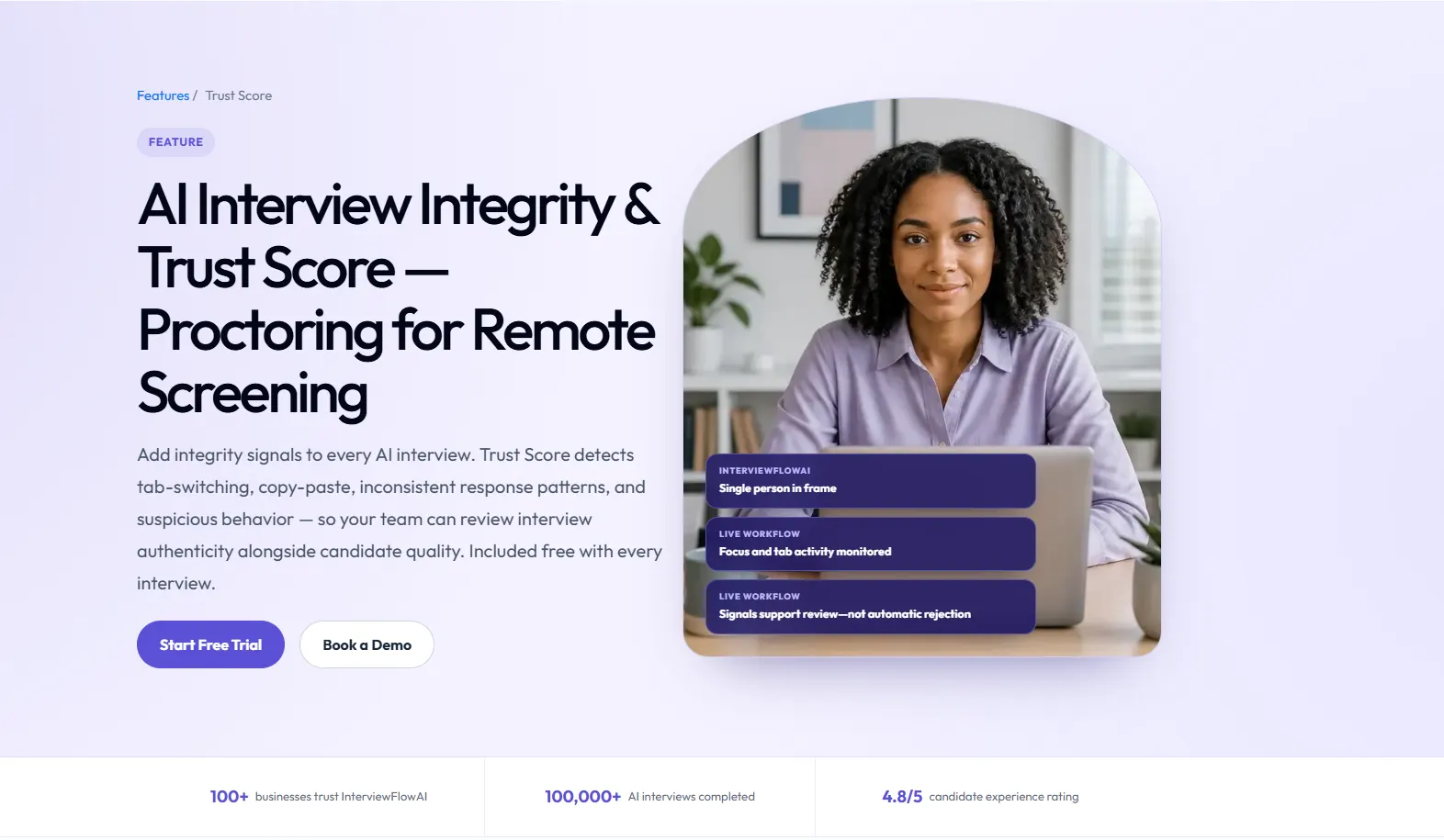
InterviewFlowAI's Trust Score is built into the interview workflow. It records applicable integrity indicators such as tab and window focus changes, copy-paste activity, response timing patterns, and inconsistencies across related questions. The resulting signals appear beside the candidate's competency scorecard.
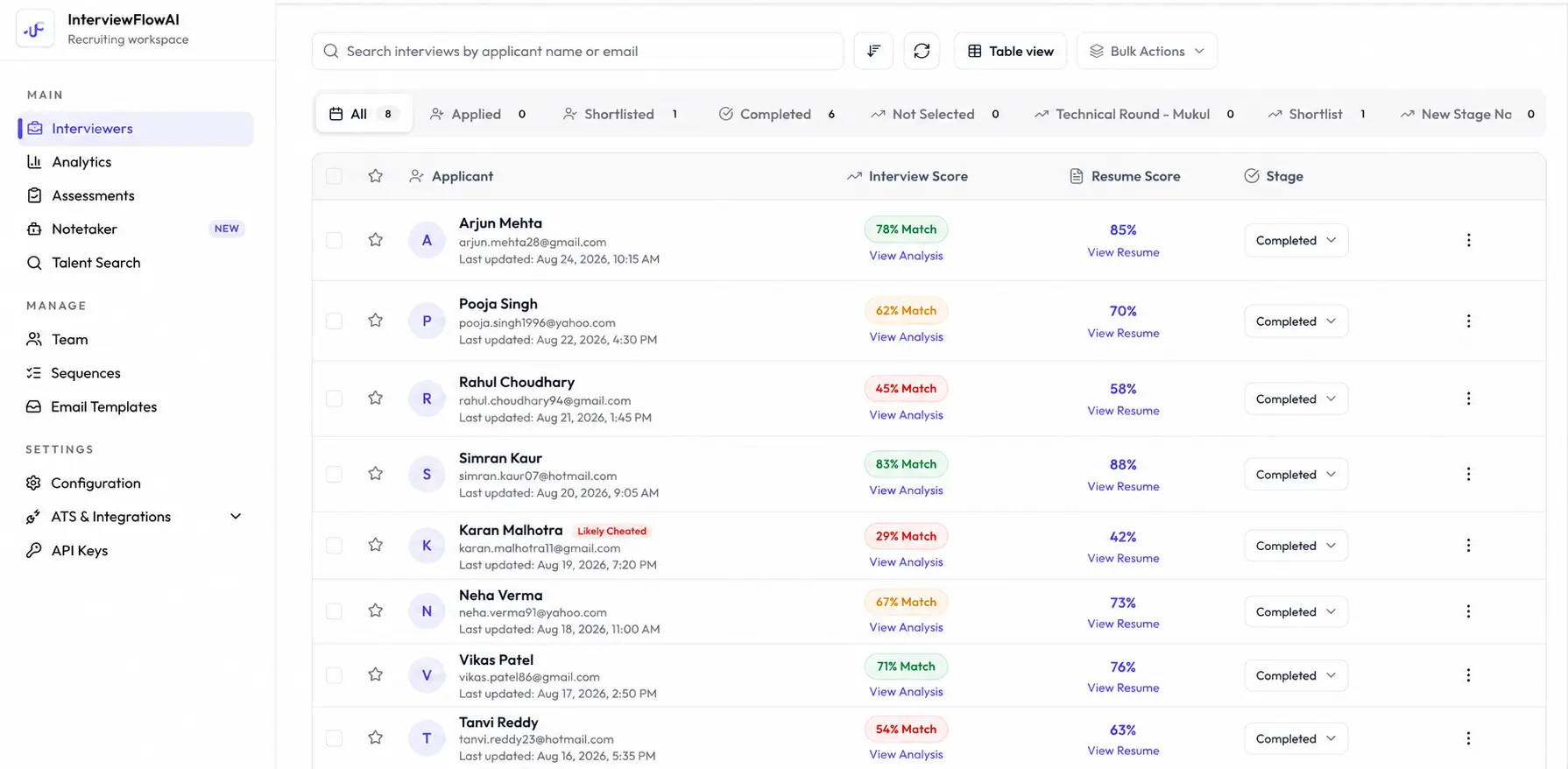
Recruiters can review a timestamped integrity timeline, open the relevant part of the recording or transcript, and compare the flag with the answer itself. Trust Score is included with every InterviewFlowAI interview.
Trust Score is not a lie detector. It does not turn one event into an automatic rejection. Its practical job is narrower: help a recruiter find the interviews and moments that deserve closer review.
What to do when an interview receives a low Trust Score
1. Open the event, not just the score
Check which signal affected the result and when it occurred. Five focus changes spread across a forty-minute interview mean something different from five changes immediately before five technical answers.
2. Compare the flag with the answer
Read the transcript around the event. Does the answer contain a specific example the candidate can reasonably own, or does it repeat broad language from the job description? Does the next answer support it or contradict it?
3. Look for an aligned pattern
A tab change plus a long delay plus a generic answer that collapses under a follow-up is more informative than any one of those signals. If the only issue is a single focus loss, record it and keep evaluating.
4. Give the candidate a proportionate way to verify the skill
Use a short follow-up conversation, a live explain-back, or a job-related work sample. Ask the candidate to apply the same idea to a changed constraint. The follow-up should test the capability in question, not force the candidate to prove innocence against a vague accusation.
5. Document the decision
Record the signal, the evidence reviewed, any explanation, and the job-related reason for the final decision. This makes the process easier to audit and prevents each recruiter from inventing a different standard.
NIST's AI Risk Management Framework recommends defining the roles of people and AI systems in oversight and decision-making. In this workflow, the software points to evidence; the recruiter remains responsible for interpreting it. Review the NIST AI Risk Management Framework.
How to make interviews harder to script
Detection helps after a suspicious pattern appears. Better interview design reduces the value of a generated answer in the first place.
Replace generic prompts with questions that require owned detail. Instead of asking, “How do you handle a difficult stakeholder?” ask:
“Tell me about one decision a stakeholder opposed. What did they want, what did you recommend, and which result changed their mind?”
Then change one condition:
“Assume the stakeholder still says no, and the deadline cannot move. What would you do next?”
Useful follow-ups ask for numbers, constraints, alternatives, mistakes, and the candidate's exact contribution. A person drawing on real experience can usually move around inside the example. A prepared answer becomes less useful once the facts change.
Conversational AI interviews can apply this approach consistently. InterviewFlowAI asks follow-ups based on the candidate's answer instead of moving through a fixed list of one-way prompts. The recruiter still reviews the transcript and evidence before deciding who advances.
Other practical changes include:
Tell candidates which tools and reference materials are allowed.
Ask candidates to explain their reasoning, not only state an answer.
Use a short, role-relevant work sample when the role requires demonstrable output.
Rotate scenarios while keeping the same scoring criteria.
Check whether one question triggers unusual behavior across many candidates.
Reduce cheating without punishing honest candidates
Interview integrity and candidate fairness are the same operational problem. A process that catches more suspicious behavior but rejects qualified people for accessibility, language, or technical reasons has not improved hiring quality.
Before using interview monitoring or an automated score:
Explain what the interview records and how the information will be used.
Publish the AI and reference-material policy before the candidate begins.
Provide an accommodation route and a workable alternative where appropriate.
Keep a person responsible for reviewing flags and changing the outcome.
Audit flag and progression rates across roles and relevant candidate groups.
Set retention and access rules for recordings, transcripts, and integrity events.
The US EEOC has warned that AI-enabled employment tools can unlawfully screen out people with disabilities when employers do not provide proper safeguards and reasonable accommodations. Read the EEOC and DOJ technical assistance.
Legal duties vary by location and by how the tool influences the decision. For example, New York City's rules for automated employment decision tools address bias audits and candidate notice in covered uses, while Illinois has specific requirements for employers that ask applicants to record video interviews and use AI analysis. Review the NYC DCWP guidance and the Illinois Artificial Intelligence Video Interview Act, then take advice for the locations where you hire.
Frequently asked questions about AI interview cheating detection
Can Zoom or Google Meet detect a candidate using ChatGPT?
Not reliably on their own. A video-call platform shows what is visible, audible, or deliberately shared. It does not automatically produce a defensible AI-cheating verdict. Use role-specific follow-ups and, where appropriate, an interview platform that records relevant integrity events for human review.
Can interviewers tell when a candidate is reading an AI answer?
They may notice a repeated pattern, such as the same delay before each answer, unusually polished but generic language, and difficulty answering a specific follow-up. None of those behaviors proves AI use by itself. Review several signals and verify the underlying capability.
Is using AI during a job interview always cheating?
No. Preparation, employer-permitted tools, and disclosed accessibility support are different from secretly generating answers during a stage intended to test independent ability. State the rules before the interview so the candidate does not have to guess.
What does InterviewFlowAI's Trust Score detect?
The published feature covers signals including tab and window focus changes, copy-paste activity, unusual response timing, and consistency across related answers. The signals appear with the candidate's interview evidence so a recruiter can decide whether closer review is needed.
Should a low Trust Score automatically reject a candidate?
No. Trust Score is a review-prioritization signal, not a pass/fail judgment. Inspect the flagged event, compare it with the transcript and competency evidence, consider an innocent explanation, and use a proportionate follow-up when doubt remains.
Can AI interview cheating detection produce false positives?
Yes. Internet delay, anxiety, disability, second-language processing, permitted notes, notifications, or a confusing question can resemble suspicious behavior. That is why one event should not decide the outcome and why teams should audit whether certain questions or candidate groups are flagged more often.
Is AI interview proctoring legal?
The answer depends on the location, the data collected, the notice and consent process, and how the output affects an employment decision. Some jurisdictions regulate AI-analyzed video interviews or automated employment decision tools. Treat the product documentation as operational guidance, not legal advice, and review the rules that apply to your hiring locations.
Use integrity signals to ask better questions
AI interview cheating detection works best when it improves the quality of review. A score can point to a timestamp. It cannot decide whether a candidate has the judgment, experience, or skill the role requires.
Set the rules before the interview. Ask questions that require specific, owned evidence. Review patterns instead of isolated behavior. When doubt remains, give the candidate a fair way to demonstrate the same skill in another format.
InterviewFlowAI brings those steps into one workflow with two-way AI interviews, transcripts, competency scorecards, and Trust Score signals. Proctoring and cheat detection are included with every interview at the current published price of $0.99 per interview.