A polished resume used to count as a mild positive. It suggested care, communication skills, or at least enough interest to tailor an application. AI-generated job applications have weakened that inference. A candidate can now turn a generic resume into a fluent, keyword-matched document in minutes. The experience behind it may be real, exaggerated, or fabricated, but the writing alone will not tell you which.
That does not make every candidate who uses AI dishonest. Plenty of people use it to fix grammar, translate experience, or express work they genuinely did. The hiring problem is more specific: employers are receiving more polished applications while finding it harder to verify the claims inside them. A prose detector will not fix this. The hiring process has to rely less on polished self-description and more on job-related evidence.
The Application Flood is Measurable
Recruiters are not imagining the increase.
Greenhouse analyzed more than 640 million applications from over 6,000 companies between 2022 and 2025. Its benchmark found that the average number of applications per job rose from 116 to 244, an increase of 111%. Over the same period, the average recruiting team shrank by 56% and time to fill increased by 37%. The pressure is coming from both directions: more applications and fewer people available to review them. See the Greenhouse hiring benchmarks.
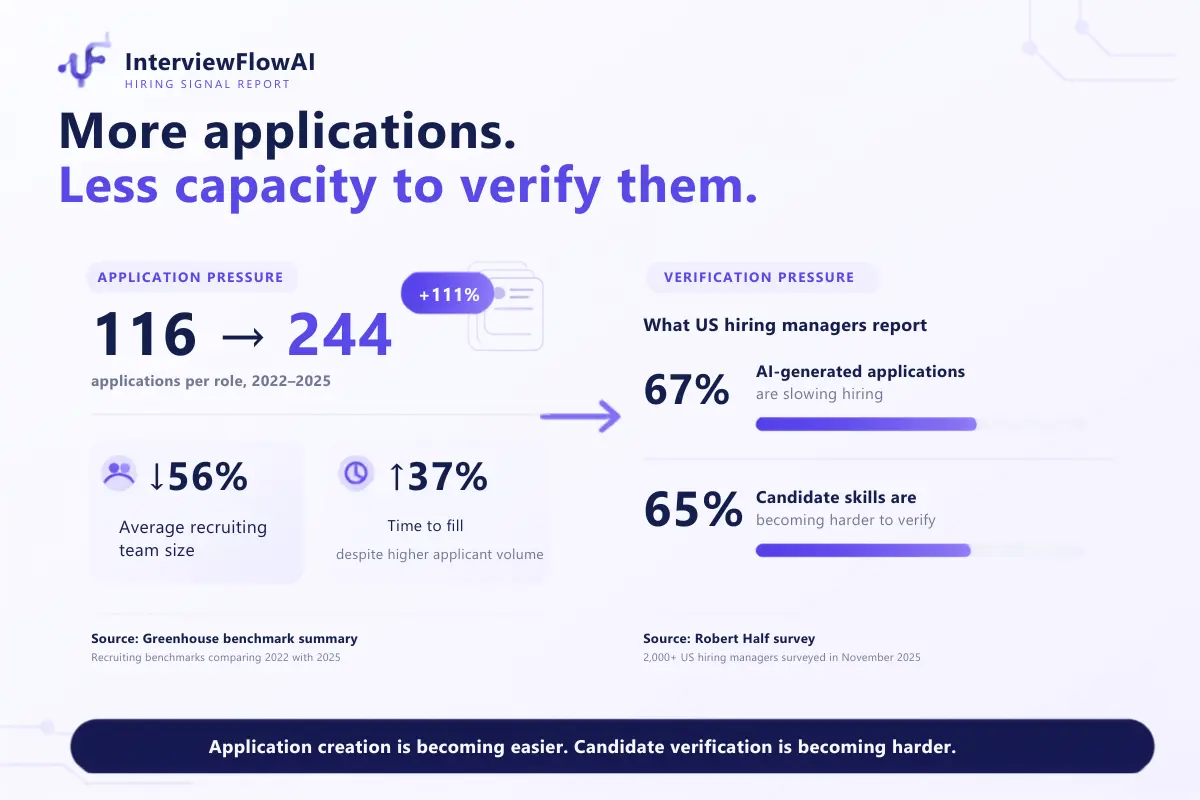
AI has made each application easier to produce, but it has not made each one easier to trust. In a November 2025 survey of more than 2,000 US hiring managers, 67% told Robert Half that reviewing AI-generated applications had slowed hiring. 20% reported delays of more than 2 weeks. Meanwhile, 84% of HR leaders said workloads had increased, and 65% of hiring managers said AI-enhanced resumes made it harder to verify candidates' skills. Read the Robert Half survey and methodology.
The numbers show up in recruiters' day-to-day language too. One recruiter described receiving 150 applications within an hour for an AI engineering role and nearly 900 by the end of the first day. Another asked how to judge applications when every resume now looks polished. These are individual accounts, not labor-market estimates, but they capture the operational problem clearly: application volume is rising faster than verification capacity. Read the recruiter discussion about application volume and the discussion about uniformly polished resumes.
Hiring teams have responded by making rejection cheaper and more frequent. They add knockout questions, keyword rules, or another ranking model. That can reduce the pile, but it may also bury qualified people more efficiently. In Greenhouse's 2025 AI in Hiring survey, only 21% of US recruiters and hiring managers were very confident that their systems were not rejecting qualified candidates. The survey covered 4,136 respondents across the US, UK, Ireland, and Germany. Review the Greenhouse findings.
That is a strange place to land. The application looks better, but the recruiter knows less.
AI Use & Candidate Dishonesty Are Not The Same Thing
Any useful response has to begin with this distinction. AI assistance exists on a spectrum.
| Candidate use of AI | What it may mean | A proportionate employer response |
|---|---|---|
| Correcting grammar or translating experience | The underlying claim may be entirely genuine | Evaluate the experience, not the writing style |
| Reorganizing a resume for a specific role | The candidate is making relevant experience easier to find | Ask for concrete examples and outcomes |
| Drafting a cover letter from real experience | The prose is assisted, but the evidence may still be sound | Verify the examples during screening |
| Adding skills, employers, or results that are not real | The application contains a substantive misrepresentation | Check contradictions and request job-related evidence |
| Auto-applying without reviewing role fit | The application may reflect convenience rather than intent | Use clear eligibility questions and explain the next step |
| Hiding instructions intended to manipulate an AI reviewer | The candidate is attempting to influence the screening system | Treat it as an integrity and process-security issue |
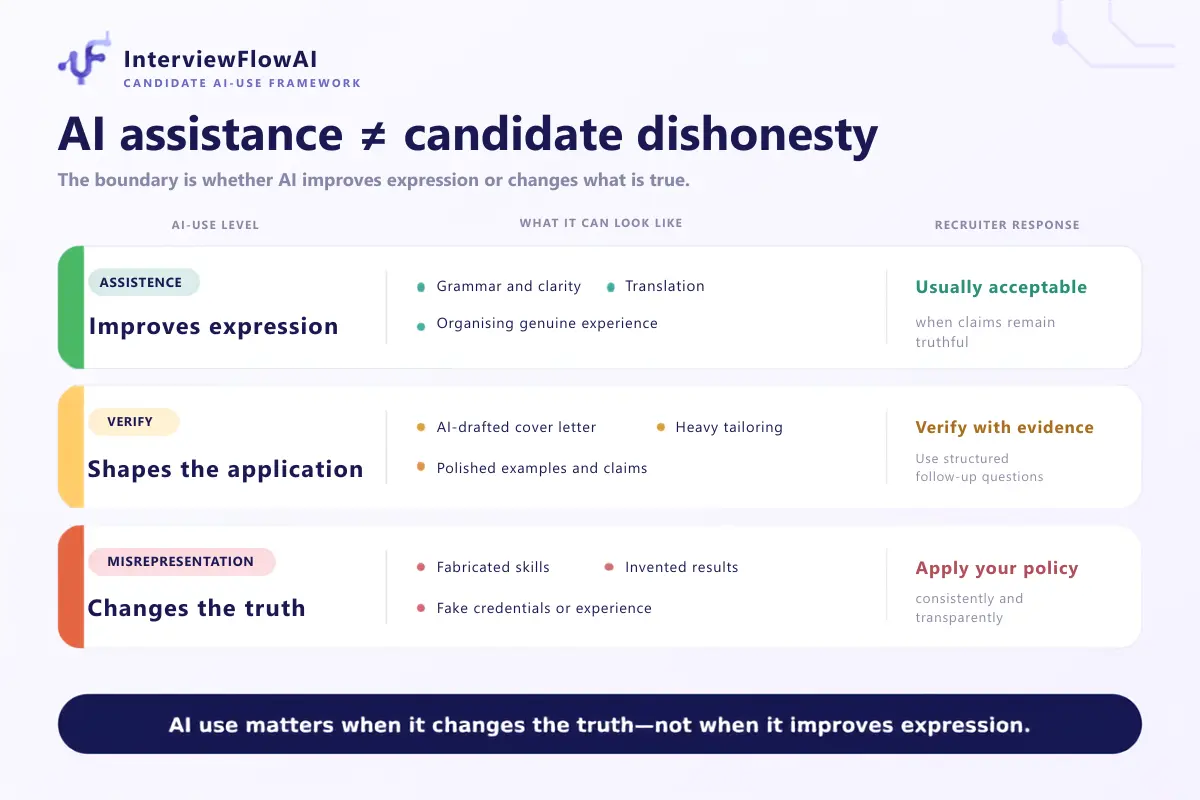
Robert Half makes the same caution explicit: not all AI-generated applications are inaccurate or misleading. This matters because a policy built around catching AI wording will punish responsible use while doing little to expose a well-written fabrication.
It can also create accessibility problems. A candidate may use AI because they are writing in a second language, managing dyslexia, or translating technical work into recruiter-friendly language. None of those uses tells you whether they can do the job. Recruiters should stop asking, “Was this resume written by AI?” The useful question is, “Which claims matter for this role, and what evidence would make those claims credible?”
That is also the practical next step in skills-first hiring. A resume can point toward capability. It should not be asked to prove capability on its own.
Why More AI Resume Scoring Cannot Fully Solve the Problem
The obvious response to AI-written applications is to add more AI screening. Sometimes that helps. It can organize large pools, check minimum requirements, and surface information a recruiter would otherwise miss.
The limitation appears when one model writes the application and another model judges it. The pipeline can start rewarding stylistic compatibility instead of stronger experience.
A 2025 controlled study examined 2,245 human-written resumes and generated counterfactual versions with several large language models. Each version described the same underlying candidate. In simulated screening pipelines covering 24 occupations, candidates whose resumes were generated by the evaluator model were 23% to 60% more likely to be shortlisted than candidates with the equivalent human-written version. Read the AI self-preferencing study.
This was a controlled experiment and simulation, not a field trial inside an employer's live ATS. It does not prove that every commercial resume screener behaves this way. It does show a structural risk: when AI creates and evaluates the same kind of artifact, fluent phrasing can become a hidden selection advantage.
Resume scoring remains useful when its job is narrow and visible. It becomes risky when a team treats one opaque score as a complete judgment of capability.
Our guide to AI candidate screening uses a simple boundary: AI can collect, structure, and prioritize evidence. A human should remain responsible for interpreting that evidence and deciding who moves forward.
The Resume Is Now A Routing Document
The resume still has a job. It is simply a narrower one. It still helps answer basic questions:
Has the candidate worked in a relevant environment?
Do they meet a licence, location, or work-authorization requirement?
Is there enough role overlap to justify collecting more evidence?
Which experience deserves a follow-up question?
Those are routing questions. They help a recruiter decide what to verify next. They are different from deciding who is the best candidate. A more reliable funnel separates four kinds of signal:
| Signal level | Example | Best use |
|---|---|---|
| Declared | Resume, application answer, cover letter | Route candidates and identify claims to verify |
| Demonstrated | Structured interview answer, role-play, work sample | Observe how the candidate applies knowledge |
| Corroborated | Portfolio, reference, credential check, prior result | Confirm important claims where appropriate |
| Judged | Recruiter and hiring-manager review against a shared rubric | Decide who advances and document why |
Problems begin when a team collapses all four levels into a resume score and calls the result a hiring decision.
A 5 Step Process To Recover the Hiring Signal
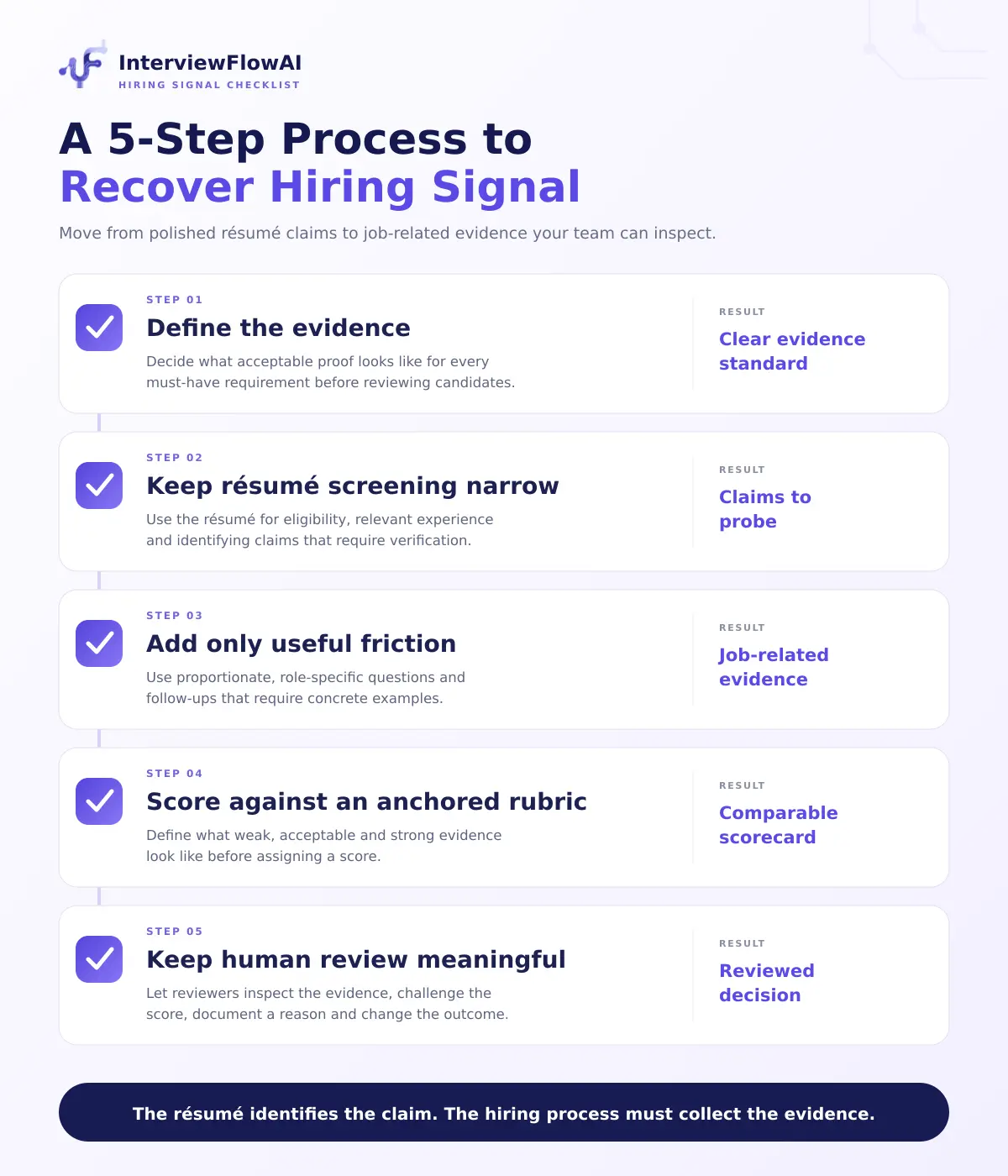
1. Define the evidence before applications arrive
Start with the job, not the applicant pool. For each must-have requirement, write down what acceptable evidence would look like.
“Strong stakeholder management” is too vague. A better definition might be: the candidate can describe a disagreement with a senior stakeholder, explain the trade-off, show what they did, and name the outcome.
This step prevents the team from changing its standards after seeing a charismatic resume or a familiar employer name. It also gives any screening tool a clearer task.
2. Keep resume screening narrow
Use the resume to confirm minimum eligibility, map relevant experience, and decide which claims need probing. Avoid turning minor wording differences into precise scores.
For a customer-support role, the resume may show experience with ticketing tools and difficult customers. It cannot tell you how the person responds when an angry customer rejects the first solution. That requires a question, a scenario, or a work sample.
3. Add only the friction that produces evidence
Some friction improves a hiring process. A short, role-specific screen asks the candidate to invest enough effort to demonstrate interest and capability. It gives the employer evidence that a one-click application cannot provide.
The friction should stay proportionate to the stage. A candidate should not complete a two-hour assignment before learning the salary or speaking to a person. For many early screens, a focused conversation with a clear time estimate and an accommodation path is enough.
Questions should make generic AI answers less useful by asking for specifics:
“You mentioned reducing ticket backlog. What was the starting volume, what did you change, and what happened over the next month?”
“A customer says they have already tried your suggested fix twice. What would you say next?”
“Which part of this role would take you the longest to learn, and why?”
Follow-up questions matter because rehearsed language often stays broad. Evidence appears when the candidate has to explain a choice, recall a constraint, or respond to a realistic change in the scenario.
4. Score the evidence against an anchored rubric
The US Office of Personnel Management notes that more structured interviews tend to produce higher validity, rater reliability, and agreement between raters. The useful ingredients are job-related questions, a consistent process, and defined standards for evaluating responses. See OPM's guidance on structured interviews.
An anchored rubric describes what weak, acceptable, and strong evidence look like. It is much more useful than asking an interviewer to rate “communication” from one to five with no shared definition.
5. Keep human review meaningful
A person in the loop should do more than approve a recommendation. They need enough context to challenge the score, inspect the underlying answer, and change the outcome.
The UK's Information Commissioner's Office has made automated decision-making in recruitment a regulatory focus. Its recruitment audits call for meaningful human checks and formal review of AI outputs. Read the ICO's recruitment findings.
In practice, meaningful review means the recruiter can see why a candidate received a score, locate the answer behind it, compare that evidence with the rubric, and document an override. If the system only presents a ranking, the human is being asked to trust the machine rather than review its work.
What The Early Field Evidence Says
The case for collecting new evidence, instead of repeatedly scoring the resume, is beginning to move beyond theory.
An August 2026 preprint studied two field experiments on a recruitment platform. Candidates shortlisted with an AI interview report passed a later human interview at rates 17.5 to 20 percentage points higher than candidates shortlisted from resumes alone. The final human interviewers were blind to the earlier shortlisting condition. The report added more predictive information for junior candidates, whose resumes often contain less evidence. Read the field experiments.
There is an important cost. In the same research, 75% of invited candidates did not complete the AI interview. Some authors were affiliated with the platform studied, and the paper is a preprint. The results are promising, but they are not a licence to insert an interview into every application.
Interview design and invitation framing can change participation substantially. In InterviewFlowAI's own platform data, 70% to 85% of invited candidates complete within a four-day window, with a median interview duration of about 13 minutes. Candidates who completed an interview and chose to rate it gave the experience an average of 4.8 out of 5. These are product-specific observations, not a randomized comparison with other methods. Review our methodology and data from 100,000+ AI interviews.
Read together, the evidence points to a sensible operating rule: collect more useful information, but earn the candidate effort you ask for. Disclose how AI is used, state how long the step takes, explain who reviews the result, and provide an accommodation route.
What This Looks Like For One High-Volume Role
Imagine a company receives 800 applications for a customer-support position. The old funnel asks a recruiter to scan every resume, choose 80 based largely on wording and prior employers, conduct 25 phone screens, and send a smaller group to the hiring manager. The recruiter spends most of the week reducing a pile.
A signal-led funnel works differently:
The application asks a small number of transparent eligibility questions tied to the role.
The resume provides work history and identifies claims that need verification.
Candidates who meet the published requirements receive a short structured screen with a clear time estimate.
The screen asks the same core questions, then uses follow-ups to test examples and a realistic customer scenario.
The system returns the transcript and an evidence-linked scorecard. It does not make the final decision.
The recruiter reviews the strongest evidence, checks borderline cases, and audits a sample of lower-ranked candidates for missed signal.
The hiring manager receives a smaller pool with comparable evidence, then runs the human interview or work sample.
Interviewing all 800 people simply because interviews have become inexpensive would move screening cost onto candidates and create a new form of waste. A better funnel asks for proportionate evidence and stops treating a perfectly tailored resume as enough proof for a confident decision.
Measure Signal Quality Before Throughput
“Applications reviewed” is an activity metric. It says little about whether the process found the right people. Track measures that show whether the team is collecting useful evidence without creating unnecessary burden:
| Metric | What it tells you | Warning sign |
|---|---|---|
| Time to verified evidence | How quickly the team moves from a claim to reviewable proof | Faster rejection but no richer evidence |
| Screen completion rate | Whether candidates understand and accept the next step | Drop-off concentrated in a role or applicant group |
| Recruiter review minutes per advancing candidate | Whether automation reduces low-value review work | Recruiters still read every transcript from beginning to end |
| Rubric coverage | Whether each decision is supported by evidence on the job criteria | High scores with missing competency evidence |
| Override rate and reason | Whether people can challenge automated recommendations | No overrides across a large pool |
| Borderline and rejection audit | Whether the process is hiding false negatives | Strong candidates repeatedly found in the rejected sample |
| Candidate rating and comments | How the step feels to the people taking it | Complaints about disclosure, access, or unclear next steps |
| Score-to-human outcome relationship | Whether early evidence agrees with later job-related evaluation | High early scores fail to hold up in human interviews |
If time to hire is a bottleneck, connect these measures to the wider funnel rather than optimizing the first screen in isolation. Our guide on reducing time to hire with structured screening explains how to find delays between application, screening, review, and interview.
5 Responses That Make The Problem Worse
Trying to detect AI from writing style alone
Polished language is not proof of deception. A detector-first policy risks penalizing candidates who use AI for legitimate editing or accessibility support.
Adding more interviews for every candidate
Robert Half found that 38% of surveyed HR leaders were increasing the number of interviews per candidate to validate applications. More interviews may help in some roles, but adding stages without defining the evidence each one should collect creates delay for everyone.
Letting one score decide who disappears
A ranking can help a recruiter decide where to look first. It should not erase the answers, rubric, or opportunity to review a borderline case.
Treating completion as pure motivation
Completion can reflect interest, but it also reflects time, accessibility, internet access, and a candidate's understanding of the process. Offer reasonable accommodations and avoid using completion as a character judgment.
Asking generic questions candidates can answer without experience
“Tell me about yourself” and “What is your greatest weakness?” create fluent answers, not much evidence. Ask about choices, constraints, tradeoffs, and role-specific scenarios.
The Resume Is Not Dead. Its Burden of Proof Has Changed
AI did not make resumes worthless. It made them easier to optimize, which means hiring teams should be more precise about what a resume can and cannot tell them. Use it to understand history and route the application. Do not make it carry the full weight of candidate evaluation. When an important claim affects the decision, collect evidence through a structured question, a work sample, a portfolio review, or a human conversation.
Faster rejection is a poor ambition for hiring technology. A useful process reaches credible evidence sooner and leaves a person with enough context to make the call.
Frequently asked questions
Are AI-generated resumes always dishonest?
No. Candidates often use AI to edit grammar, translate experience, reorganize a resume, or draft a cover letter from genuine information. Employers should focus on verifying material claims rather than guessing which tool produced the prose.
Can recruiters reliably tell whether a resume was written by AI?
Writing style alone is weak evidence. AI can produce bland language, but people can too, and candidates often edit AI output. A better process identifies the claims that matter for the job and verifies them through structured questions, work samples, portfolios, or references where appropriate.
How should recruiters handle hundreds of applications?
Use transparent eligibility questions to remove clearly ineligible applications, keep resume screening focused on relevant history, and add a short structured assessment for the candidates who meet the stated requirements. Review evidence against a shared rubric and audit borderline or rejected cases for missed signal.
Should AI automatically reject candidates?
AI can organize and prioritize evidence, but final or consequential decisions should receive meaningful human review. The reviewer should be able to inspect the evidence, challenge the score, record a reason, and change the outcome.
What can replace the resume as a hiring signal?
No single artifact needs to replace it. Combine the resume with job-related evidence such as structured interview responses, work samples, role-plays, portfolios, credential checks, or references. Choose the least burdensome method that can verify the capability in question.
How can employers use AI screening without hurting candidate experience?
Tell candidates where AI is used, how long the step should take, what information it collects, who reviews the result, and how to request an accommodation. Keep the assessment proportionate to the stage and make the next human step visible.