High-volume hiring rarely breaks because a team cannot attract enough candidates. It breaks when applications arrive faster than recruiters and managers can screen, compare, and move people forward. Greenhouse reports that average applications per job on its platform rose from 28 in 2021 to 95 in 2025, while recruiters managed about one-third fewer roles. Add seasonal deadlines, shift requirements, multiple locations, and slow manager reviews, and a process built for a few openings starts to buckle.
Automation can restore capacity, but it can't fix vague criteria or unclear ownership. A scalable process needs a defined hiring bar, a structured first screen, fast communication, explicit handoffs, and metrics that show where candidates are getting stuck. AI can handle repetitive screening and administration. People still need to own job requirements, exceptions, accommodations, and hiring decisions.
This guide explains how to build that operating model without lowering the standard.
Key takeaways: Scale high-volume hiring by defining job-related criteria, standardizing the first screen, automating repetitive administration, and measuring the slowest funnel constraint. Use AI to collect and organize evidence while people remain responsible for exceptions, accommodations, and hiring decisions.
What is high-volume hiring?
High-volume hiring is the process of filling many similar, repeated, or time-sensitive roles within a compressed period. The hiring may happen for one role, several locations, multiple shifts, a seasonal surge, a new site, or a rapid expansion.
Retail, hospitality, logistics, customer support, business process outsourcing, healthcare support, campus recruitment, staffing agencies, and sales development teams often use a volume hiring model. The same operating problem can also appear in professional hiring when one popular role attracts hundreds of applications.
What counts as high volume?
There is no official threshold that applies to every employer. Fifty applicants may be routine for one recruiting team and unmanageable for another. A better test is based on capacity:
Hiring becomes high volume when the applications and screens arriving inside the required decision window demand more recruiter hours than the team has available.
For example, 60 first-round calls at 20 minutes each require 20 interview hours before scheduling, notes, no-shows, and manager updates. One recruiter can absorb that for an occasional role. The same workload across five locations every week needs a different process.
High-volume hiring vs. traditional recruiting
| Area | Traditional recruiting | High-volume hiring |
|---|---|---|
| Hiring pattern | A small number of distinct roles | Many similar roles, repeated openings, or a large applicant pool |
| Timeline | Often measured in weeks or months | Frequently tied to a launch, season, shift plan, or service-level deadline |
| Screening | Individual resume review and scheduled calls | Standardized eligibility checks and structured screening at scale |
| Evaluation | More room for interviewer discretion | Shared questions, rubrics, thresholds, and calibration |
| Candidate communication | Recruiter-managed updates | Triggered updates with a visible human support route |
| Main risk | A slow search for one specialist | Backlogs, inconsistent standards, candidate drop-off, and rushed decisions |
| Technology | ATS plus manual coordination | ATS plus batch workflows, screening, scheduling, reminders, and funnel analytics |
Why high-volume hiring processes fail
Most failing volume funnels have enough activity. They lack control over where the activity goes.
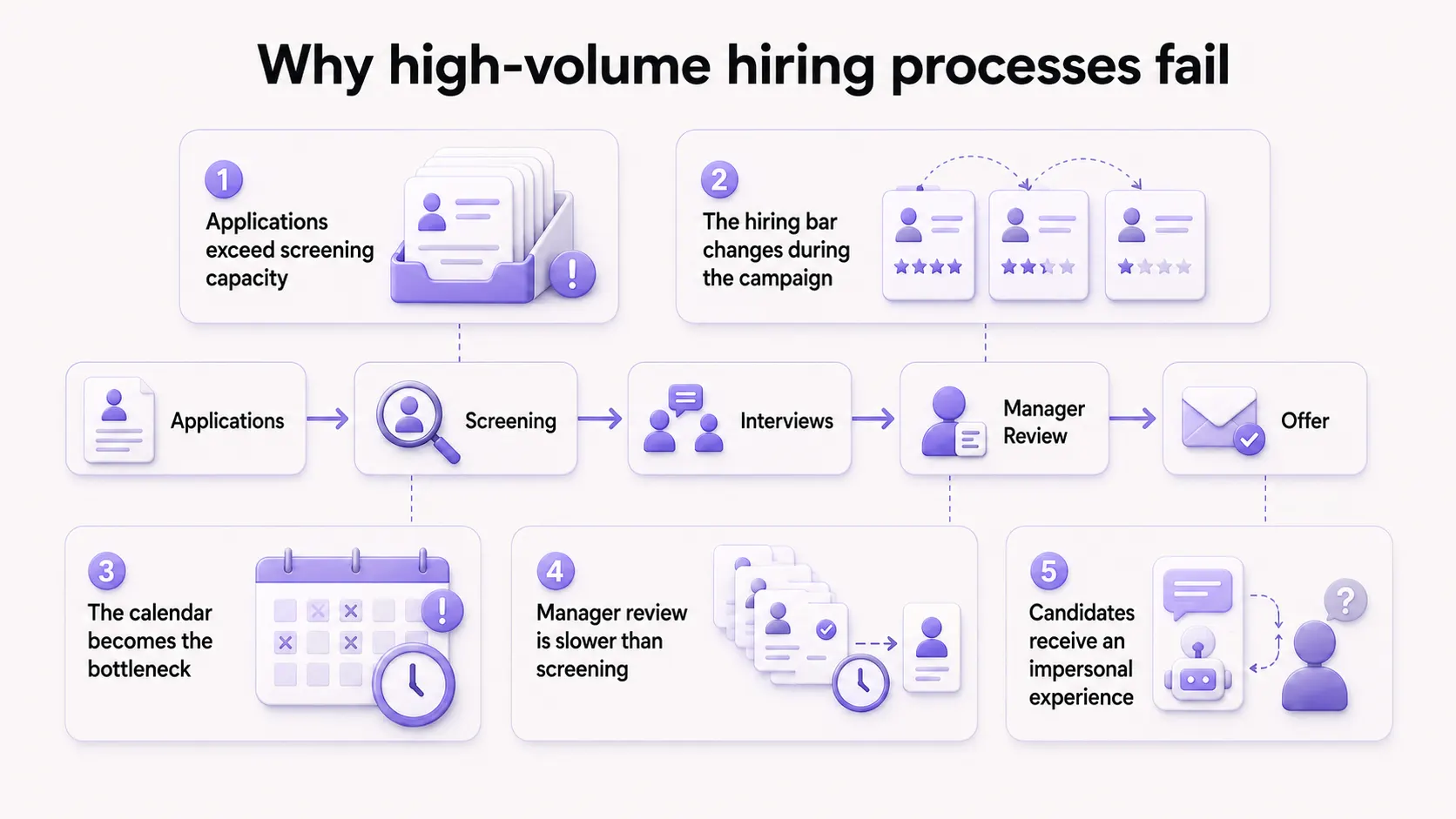
Applications exceed screening capacity
Greenhouse customer data shows that applications per job increased 239% between 2021 and 2025, from 28 to 95, while recruiters managed fewer roles. This is platform-specific data, but the operational lesson is straightforward: sourcing can grow faster than review capacity. When that happens, the order in which an application arrives starts influencing whether anyone evaluates it.
The hiring bar changes during the campaign
Vague requirements such as “good communicator” or “culture fit” give every recruiter and manager a different standard. One site advances candidates; another site rejects. Teams then respond to missed targets by changing the bar halfway through the campaign, which makes funnel data almost impossible to interpret.
The calendar becomes the bottleneck
A resume can be reviewed asynchronously. A manual first-round call needs overlapping availability, reminders, rescheduling, notes, and follow-up. Once interview demand exceeds open recruiter hours, qualified candidates wait even when the rest of the process is ready.
Manager review is slower than screening
Faster screening can create a larger queue somewhere else. If managers do not trust the evidence, do not know which candidates to review first, or have no response deadline, completed screens pile up without improving time to hire.
Candidates receive an impersonal experience
Candidates may not know why they received an automated step, what the technology measures, how long it takes, or when they will hear back. In Greenhouse's 2026 survey of 2,950 job seekers across five markets, 70% of US candidates who had experienced AI evaluation said it was not clearly disclosed before their most recent AI interview. The same report found that 38% had withdrawn from a process because it included an AI interview.
12 high-volume hiring best practices
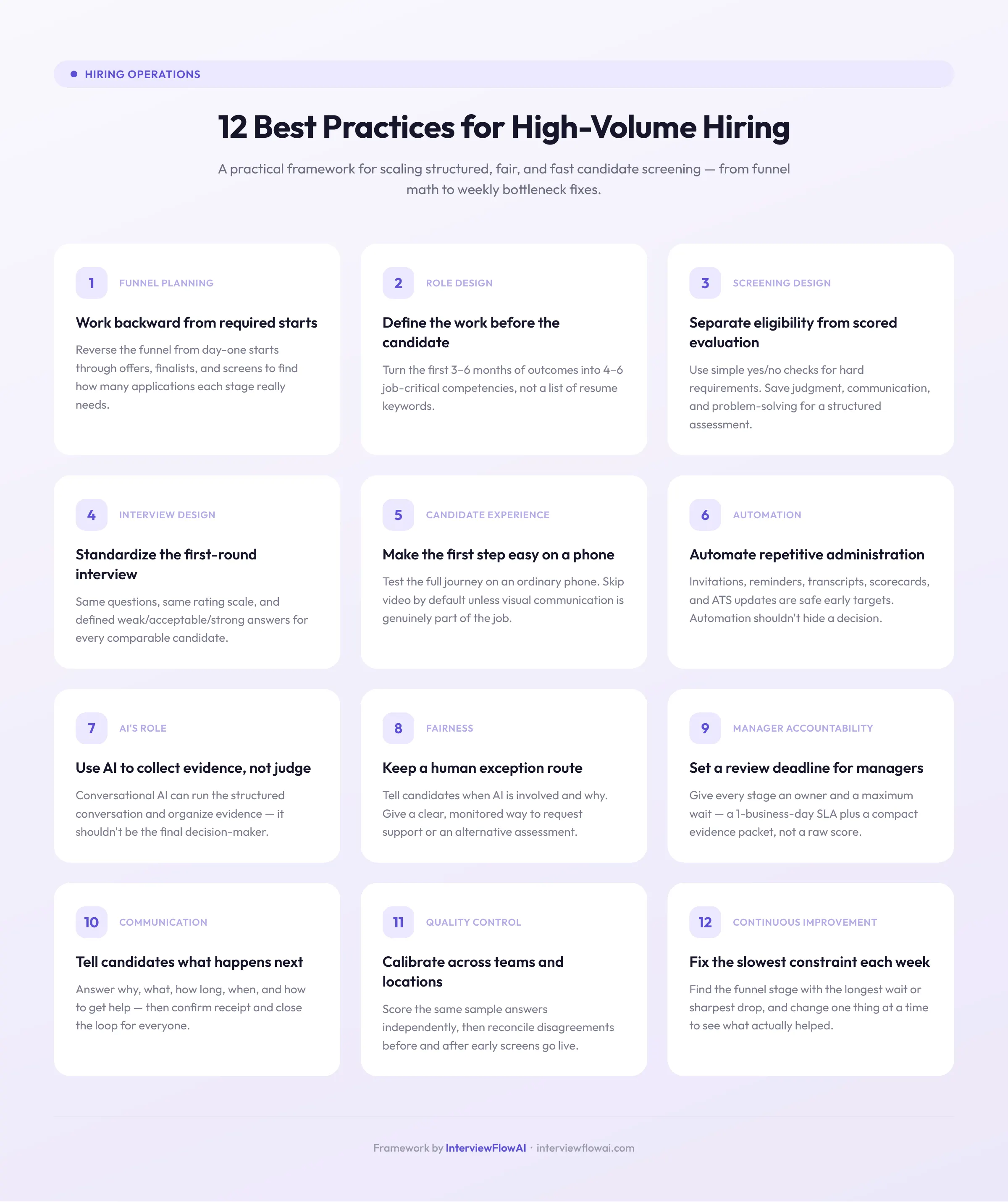
1. Work backward from the number of people who must start
Do not begin with an application target. Begin with the required starts, then use your own conversion rates to estimate how much volume each earlier stage needs.
Use this sequence:
Required offers = target starts divided by expected day-one show rate.
Required finalists = required offers divided by finalist-to-offer rate.
Required completed screens = required finalists divided by screen-to-finalist rate.
Required invitations = required completed screens divided by expected screen completion rate.
Required applications = required invitations divided by application-to-invitation rate.
Run the calculation separately for each role, location, shift, and source. A national average can hide a site that needs twice as many candidates or a shift with unusually low acceptance.
2. Define the work before defining the candidate
Ask the hiring manager what the person must deliver in the first three to six months. Convert those outcomes into four to six job-critical competencies. Then decide what evidence would show that a candidate meets the bar.
For a customer support role, the criteria may include diagnosing a common issue, calming a frustrated customer, writing a clear case note, and knowing when to escalate. “Three years in SaaS” may be one way a candidate learned those skills, but it is not the work itself.
If the role description is still vague, use InterviewFlowAI's job description optimizer before building the screen.
3. Separate eligibility checks from scored evaluation
Use simple checks early for requirements that have a clear yes or no answer. Examples include work authorization where relevant, required certification, location, shift availability, compensation range, start date, and ability to perform an essential job function with or without reasonable accommodation.
Do not use a knockout question for a criterion that needs context. Communication, judgment, problem-solving, motivation, and customer handling belong in a structured assessment or interview.
This distinction prevents the application form from becoming a crude scoring system and keeps the first interview focused on evidence that a resume cannot provide.
4. Standardize the first-round interview
Use the same core, job-related questions and rating scale for comparable candidates. Define what a weak, acceptable, and strong answer looks like before the campaign starts.
The U.S. Office of Personnel Management describes structured interviews in the same terms: candidates receive predetermined questions in the same order, and responses are evaluated against common rating standards. The point is not to make every conversation robotic. It is to keep the evidence and scoring criteria comparable. The full candidate screening process guide shows where this interview fits between application review and manager evaluation.
Write follow-up rules as well as opening questions. If a candidate gives a general answer, ask for the specific situation, their own action, the result, and what they would change. InterviewFlowAI's free interview script generator can provide a starting point, but a hiring manager should review every question and rubric before use.
5. Make the first step easy to complete on a phone
Many hourly, frontline, and shift-based candidates apply outside office hours. Test the complete journey on an ordinary phone, not only on a recruiter laptop.
Check the invitation length, page load, sign-in steps, audio permissions, instructions, support route, and expected duration. If the job does not require a camera, do not add video by default. A phone-first AI interview may suit mobile candidate pools better, while video can be reserved for roles where visual communication is genuinely relevant.
Shorter is not automatically better. The screen must be long enough to collect useful evidence and short enough to respect the candidate's time. Measure completion by role and device instead of choosing a duration from a generic benchmark.
6. Automate repetitive administration
The safest early automation targets are tasks with clear rules and low judgment:
Sending invitations after an eligibility pass
Reminding candidates before a deadline
Confirming that an interview was completed
Creating transcripts and scorecards
Notifying recruiters that evidence is ready
Updating the ATS or exporting a batch
Sending timely status updates
Automation should remove waiting and duplicate data entry. It should not create a hidden decision that nobody can explain.
7. Use AI to collect evidence, not to act as the final judge
Conversational AI interviews can conduct a structured conversation, ask relevant follow-ups, summarize responses, apply a written rubric, and organize evidence for review. This expands the number of candidates who can receive a substantive first screen without adding the same number of recruiter calls.
8. Keep a human exception and accommodation route
Tell candidates when AI or automation is involved, what the step assesses, how the output will be used, and who is accountable for the decision. Give candidates a clear way to ask for support or an alternative assessment.
The U.S. Department of Justice warns that hiring technology can screen out qualified applicants with disabilities when it measures an impairment rather than a job skill. The UK's Information Commissioner's Office also calls for better transparency, consistent human involvement, and fairness monitoring in automated recruitment. Human review should be meaningful, not a quick approval of a score the reviewer does not understand.
9. Set a review deadline for hiring managers
Every stage needs an owner and a maximum waiting time. For example, require managers to review shortlisted candidates within one business day and to record the reason for advancing or holding someone.
Give managers a compact evidence packet: the scorecard, supporting answer excerpts, transcript or recording, outstanding questions, and any exception flag. Automated candidate ranking can help prioritize review, but managers should still inspect the job-related evidence behind the ranking.
Escalate overdue reviews automatically. Do not send a notification for every small event. Alert the owner when a candidate is approaching the service-level limit or a decision needs attention.
10. Tell candidates what happens next
A good invitation answers five questions:
Why did I receive this step?
What will I be asked to do?
How long should it take?
When is the deadline?
How can I get help or request an alternative?
After completion, confirm receipt and give a realistic decision window. Send an update if that window changes. Close the loop for people who do not advance.
This can be automated without sounding anonymous. Use plain language, name the employer, explain the purpose, and provide a monitored contact route.
11. Calibrate across recruiters, managers, and locations
Before launch, ask several reviewers to score the same sample answers independently. Compare their ratings, discuss the evidence behind disagreements, and rewrite vague score anchors.
Repeat calibration after the first 20 to 30 completed screens and whenever the role or applicant pool changes. Review pass rates by recruiter, location, source, and hiring manager. A large difference may indicate a market issue, but it may also reveal that one team has quietly changed the standard.
12. Fix the slowest constraint each week
Review the funnel by role and location every week. Look for the stage with the longest wait, the sharpest drop, or the weakest downstream conversion.
If invitation delivery is healthy but starts are low, inspect the message and candidate effort. If screens finish quickly but manager review takes three days, adding more screening capacity will make the queue worse. If offers are accepted but day-one attendance is weak, the problem sits after selection.
Change one material part of the workflow at a time. That makes it possible to tell whether a new invitation, scorecard, reminder, or review rule improved the result.
A practical high-volume hiring process
| Stage | Owner | Output | Suggested control |
|---|---|---|---|
| 1. Workforce demand | Operations and hiring manager | Starts needed by role, site, shift, and date | Approved demand plan and conversion assumptions |
| 2. Role definition | Hiring manager and recruiting | Outcomes, eligibility rules, competencies, and scorecard | Written evidence standard before sourcing |
| 3. Attraction and application | Recruiting or talent marketing | Qualified applicant pool | Source tracking and mobile application test |
| 4. Eligibility check | Recruiting operations | Candidates who meet clear prerequisites | Review rejection logic and false negatives |
| 5. Structured first screen | Recruiter or screening system | Comparable answers, transcript, and scorecard | Same core criteria and a support route |
| 6. Human review | Recruiter and hiring manager | Advance, hold, or reject decision with reason | Review deadline and exception handling |
| 7. Offer and start | Recruiting and operations | Accepted offer, day-one attendance, and onboarding handoff | Offer follow-up and attendance tracking |
The ATS should remain the system of record. Add specialist tools only where the ATS does not solve a real constraint. InterviewFlowAI, for example, fits between initial eligibility and the live manager interview. Its high-volume hiring workflow conducts structured phone or video screens and returns transcripts, scorecards, and ranked outputs for human review.
What AI should automate and what people should own
| Task | Good use of automation or AI | Human responsibility |
|---|---|---|
| Application intake | Capture data, remove duplicates, route by role | Decide which information is necessary |
| Eligibility | Apply explicit, job-related rules | Approve rules and review edge cases |
| First-round screening | Ask structured questions, probe answers, create transcripts and scorecards | Define competencies, validate questions, review evidence |
| Scheduling and reminders | Offer times, send confirmations, chase incomplete steps | Handle exceptions and candidate support |
| Shortlist review | Prioritize records using a documented rubric | Inspect evidence and make the advancement decision |
| Candidate communication | Trigger receipts, reminders, and status updates | Set expectations, approve tone, respond to concerns |
| Monitoring | Surface drop-off, delay, conversion, and selection-rate changes | Investigate causes and decide corrective action |
| Final selection | Organize the evidence used by decision-makers | Own the final decision and document the reason |
What InterviewFlowAI's benchmark shows
InterviewFlowAI's 2026 AI recruitment benchmark covers more than 100,000 completed AI interviews across 100+ businesses from May 2025 through July 2026. The platform recorded:
70 interview invitations per job on average
70% to 85% completion within a four-day deadline, depending on cohort
About 13 minutes per completed interview
Scorecards available when the interview finishes
A 4.8/5 average among candidates who completed an interview and chose to rate it
At those ranges, 70 invitations produce about 49 to 60 completed interviews. At 13 minutes each, that is roughly 10.6 to 13 hours of structured interview activity for one job.
High-volume hiring FAQ
Which industries use high-volume hiring?
Retail, hospitality, logistics, customer support, BPO, staffing, healthcare support, campus recruitment, and sales development frequently hire at volume. Any employer can face the same problem when a role attracts more applicants than the team can review in time.
What is the difference between high-volume hiring and mass hiring?
The terms are often used interchangeably. “Mass hiring” usually emphasizes the number of people being hired, while “high-volume hiring” often includes the larger operating problem of processing many applicants, screens, decisions, and locations quickly.
How can recruiters screen hundreds of candidates without lowering quality?
Define job-related criteria before launch, move simple eligibility checks early, use the same structured first-round questions and rating scale, give reviewers evidence instead of raw notes, and calibrate pass standards across locations. Increase capacity by automating repetitive work, not by removing the hiring bar.
How can AI help with high-volume hiring?
AI can help with resume organization, candidate communication, scheduling, structured first-round interviews, follow-up questions, transcripts, scorecards, and reporting. It should support a defined process and human review. Employers remain responsible for the criteria, accommodations, monitoring, and decisions.
Which metrics matter most in volume hiring?
Track application completion, invitation delivery, screen start and completion, invite-to-complete time, manager review time, stage conversion, offer acceptance, day-one attendance, and early retention. Review the metrics by role and location so aggregate results do not hide a local problem.
How do you protect candidate experience at scale?
Keep the application mobile-friendly, explain every automated step, state the expected time and deadline, provide support and an accommodation route, confirm completion, and give a realistic response window. Close the loop even when the candidate does not advance.
What should high-volume hiring software include?
Look for mobile candidate access, configurable job-specific screening, structured scorecards with supporting evidence, batch workflows, reminders, ATS connectivity, role and location reporting, security documentation, access controls, and a clear human exception path.