AI interviews for software engineers can collect structured evidence before a recruiter asks an engineering manager to join the process. A conversational system can probe a candidate's recent projects, stack experience, debugging approach, and technical decisions, then return the recording, transcript, and rubric-based scorecard for human review.
That does not make it a substitute for every technical assessment. A spoken interview cannot prove that someone can write production code, and an automated score should not decide who gets hired. The useful role is narrower: replace repetitive first-round screening with a consistent conversation, surface candidates who deserve deeper review, and give engineers better evidence before they spend time on a live interview.
This guide explains where AI technical interviews fit, what they can assess, how to design the questions, and where human judgment must stay.
What is an AI interview for software engineers?
An AI interview for software engineers is a structured phone or video conversation conducted by conversational AI. It asks role-related questions, follows up when an answer needs more detail, and evaluates the response against criteria set by the hiring team. A recruiter or hiring manager then reviews the evidence and decides what happens next.
It is different from three tools that often get grouped under the same label:
| Format | What it collects | Best use |
|---|---|---|
| Resume screening | Evidence already written in the application | Initial relevance and minimum requirements |
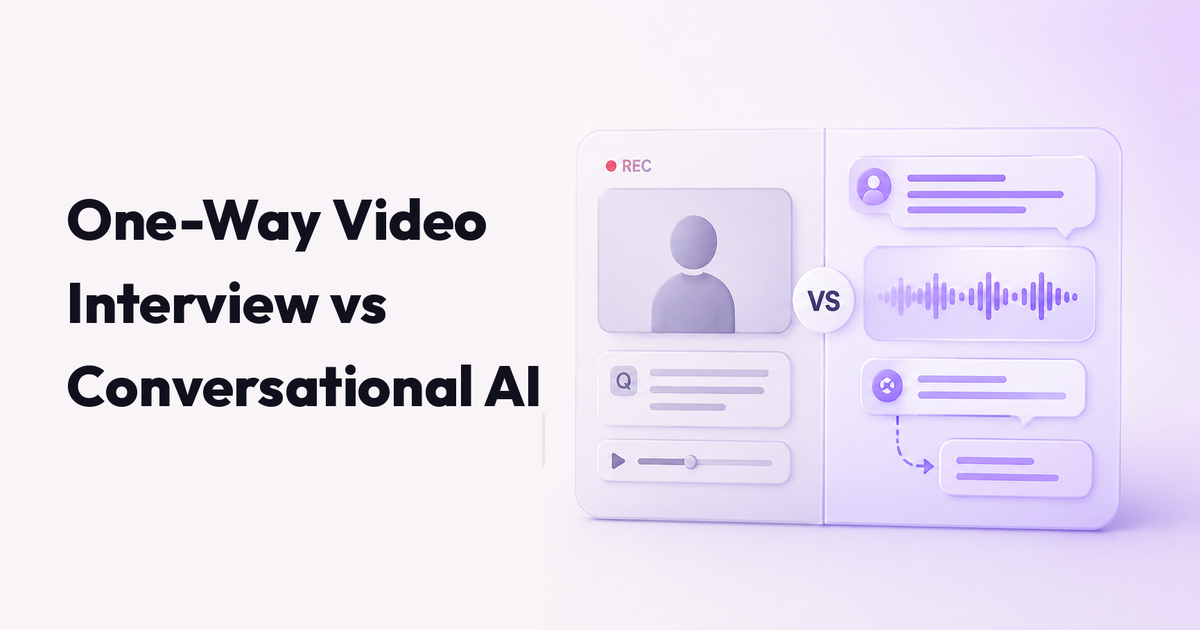
| One-way video interview | Recorded answers to fixed prompts | Asynchronous communication samples |
| Conversational AI interview | Two-way answers, follow-ups, transcript, and structured scorecard | First-round evidence on experience, reasoning, and communication |
| Coding assessment | Executed code or a submitted work sample | Coding skill, testing, debugging, and implementation |
| Human technical interview | Live discussion, collaborative problem-solving, and follow-up judgment | Depth, seniority, system thinking, and team interaction |
The distinction matters. If a product does not provide an editor, test runner, or repository task, it should not be presented as a code grader. InterviewFlowAI, for example, evaluates conceptual understanding, architecture explanations, problem-solving methodology, and the evidence in a candidate's responses. Use a coding assessment or work sample when the role requires proof of implementation skill.
Where AI belongs in the engineering hiring funnel
For most software-engineering roles, the AI interview belongs after basic eligibility screening and before expensive live technical stages.
| Stage | Question the stage should answer | Recommended owner |
|---|---|---|
| 1. Application review | Does the candidate meet the non-negotiable requirements? | Recruiter with defined criteria |
| 2. AI first-round interview | Can the candidate explain relevant work, technical choices, and problem-solving with enough depth to continue? | AI collects evidence; recruiter reviews it |
| 3. Coding task or work sample | Can the candidate produce, read, test, or improve code at the required level? | Engineering team or validated assessment |
| 4. Human technical interview | Can the candidate handle ambiguity, defend trade-offs, and collaborate with engineers? | Engineer or hiring manager |
| 5. Final decision | Does the complete evidence support hiring this person for this role? | Accountable human decision-makers |
This sequence is not universal. A high-volume junior role may use a short coding assessment before the AI conversation. A senior staff role may start with a hiring-manager call because scope and leadership matter more than top-of-funnel efficiency. The rule is simple: automate the repeatable evidence collection, not the judgment that needs professional context.
That approach is consistent with the broader evidence on structured interviews. The U.S. Office of Personnel Management notes that interviews become more reliable when candidates receive predefined lead questions and follow-up probes and when reviewers use proficiency benchmarks rather than a global impression.
What an AI technical interview can and cannot assess
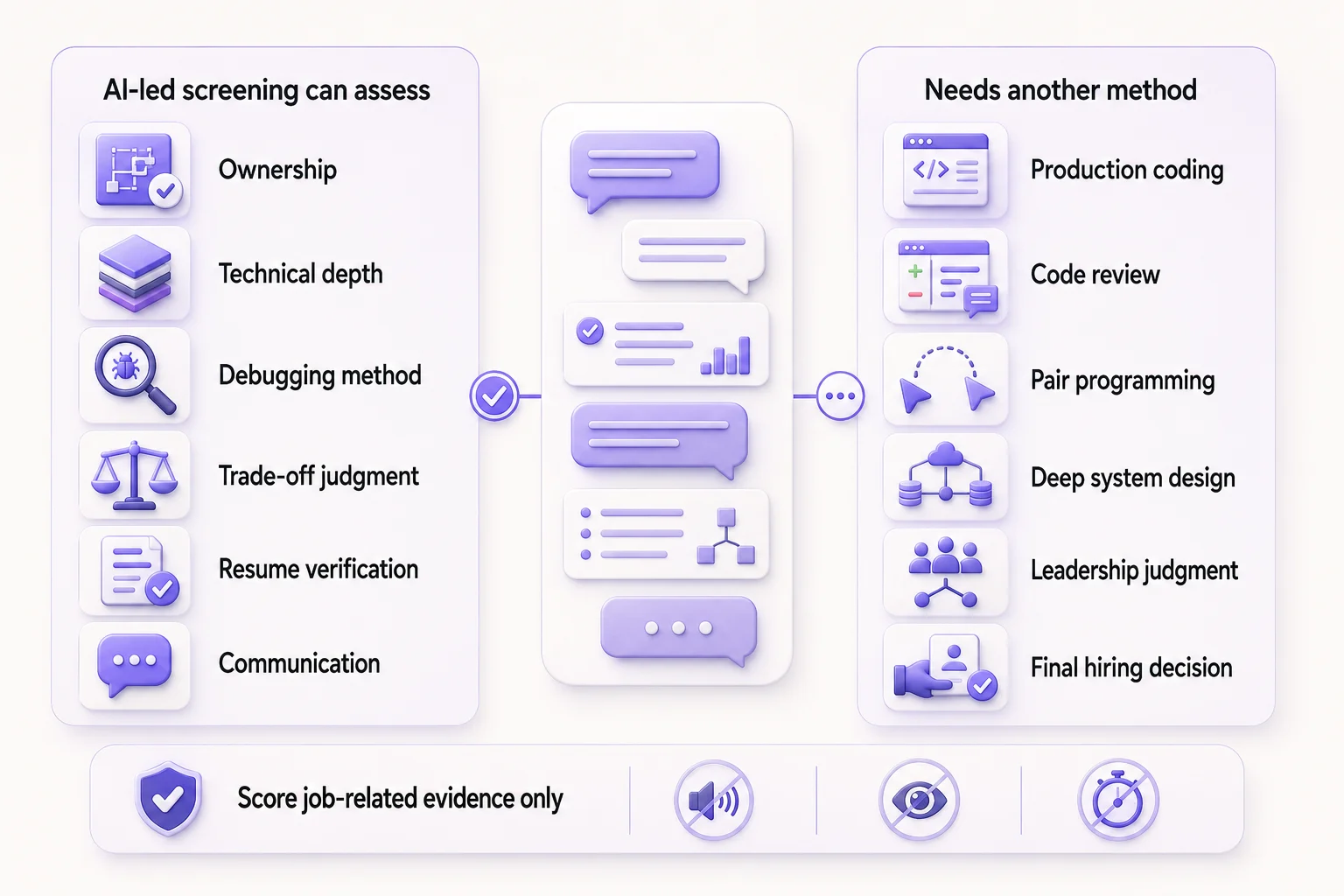
An AI interview is useful when the evidence can be expressed and examined in conversation.
Good candidates for AI-led screening
Relevant ownership: what the candidate personally designed, built, fixed, or reviewed
Technical depth: why a particular architecture, framework, database, or deployment approach was chosen
Debugging method: how the candidate forms hypotheses, checks evidence, and narrows a fault
Trade-off judgment: what the candidate optimized, what they accepted, and what they would change now
Resume verification: whether claimed projects can be explained beyond surface-level terminology
Communication: whether the candidate can make a technical decision understandable to another person
Evidence that still needs another method
Writing and running production-quality code
Test design and code-review behavior inside a real repository
Pair programming and collaboration under changing requirements
Deep system design for senior or staff-level positions
Leadership influence, stakeholder judgment, and team dynamics
Final hiring suitability
Do not score accent, facial expression, eye contact, speaking speed, or a vague idea of “culture fit.” These signals are weakly connected to engineering performance and may disadvantage candidates for reasons unrelated to the job. Score the content of the answer against a job-related rubric.
How to design an AI interview for an engineering role
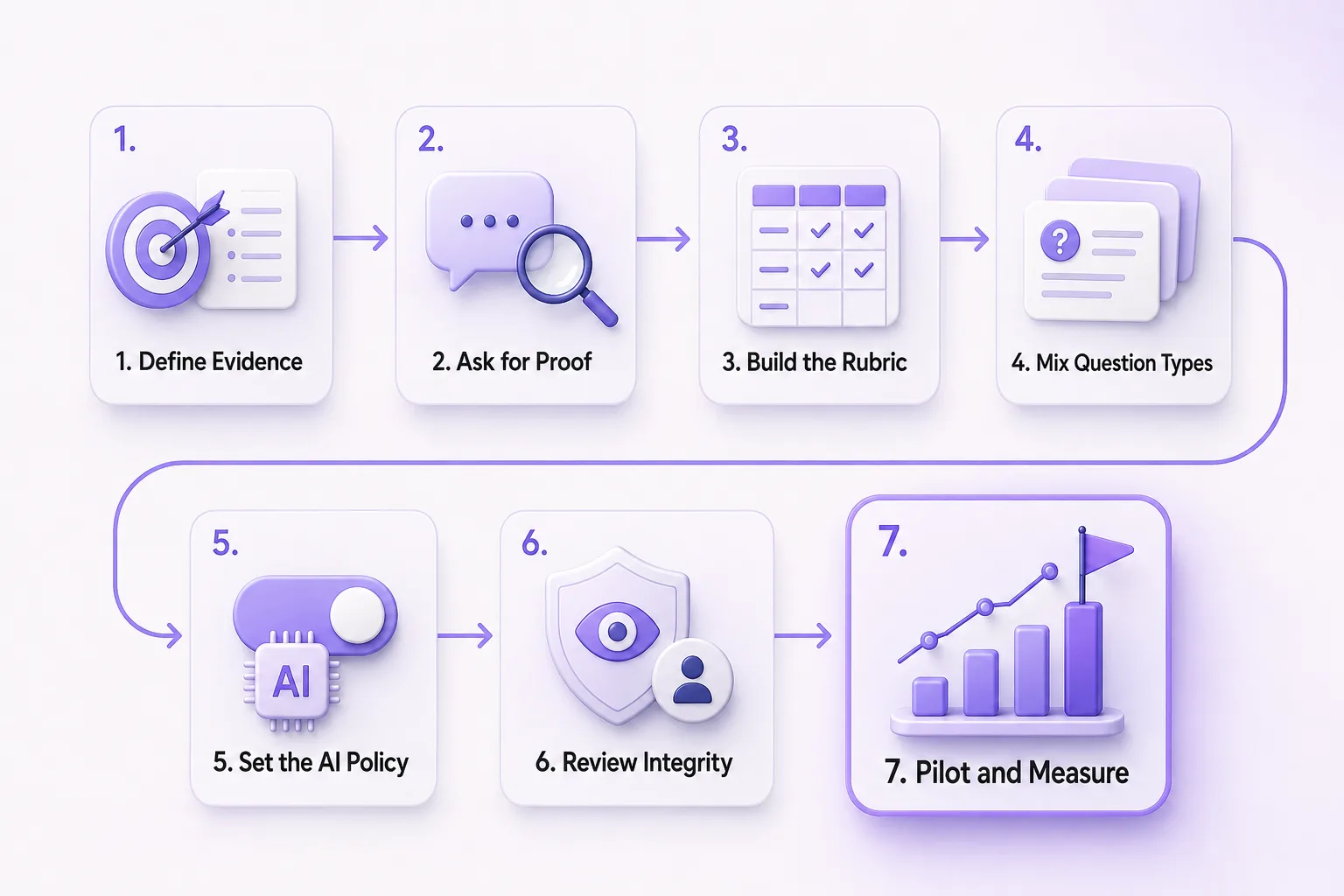
1. Define the evidence before writing questions
Start with the work the engineer must perform in the first six to twelve months. For a backend engineer, that might include diagnosing production failures, designing an API change, reviewing database queries, and explaining a risky migration. “Five years of Python” is a background requirement. It is not evidence of how the person works.
Ask the hiring manager to name four to six competencies that would change the hiring decision. Then define what weak, acceptable, and strong evidence looks like for each one.
If the job description is too vague to support this step, clarify it with the free job description optimizer before building the interview.
2. Replace trivia with questions that require evidence
Questions such as “What is the difference between a Python list and a tuple?” are easy to search and easy to answer without practical experience. This is the exact problem raised by an engineering manager in a discussion about making interviews resistant to AI-generated answers.
Ask for a real situation, the candidate's action, the reason for it, and the result. Then probe the weak point in the answer.
Example lead question:
Tell me about a production issue you diagnosed in a Python service. What did you observe first, which hypotheses did you rule out, and what fixed the problem?
Useful follow-ups:
What evidence made you change your first hypothesis?
Which logs, metrics, or traces were missing?
What was the risk in the fix you chose?
How did you confirm the issue would not recur?
What would you do differently at ten times the traffic?
A candidate can look up a definition. It is much harder to sustain a coherent explanation across specific follow-ups without understanding the work.
3. Give each question an anchored rubric
Avoid a single score for “technical ability.” Split the answer into dimensions that a reviewer can inspect.
Example rubric for the production-issue question:
| Dimension | Weak evidence | Acceptable evidence | Strong evidence |
|---|---|---|---|
| Ownership | Speaks only about what “we” did | Identifies a personal task and decision | Separates personal work, team input, and escalation clearly |
| Diagnostic method | Jumps to a fix with no evidence | Describes a plausible sequence of checks | Uses observations to eliminate alternatives and explains uncertainty |
| Technical depth | Repeats generic terms | Connects symptoms to the relevant system | Explains failure mechanics, trade-offs, and edge cases |
| Validation | Says the fix worked | Names a test or monitoring check | Covers rollback, regression risk, monitoring, and prevention |
The score should point a reviewer to evidence in the transcript. It should not hide the answer behind an unexplained number.
4. Mix question types
A useful first-round engineering interview usually combines:
Resume-aware questions about a claimed project or responsibility
Skills questions tied to the role's actual stack and failure modes
A scenario that tests judgment under realistic constraints
A clear closing question so the candidate can add context the rubric may have missed
InterviewFlowAI supports dynamic skills questions, resume-aware questions, and manually written custom questions with scoring rubrics. Its software-engineer interview page explains the current workflow and output.
5. Decide how candidates may use AI
There are two defensible policies. Choose one before the interview and state it plainly.
In an AI-prohibited screen, the goal is to hear the candidate's unaided explanation of past work and technical judgment. Tell candidates that live answer-generation tools are not allowed and explain which behavior the process may record.
In an AI-permitted assessment, the goal is to observe how the candidate uses modern tools. Give everyone the same access and evaluate prompt quality, verification, debugging, and whether the candidate can explain the generated result. Canva's engineering team uses this model for some backend, frontend, and machine-learning interviews because it better reflects the tools engineers use at work.
Secret rules create a bad assessment. If one candidate assumes Copilot is allowed and another assumes it is prohibited, their results are not comparable.
6. Keep integrity signals in the review, not in the rejection rule
Tab switches, copy-and-paste behavior, unusual response timing, or inconsistent answers may justify a closer look. None proves misconduct on its own. A candidate might change tabs to open an accommodation tool, read the job description, or resolve a technical problem.
InterviewFlowAI's Trust Score surfaces integrity signals for recruiter review. The product does not automatically reject a candidate from those signals. The safer response is a targeted human follow-up: ask the candidate to explain an answer, change one assumption, or critique the approach they gave.
7. Pilot one role and compare downstream signal
Do not roll out a generic interview across every engineering job. Start with a recurring role that has clear competencies and enough hiring activity to compare results.
During the pilot, have a recruiter and an engineering reviewer inspect every completed interview. Track:
Invitation delivery, start, and completion rates
Time from invitation to completion
Advance rate and the reasons candidates were advanced or declined
Reviewer agreement with the scorecard
Performance in the later coding or human technical stage
Candidate rating, response rate, support requests, and accommodation requests
Selection rates by relevant groups where collection and analysis are lawful
InterviewFlowAI's broader platform benchmark covers more than 100,000 completed interviews across 100+ businesses. Invited candidates complete at a rate of 70 to 85 percent within four days, completed interviews average about 13 minutes, and the voluntary post-completion rating averages 4.8/5. These are first-party operational benchmarks, not a promise that every engineering role will reproduce the same result. See the methodology and limitations before setting a target.
Does structured AI screening improve hiring signal?
The evidence is promising, but it does not support handing the decision to an algorithm.
A 2026 revision of the preprint Better Together: Quantifying the Benefits of AI-Assisted Recruitment reports two field experiments on a recruitment platform. Candidates shortlisted with AI interview information passed a later human interview, whose interviewer was blind to the shortlisting method, at rates 17.5 to 20 percentage points higher than candidates shortlisted from resumes alone. The gains were larger for junior candidates, whose resumes carried less information.
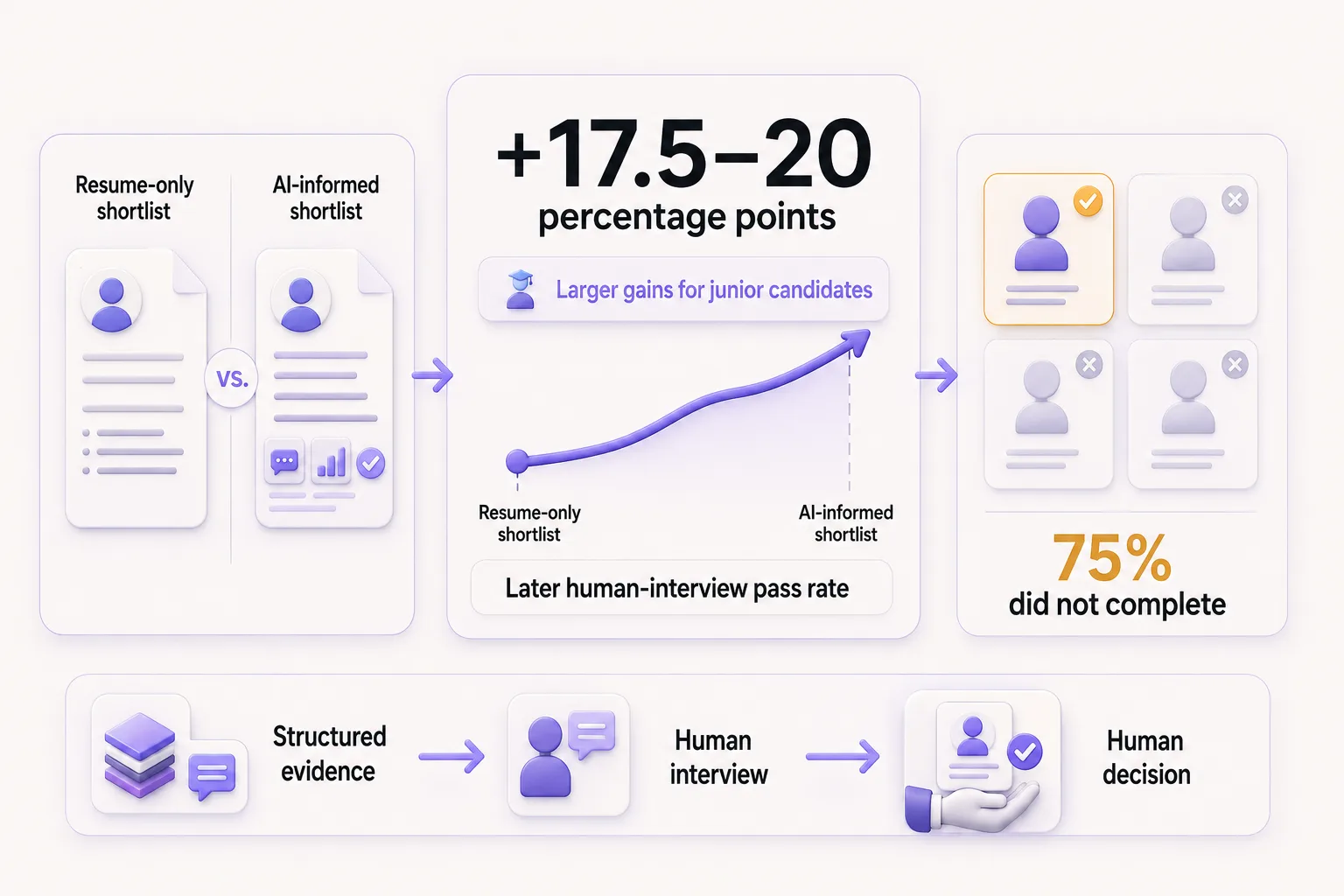
There is an important cost. In the study, 75 percent of invited candidates did not complete the AI interview. That result should stop teams from assuming automation is automatically more inclusive or convenient. Invitation wording, task length, transparency, role level, and candidate alternatives all affect participation.
The most credible conclusion is modest: a structured interview can add evidence that a resume misses, especially early in a career. Whether it improves your process depends on question quality, completion, downstream validation, and human review.
How to protect candidate experience
Candidates rarely object to efficiency in the abstract. They object when they do not know that AI is evaluating them, cannot get help, and never hear from a person afterward.
Greenhouse surveyed 2,950 job seekers across the United States, United Kingdom, Ireland, Germany, and Australia for its 2026 Candidate AI Interview Report. Among US respondents who had experienced AI evaluation, 70 percent said it had not been clearly disclosed before their most recent AI interview. Thirty-eight percent said they had withdrawn from a hiring process because it included an AI interview. The survey does not isolate conversational technical interviews, but it makes the implementation risk hard to ignore.
Every invitation should explain:
That the interview is conducted by AI
Why the company uses it and where it sits in the process
What competencies and data the system will evaluate
The expected duration, deadline, device requirements, and retake policy
Whether a person will review the recording, transcript, and scorecard
Whether outside AI tools are allowed
How to request an accommodation or another interview format
When the candidate should expect an outcome and how to reach a person
The last point is easy to neglect. Automation may remove scheduling from the first round, but it does not excuse silence after the candidate has spent time completing it.
Fairness, accessibility, and legal review
Using the same questions and rubric can reduce random variation. It does not prove that the questions are job-related, the scoring is valid, or the process is fair.
For US employers, the EEOC and Department of Justice warn that algorithmic hiring tools can violate the Americans with Disabilities Act when they screen out qualified people with disabilities or when employers do not provide reasonable accommodations. The federal Uniform Guidelines also cover interviews and other procedures used to make employment decisions.
Local rules may add duties. New York City's Local Law 144 guidance says covered automated employment decision tools cannot be used unless they have undergone a bias audit within the previous year, the audit summary is publicly available, and required candidate or employee notices are provided. Whether a particular interview workflow meets the law's definition depends on how the tool is used.
Before launch:
Use competencies drawn from a documented job analysis.
Remove questions or scoring signals unrelated to job performance.
Provide an accessible accommodation route and a human contact.
Document who can see recordings, transcripts, scores, and integrity signals.
Keep a person accountable for every advance or rejection.
Monitor completion, selection, and downstream outcomes for material differences.
Revalidate the interview when the role, rubric, model, or workflow changes.
Ask employment counsel which notice, audit, consent, retention, and accessibility rules apply in each hiring location.
This section is operational guidance, not legal advice.
How InterviewFlowAI supports software-engineer screening
Used carefully, AI interviews for software engineers can strengthen first-round screening without replacing coding assessments or accountable human judgment.
InterviewFlowAI runs two-way AI phone and video interviews. For an engineering role, the hiring team defines the competencies and rubric, then uses dynamic skills questions, resume-aware questions, and custom prompts to collect evidence. When the interview ends, reviewers receive the recording, searchable transcript, summary, competency scorecard, ranking, and Trust Score signals.
The final decision stays with the hiring team. The product is best used to decide which candidates deserve the next assessment, not to replace a coding exercise or the engineer who evaluates deeper technical work.
Frequently asked questions
Can AI interview software engineers?
Yes, conversational AI can conduct a structured first-round interview about a software engineer's experience, technical decisions, debugging method, and role-specific knowledge. A recruiter or engineer should review the evidence and use a separate coding task or work sample when implementation skill must be demonstrated.
Can an AI interview assess coding ability?
Conversation can assess how a candidate explains code, architecture, debugging, and trade-offs. It cannot prove production coding ability unless the platform also provides a code editor, tests, and a suitable work sample. InterviewFlowAI does not present its conversational software-engineer interview as a replacement for an executed coding assessment.
What questions should an AI technical interview ask?
Ask questions tied to real work: a production issue the candidate diagnosed, an architecture decision they made, a code review they disagreed with, or a system constraint they handled. Use follow-ups to test ownership, evidence, alternatives, and results. Avoid definitions and trivia that can be searched in seconds.
How long should an AI interview for an engineer take?
It should be long enough to collect evidence on the few competencies that determine whether the person advances. Across InterviewFlowAI's broader benchmark, completed interviews average about 13 minutes. A senior or highly specialized role may need a longer human conversation instead of a longer automated one.
Should candidates be allowed to use ChatGPT or coding assistants?
Either policy can work if it matches the job and applies equally. Prohibit live AI when you need an unaided baseline. Allow it when you want to assess how candidates prompt, verify, debug, and improve generated work. Tell candidates the rule before the assessment.
Are AI interviews fairer than human interviews?
They can apply the same questions and rubric more consistently, but consistency alone does not guarantee fairness. The competencies must be job-related, accommodations must be available, outcomes should be monitored, and humans must remain accountable for decisions.
Do AI interviews replace engineering interviewers?
No. They can replace repetitive first-round evidence collection for suitable roles. Engineers are still needed to evaluate code, explore deeper system decisions, test collaboration, and make the hiring decision.
How can recruiters reduce AI-assisted cheating?
Set a clear tool-use policy, ask project-specific questions, use dynamic follow-ups, and require candidates to explain trade-offs or respond to a changed assumption. Treat automated integrity flags as prompts for review, not proof of misconduct.