Hiring has been getting slower, not faster. Gem's analysis of more than 140 million applications found that average time to hire rose from 33 days in 2021 to 41 days in 2024, while companies ran 42% more interviews per hire. Ashby's 2026 data shows why: roles now receive more than 300 applications per hire on average, triple the 2021 level. In GoodTime's survey of 500+ US talent acquisition leaders, 60% said their time to hire increased in 2025, and only about 1 in 9 managed to reduce it.
Every extra day has a cost, even if it never appears as a line item. Work goes undone, recruiters lose hours to scheduling, and good candidates accept other offers. This guide explains how to measure time to hire, how to put a number on the cost of a slow hiring process, where the days actually go, and how automating the first round removes the biggest delay.
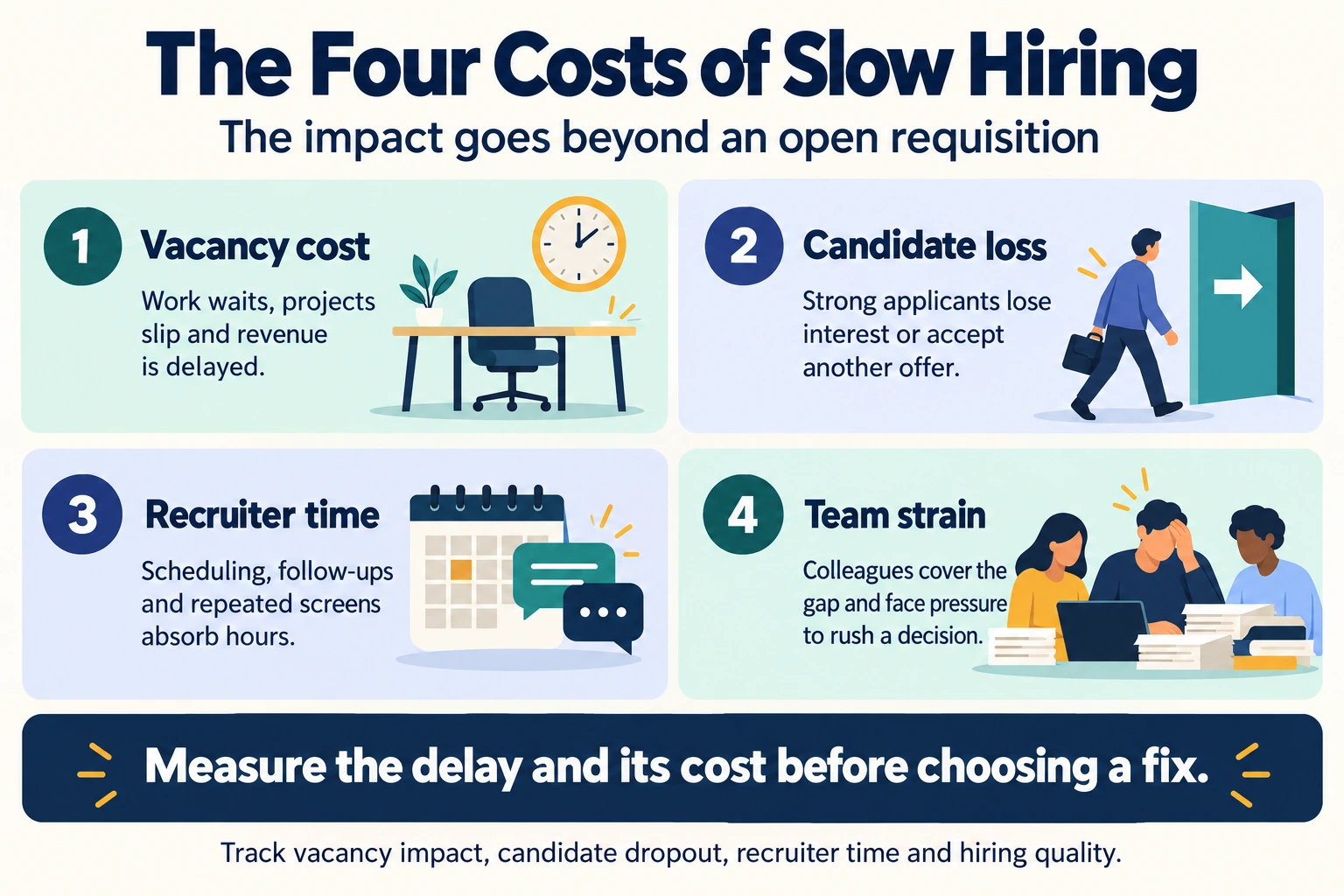
Quick answer: A slow hiring process costs you in four ways: the value of work left undone while the role is open (the cost of vacancy), candidates who drop out, recruiter hours spent on scheduling, and strain on the team covering the gap. A simple estimate of the cost of vacancy is (annual salary ÷ 260 working days) × a value multiplier of 1–3 × the number of days the role stays open. The fastest fix is usually the first round: replace scheduled phone screens with on-demand AI interviews, and cut interview rounds that don't add new evidence.
Time to hire vs time to fill: definitions, formulas, and benchmarks
Time to hire is the number of days between a candidate entering your hiring process and accepting your offer. Time to fill is the number of days between a job opening being approved and a candidate accepting the offer. You need both to speed hiring up, and the two are often confused:
| Time to hire | Time to fill | |
|---|---|---|
| Measures | Days from when the eventual hire enters your pipeline (applies or is sourced) to when they accept the offer | Days from when the job requisition opens to when a candidate accepts the offer |
| Tells you | How quickly your process moves a good candidate through screening, interviews, and offer | How long the business goes without someone in the role, including approvals and sourcing |
| Typical delays it reveals | Scheduling, slow feedback, too many interview rounds, offer delays | Requisition approvals, unclear job descriptions, weak sourcing |
| Recent benchmark | 41 days on average (Gem, 2024 data) | About 45 days median (SHRM, 2025) |
How to calculate time to hire and time to fill
Time to hire = offer acceptance date − date the hired candidate entered the pipeline
Time to fill = offer acceptance date − date the requisition was approved
Average time to hire = sum of time to hire for all hires ÷ number of hires
Example: a requisition is approved on February 2. The eventual hire applies on February 20 and accepts the offer on March 30. Time to hire is 38 days (February 20 to March 30). Time to fill is 56 days (February 2 to March 30). The 18-day gap is spent on approvals, writing the job post, and sourcing, before any candidate is in the process.
Time to fill is always the longer number, because the clock starts before anyone applies. Calculate both in calendar days, use the median rather than the average if a few unusual hires skew your data, and break time to hire down by stage so you can see where the delay sits. The free time-to-hire calculator does this from your stage durations.
Time to hire benchmarks
| Source | Metric | Benchmark |
|---|---|---|
| Gem (140M+ applications, 2021–2024) | Average time to hire | 41 days in 2024, up from 33 days in 2021 |
| SHRM (2,300+ members, 2025) | Median time to fill | About 45 days (roughly a month and a half) for both executive and nonexecutive roles |
| Ashby (100M+ applications, 2026) | Time to fill a role | About 8 weeks for business roles and 10 weeks for technical roles |
Benchmarks vary widely with role type, seniority, and location, and each source measures something slightly different. Your own trend by stage matters more than any industry average. If you are choosing software to improve these numbers, see our comparison of the best AI tools to reduce time to hire.
The four costs of a slow hiring process
1. The cost of vacancy
An open role still costs money. Revenue goes uncollected, projects slip, and customers wait. The most common way to estimate this, popularized by recruiting strategist Dr. John Sullivan, uses salary as a stand-in for the value the role produces:
Cost of vacancy = (annual salary ÷ 260 working days) × value multiplier × days the role is open
The value multiplier reflects that most roles produce more value than they cost. Use about 1 for support roles, 1.5–2 for most professional roles, and up to 3 for revenue-generating or business-critical roles. For sales roles, you can replace salary with the revenue each rep typically brings in.
| Worked example | Value |
|---|---|
| Annual salary for a software engineer role | $120,000 |
| Daily salary ($120,000 ÷ 260) | $462 |
| Value multiplier (core product role) | 2 |
| Estimated cost per open day | $923 |
| Saving from filling it 14 days faster | About $12,900 |
This is an estimate, not an accounting figure, but it makes speed comparable to other investments. Multiply it by the number of roles you hire each year and the total is usually large. As a quick reference, here is the estimated cost of vacancy per open working day:
| Annual salary | Multiplier 1.5 | Multiplier 2 |
|---|---|---|
| $50,000 | $288/day | $385/day |
| $75,000 | $433/day | $577/day |
| $100,000 | $577/day | $769/day |
| $150,000 | $865/day | $1,154/day |
| $200,000 | $1,154/day | $1,538/day |
2. Losing your best candidates
Strong candidates are rarely in only one process. In a Robert Half survey of 2,500+ US workers, 39% said a lengthy hiring process makes them lose interest in a job, 40% said the same about more than three interview rounds, and 52% cited poor communication and follow-up. Each lost finalist sends you back several stages, often all the way to sourcing, so one dropout can add weeks to time to fill.
3. Recruiter time lost to scheduling
GoodTime's 2025 Hiring Insights survey found that recruiters spend 38% of their time scheduling interviews. That time doesn't go to sourcing, candidate relationships, or advising hiring managers. It also creates the gaps that slow everything down: a first call booked for next Thursday, a hiring manager on leave, a candidate in another time zone.
4. Strain on the team and rushed decisions
While a role stays open, colleagues absorb the work, which raises their risk of burnout and turnover. After a long search, there is also pressure to hire whoever is still available instead of whoever is best. A bad hire costs far more than a few extra days of searching.
Where the days actually go
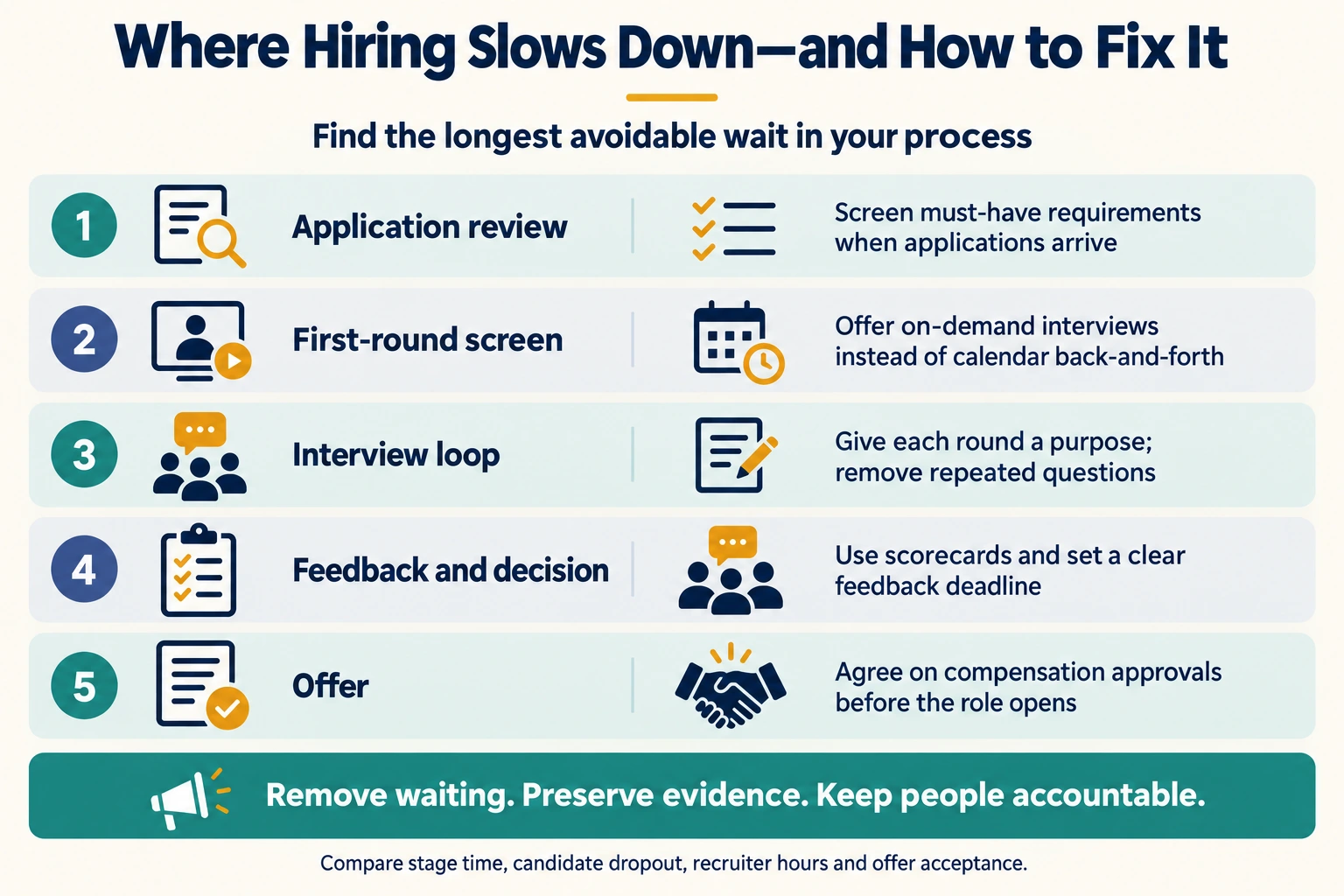
Time to hire usually grows in a few predictable places. Fix the slowest stage first:
| Stage | Common delay | Fix |
|---|---|---|
| Application review | Hundreds of resumes reviewed one by one, often days after people apply (Ashby: 300+ applications per hire) | Screen resumes against must-have requirements automatically, the same day they arrive |
| First-round screen | Back-and-forth emails to book a 30-minute call, then no-shows and reschedules | On-demand AI phone or video interviews that candidates take within hours |
| Interview loop | Too many rounds that repeat the same questions (Gem: 20 interviews per hire, up from 14) | Give each round a distinct purpose and remove rounds that add no new evidence |
| Feedback and decision | Interviewers take days to submit feedback, so decisions wait | Use structured scorecards and agree on a 24-hour feedback deadline |
| Offer | Approvals for compensation and paperwork | Pre-approve salary ranges before the role opens |
How automating the first round fixes the biggest bottleneck
The first-round screen is where scheduling delays, recruiter hours, and early dropouts overlap. Automating it changes the pace of the whole process:
- Interviews happen within hours, not a week later. With 24/7 AI interviews, candidates take their first-round phone or video interview when it suits them, including evenings and weekends, so there is nothing to schedule.
- Every application is reviewed the same day. Resume screening checks must-have requirements and ranks candidates as they apply.
- Recruiters review evidence instead of running calls. Each interview produces a scorecard and transcript. Reading one takes minutes, compared with a 30-minute call plus notes.
- Qualified candidates move forward automatically. InterviewFlowAI's Coordinator emails candidates who meet your pass score a link to book the next interview with your team, so the handoff doesn't wait for a recruiter to notice.
- Fewer candidates go quiet. Automated reminders follow up, and every candidate gets a response.
Completed InterviewFlowAI interviews average about 13 minutes, and in our benchmark 70–85% of invited candidates complete their interview within four days when it is clearly disclosed and conversational (methodology). Automation should remove waiting, not judgment: your team still reviews the evidence and decides who advances. For a comparison of tools, see the best AI tools to reduce time to hire.
How to measure whether you're getting faster
- Set a baseline for each stage for your last 10–20 hires: application to first screen, screen to interview loop, final interview to offer, and offer to acceptance.
- Track time to first interview. This is usually the stage that improves most when you automate.
- Watch candidate dropout at each stage, especially between application and first screen.
- Count recruiter hours per hire spent on scheduling and screening calls.
- Check that quality holds. Track offer acceptance rate and how new hires perform at 90 days, so speed doesn't come at the cost of quality.
Stop losing candidates to scheduling delays
See how on-demand AI interviews, resume screening, and automatic scheduling for qualified candidates can take days out of your first round.
Frequently asked questions
What is time to hire?
Time to hire is the number of days between a candidate entering your hiring process, by applying or being sourced, and accepting your job offer. It measures how efficiently your screening, interviews, and offer stages move candidates forward.
How do you calculate time to hire?
Subtract the date the hired candidate entered your pipeline from the date they accepted the offer. For example, a candidate who applied on February 20 and accepted on March 30 has a time to hire of 38 days. To get your average, add up time to hire for all hires in a period and divide by the number of hires.
What is the cost of a slow hiring process?
It combines the cost of vacancy (work and revenue lost while the role is open), candidates lost to competitors, recruiter time spent on scheduling and follow-up, and strain on the team covering the role. For a $120,000 role valued at twice its salary, each open day costs roughly $900.
How do you calculate the cost of vacancy?
A common estimate is (annual salary ÷ 260 working days) × a value multiplier × the number of days the role is open. The multiplier ranges from about 1 for support roles to 3 for business-critical or revenue-generating roles. For sales roles, you can use expected revenue instead of salary.
What is the difference between time to hire and time to fill?
Time to hire runs from when the eventual hire enters your pipeline to when they accept the offer, and it reflects how efficient your process is. Time to fill runs from when the requisition opens to offer acceptance, and it reflects how long the business goes without the role filled. Time to fill is always longer.
What is a good time to hire?
Recent benchmarks put average time to hire at about 41 days (Gem, 2024 data) and median time to fill at about 45 days (SHRM, 2025). Ashby's 2026 data shows technical roles taking about 10 weeks to fill, compared with 8 weeks for business roles. Compare against your own baseline by stage rather than a single industry average.
Does a slow hiring process really lose candidates?
Yes. In a Robert Half survey, 39% of workers said a lengthy hiring process makes them lose interest in a job, and 40% said the same about more than three interview rounds. Poor communication was the top reason, cited by 52%.
How can automation reduce time to hire?
Automation removes waiting. Resume screening reviews applications as they arrive, on-demand AI interviews replace scheduled phone screens, and qualified candidates can be invited to the next round automatically. Your team spends its time reviewing evidence and making decisions, not coordinating calendars.
Sources
- Gem, 2025 Recruiting Benchmarks Report (140M+ applications, 2021–2024).
- SHRM, 2025 Recruiting Executives Benchmarking, October 2025.
- Ashby, hiring data report (100M+ applications, May 2026).
- HR Dive, GoodTime Hiring Insights Report (500+ US TA leaders, November 2025).
- Robert Half, job search survey (2,500+ US workers, May 2023).
- InterviewFlowAI, AI Recruitment Statistics 2026 (platform benchmark).