Interview bias is one of the most persistent problems in technical hiring. Interviewers rarely mean to be unfair, but a candidate who went to the same university, explains things the way you would, or stays calm at a whiteboard tends to score higher, whether or not they are better at the job. The result is less accurate hiring and less diverse teams, and the strongest engineers can be filtered out early.
This guide explains what interview bias is, the most common types (with technical hiring examples), where bias enters engineering interviews, and practical ways to reduce it. It also covers what AI can and cannot do here, because AI interview tools can reduce some biases and introduce others.
Quick answer: Interview bias is any factor unrelated to the job that distorts how an interviewer evaluates a candidate. Examples include affinity bias, first impressions, the halo effect, and stereotyping. You can't eliminate it, but you can reduce it substantially. Define job-related criteria in advance, ask every candidate the same structured questions, score answers against anchored rubrics, have interviewers score independently before discussing, and track pass rates by stage to spot adverse impact. AI interviews help with consistency, but they need the same audits, evidence, and human accountability.
What is interview bias?
Interview bias is the systematic distortion of an interviewer's judgment by factors that have nothing to do with how well a candidate would do the job. These include mental shortcuts, personal preferences, stereotypes, and the conditions of the interview itself. It is usually unconscious. Well-intentioned, experienced interviewers are affected too, which is why the fixes are about process design, not willpower.
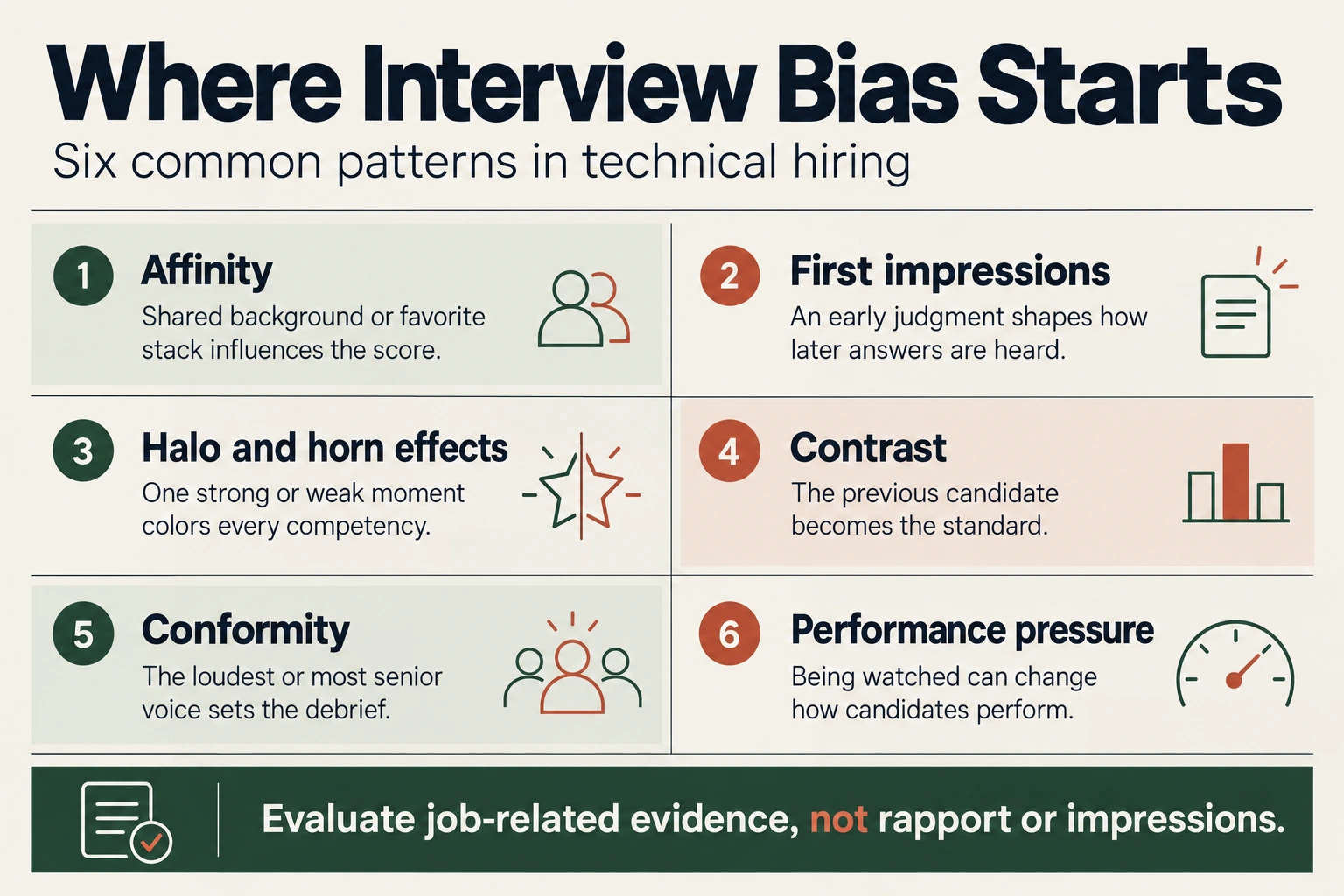
12 common types of interview bias
| Type of bias | What it looks like in technical hiring | How to counter it |
|---|---|---|
| Affinity (similarity) bias | Rating a candidate higher because they share your alma mater, former employer, or favorite stack | Score against written criteria, not overall rapport |
| First-impression bias | Deciding in the first five minutes, then looking for evidence to support it | Score each question separately, after the answer |
| Confirmation bias | Probing harder on weaknesses you expected from the resume, and accepting strengths at face value | Ask every candidate the same questions and follow-ups |
| Halo effect | A big-tech logo or one brilliant answer raising every other score | Rate each competency independently |
| Horn effect | One stumble on a syntax detail dragging down the whole evaluation | Weight competencies in advance and stick to the weights |
| Contrast effect | An average candidate looking great after a weak one, or poor after a strong one | Compare each candidate with the rubric, not the previous candidate |
| Recency bias | Remembering the last answers best and the first answers least | Take notes or keep a transcript, and score during or right after the interview |
| Leniency, severity, and central tendency | Some interviewers grade everyone high, some everyone low, and some always pick the middle | Use anchored rubrics and calibrate interviewers regularly |
| Stereotyping | Assumptions about who is "technical" based on gender, age, accent, or background | Use job-related evidence only, and monitor pass rates by group |
| Culture-fit bias | "Would I want to get a beer with them?" standing in for real job requirements | Replace "fit" with defined values or behaviors and evidence for them |
| Conformity bias | Interviewers changing their view to match the most senior person in the debrief | Submit scores independently before any discussion |
| Performance-pressure bias | Live coding while being watched measures how someone handles stress, not how they code | Offer formats without an audience, and time-boxed exercises |
Cornell University's HR team keeps a useful list of interviewer biases for training. To check your own interview script for bias and structural issues, try the free interview bias evaluator.
Where bias enters technical interviews
The whiteboard problem
Live coding in front of an interviewer is the standard technical screen, and it may measure anxiety as much as ability. In a 2020 randomized study by researchers at North Carolina State University and Microsoft, 48 computer science students solved a problem either privately or in a traditional interview while being watched. Performance fell by more than half when someone was watching. In the watched setting, every woman failed; in the private setting, every woman passed. The sample was small and the researchers call for larger studies, but the direction is clear: the format affects the result.
Pedigree and resume signals
School names, former employers, and gaps in a resume shape impressions before the interview starts. They are weak predictors on their own and often stand in for background or access to opportunity rather than skill.
Inconsistent questions and unstructured debriefs
When each interviewer picks their own questions, candidates face different tests. When the debrief starts with "So, what did everyone think?", the most confident or senior voice tends to set the outcome.
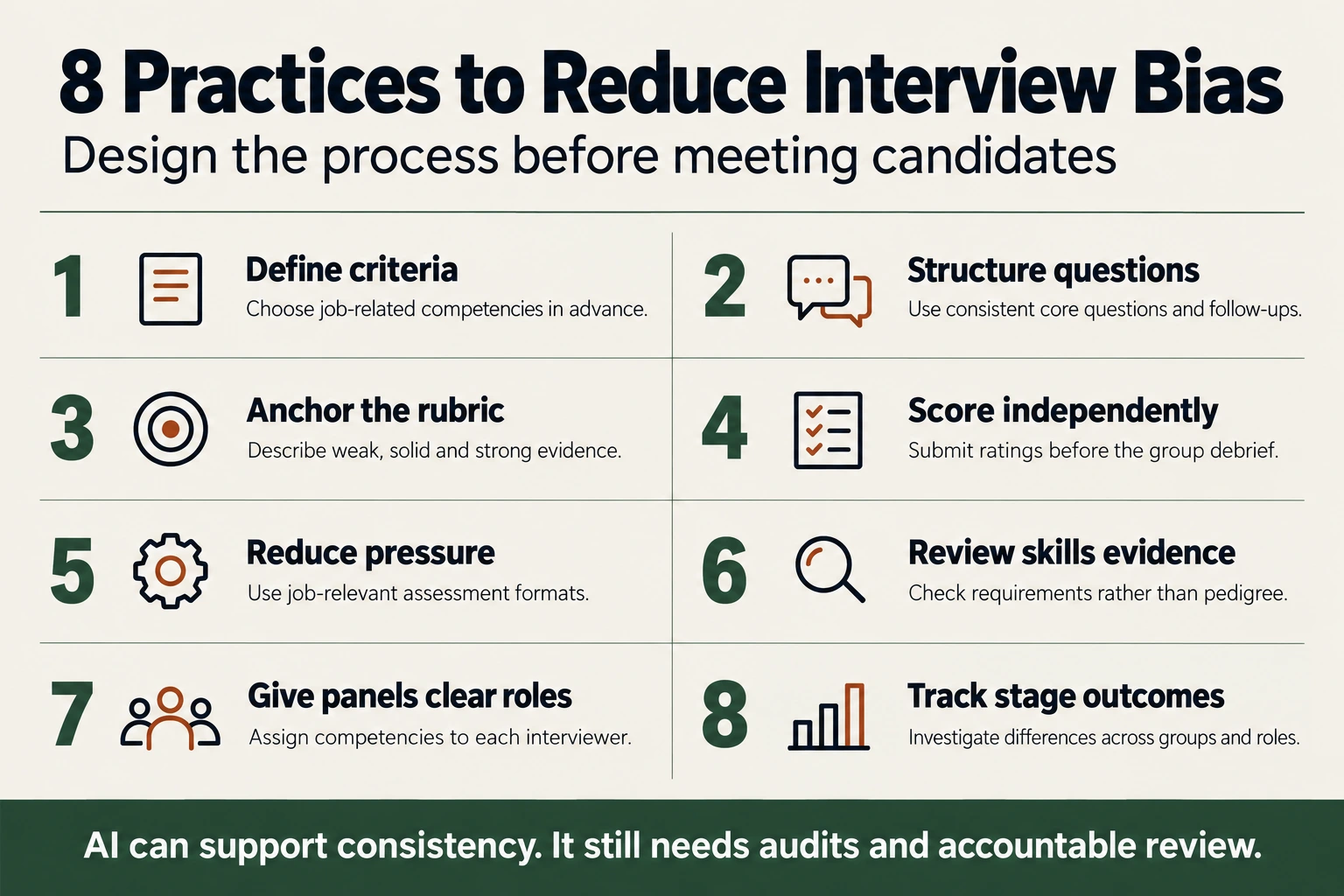
How to reduce interview bias: 8 practices that work
- Define the job criteria before you meet anyone. List the 4–6 competencies the role needs and what strong evidence looks like for each one. Every later step depends on this.
- Use structured interviews. Ask every candidate the same core questions in the same order, with planned follow-ups. Structured interviews are among the most predictive selection methods: a 2022 meta-analysis found they had the highest mean validity of the methods studied. They also give every candidate the same opportunity.
- Score against anchored rubrics. For each question, write what a weak (1), solid (3), and strong (5) answer contains. Anchors replace "I liked them" with evidence and reduce leniency and severity differences between interviewers. See an example rubric for a backend interview.
- Score independently before the debrief. Every interviewer submits their ratings and notes before discussion. This is the simplest defense against conformity and anchoring.
- Reduce performance pressure in technical rounds. Offer a time-boxed take-home task, a private coding session followed by a walkthrough, or a discussion of the candidate's own code. Keep live, watched coding to cases where it is truly job-relevant.
- Review resumes against requirements, not pedigree. Screen for evidence of the must-have skills, and consider hiding names, photos, and school names during the first review.
- Use diverse panels with defined roles. Different perspectives catch different blind spots, as long as each interviewer owns specific competencies rather than giving a general impression.
- Track outcomes by stage. Compare pass rates across groups at every stage. The US Uniform Guidelines' four-fifths rule treats a group's selection rate below 80% of the highest group's rate as a sign of possible adverse impact that is worth investigating.
Can AI reduce interview bias?
AI can reduce some sources of interview bias, but it is not bias-free and should never be marketed or used as if it were.
Where AI helps
- Consistency: an AI interviewer asks every candidate the same structured questions, with no "tough" or "easy" interviewer.
- Evidence: every answer is transcribed and scored against the same rubric, so reviewers can check the reasoning instead of relying on memory or impressions.
- Less live-audience pressure: candidates complete the first round on their own schedule, without an interviewer watching them think.
Where AI can make bias worse
- Learned bias: Amazon scrapped an experimental recruiting tool in 2018 after it learned to penalize resumes that mentioned "women's", because it was trained on a decade of mostly male hires.
- Hidden adverse impact at scale: a Stanford study published in May 2026 analyzed 4 million applications from 3.4 million people screened by one AI vendor. It found that 26% of Black applicants and 15% of Asian applicants applied to positions where the system's recommendations showed adverse impact against their group under the four-fifths rule. The problems were visible only when results were analyzed job by job, not pooled.
- Humans copy the AI's bias: in a University of Washington study of 528 people, participants shown biased AI recommendations mirrored them about 90% of the time. A "human in the loop" is not enough on its own.
How to use AI interviews responsibly
- Score only job-related criteria that you define, and require the evidence behind every score.
- Keep people accountable for every advancement and rejection decision, and train reviewers to check the evidence rather than accept the score.
- Audit outcomes for each role, not just in aggregate, and check for adverse impact at each stage.
- Tell candidates when AI is used and offer accommodations or an alternative format. In New York City, Local Law 144 also requires a bias audit and advance notice for automated employment decision tools.
- Be careful with signals that can disadvantage some candidates for reasons unrelated to the job, such as eye-movement tracking. Set any thresholds conservatively and review flags by hand.
How InterviewFlowAI supports fairer technical screening
InterviewFlowAI is built around structured evidence rather than a "bias-free" promise:
- Custom questions with rubrics: every candidate gets the same core questions, each scored against your definition of a strong (5) and weak (1) answer, with weights you set.
- Evidence for every score: each interview produces a scorecard and full transcript. Resume screening quotes the evidence it found for each requirement, or reports "No evidence found," instead of guessing.
- People decide: recruiters make the advancement decisions. The Ask FlowAI assistant can compare candidates but cannot shortlist or reject anyone.
- On-demand interviews: candidates take the first round when it suits them, in any of 16 supported languages, without a live audience.
For the full process of screening engineers with AI, including rubrics, integrity, and legal review, read the recruiter's guide to AI interviews for software engineers.
Check your interview questions for bias
Run your interview script through the free interview bias evaluator to check for biased wording and structural issues before your next hiring round.
Frequently asked questions
What is interview bias?
Interview bias is the distortion of an interviewer's judgment by factors unrelated to job performance, such as personal similarity, first impressions, stereotypes, or the stress of the interview format. It is usually unconscious and affects experienced interviewers too.
What are the most common types of interview bias?
The most common are affinity bias, first-impression bias, confirmation bias, the halo and horn effects, the contrast effect, recency bias, stereotyping, culture-fit bias, and conformity bias in group debriefs. In technical hiring, the pressure of live, watched coding is another major source.
How do you reduce bias in interviews?
Define job-related criteria in advance, ask every candidate the same structured questions, score answers against anchored rubrics, have interviewers score independently before discussing, reduce unnecessary performance pressure, and track pass rates by group at each stage of the process.
Can AI eliminate interview bias?
No. AI can reduce some biases by making interviews more consistent and evidence-based, but it can also learn or amplify bias, as Amazon's scrapped recruiting tool and a 2026 Stanford study show. Treat AI as a structured evidence-collection tool, audit its outcomes by role, and keep people accountable for decisions.
Are structured interviews less biased?
Structured interviews give every candidate the same questions and scoring standards, which reduces interviewer-to-interviewer inconsistency and room for impressions to take over. They are also among the most predictive selection methods. They still need job-related questions and well-trained interviewers.
What is the four-fifths rule?
Under the US Uniform Guidelines on Employee Selection Procedures, a selection rate for any group that is less than four-fifths (80%) of the rate for the group with the highest rate is generally treated as evidence of possible adverse impact, and should be investigated.
Sources
- Behroozi, M., Shirolkar, S., Barik, T., & Parnin, C. (2020). "Does Stress Impact Technical Interview Performance?" ESEC/FSE 2020. NC State summary.
- Stanford HAI, "AI Hiring Tools Can Yield Racial Bias and Systemic Rejection", May 2026.
- University of Washington, "People mirror AI systems' hiring biases, study finds", November 2025.
- CNBC/Reuters, "Amazon scraps a secret AI recruiting tool that showed bias against women", October 2018.
- Sackett, P. R., et al. (2022). "Revisiting meta-analytic estimates of validity in personnel selection." Journal of Applied Psychology. Summary.
- 29 CFR § 1607.4(D), Uniform Guidelines on Employee Selection Procedures.
- Cornell University HR, Interviewer Biases.