A role play exercise asks a candidate to handle a real conversation from the job, live, while someone plays the other person: a sceptical buyer, an upset customer, or a team member who needs difficult feedback. Instead of asking "how would you handle an objection?", you hear them handle one.
Role plays are among the most useful steps in hiring for sales, customer success, support, and management roles, and among the hardest to run well. We have just launched AI Role Plays in InterviewFlowAI to make them easy: an AI character plays the other person, every candidate gets the same scenario, and every call is scored against criteria you write. This guide covers the research, how to design and score a role play exercise, example scenarios, and a real report from a completed session.
What is a role play exercise in hiring?
A role play exercise is a short, simulated work conversation used to assess a candidate. The candidate gets a brief (who they are, who they are talking to, and what they need to achieve) and then holds the conversation in real time. It is scored against criteria set in advance. You will also hear it called a job simulation or work simulation.
| Method | What it tells you | What a role play adds |
|---|---|---|
| Resume screen | Experience and background | How the person talks to a customer |
| Interview | Experience, motivation, and how the candidate has handled past situations | The same skills shown live, in the situation itself |
| Skills test | Knowledge and written problem solving | Live listening, tone, and thinking on your feet |
| Role play exercise | How the candidate handles the conversation the job depends on | Works best alongside an interview, which covers experience and motivation |
Do role play exercises predict job performance? What the research says
Role plays belong to a family of methods with strong evidence behind them. In validity research, 0 means a method tells you nothing about later job performance and 1 means it predicts it perfectly.
| Finding | Source |
|---|---|
| Structured interviews are the top-ranked selection method (.42), followed by job knowledge tests (.40), work sample tests (.33), cognitive ability tests (.31), and assessment centres (.29). Structure is what lifts results: unstructured approaches score .19. | Sackett, Zhang, Berry & Lievens (2022), Journal of Applied Psychology |
| All five common assessment centre exercise types, including role plays, are significantly related to job performance (.16 to .19 each). | Hoffman et al. (2015), Journal of Applied Psychology |
| Rating answers against anchored scales lifted interview validity to .35, up from .26. | Taylor & Small (2002), as reviewed by Levashina et al. (2014), Personnel Psychology |
| Across 38 samples in 17 countries, candidates rated work samples and interviews as the selection methods they prefer most. | Anderson, Salgado & Hülsheger (2010), International Journal of Selection and Assessment |
| Only 23% of UK organisations that recruited in the past year use work sample tests and 21% use assessment centres, against 60% using competency-based interviews. | CIPD Resourcing and Talent Planning 2026 (n=791) |
The lesson: structure matters more than format. A role play with a fixed brief and anchored criteria works like a structured interview you can hear. Yet few teams use simulations, mostly because they are hard to run. (Older figures such as ".54 for work samples" come from Schmidt and Hunter, 1998, and were revised in 2022.)
Who uses role play exercises in hiring?
- UK Civil Service. The Cabinet Office's Success Profiles guidance lists role-play among the "job related simulations" used to assess behaviours, alongside presentations, in-tray, and group exercises.
- Police Service of Northern Ireland. Call handler applicants take a Customer Service Phone Simulation in which they "take on a role similar to that of Call Handler". The PSNI briefing estimates 20 minutes.
- Police forces in England and Wales. In the Briefing Exercise, candidates "assume the role of a police constable" and answer 12 questions in about 50 minutes. It is a written simulation.
- Arvato Bertelsmann (contact centre). Over half of new hires left within three months because candidates "didn't know what to expect from the job". After adding a realistic job preview and assessments, unwanted turnover fell by 63%, according to a case study published by the vendor, Harver. It covers a job preview rather than a role play.
The pattern is the same everywhere: put candidates in the situation before the offer, and both sides find out sooner whether the job fits.
Why role plays pay off, and why they are hard to run
Role plays matter most where a mis-hire is slow and expensive to discover:
| Role | What the data shows | Source |
|---|---|---|
| SDR | 3.0 months average ramp, 40% median annual attrition, 60% of SDRs at quota | The Bridge Group, 2025 (351 B2B companies) |
| Account executive | 6.2 months average ramp, the highest in the study's history; 48% of reps at quota | The Bridge Group, 2026 (158 B2B companies) |
| Contact centre agent | 31% mean annual attrition, much of it in the first 90 days, which the report calls "a problem that can be alleviated at the recruitment stage" | ContactBabel, 2024 |
| Any role | 74% of employers have hired the wrong person for a position, at a reported average loss of $14,900 per bad hire | CareerBuilder, 2017 (2,257 employers) |
(A widely shared claim that the US Department of Labor puts a bad hire at 30% of first-year salary could not be traced to any Department of Labor publication, so we don't use it.)
Run by hand, though, role plays are hard to do well:
- Manager time. Each session needs someone senior enough to play a convincing buyer, on top of a full interview calendar. Ashby's Talent Trends data shows recruiters now process 291 applications per hire, and business roles take 11.7 interviews and 12.2 interview hours per hire. Recruiters spend 38% of their time scheduling interviews (GoodTime). So live role plays usually wait until the final round.
- Consistency. One manager plays a friendly buyer, another a hostile one, so two candidates rarely face the same test.
- Scoring and records. Without written criteria and a recording, the result rests on one person's notes.
What we launched: AI Role Plays in InterviewFlowAI
An AI role play is a live voice conversation between a candidate and an AI character that stays in role. When the call ends, the transcript is scored against your criteria, and you get a score out of 100, a recommendation, the evidence behind each score, the recording, and the transcript.
- Built from a description. Describe the situation in plain words or start from a template, and the AI drafts the scenario, character, and criteria for you to review.
- Hidden facts reward good questions. The character holds back details until the candidate asks the right question.
- Same test for everyone, no scheduling. Candidates join from an email link when they are ready.
- 16 languages. Run the role play in the language the job is done in.
Role plays have their own page in the dashboard and aren't tied to one job, so you can reuse a role play across roles or invite people directly. Watch the video walkthrough.
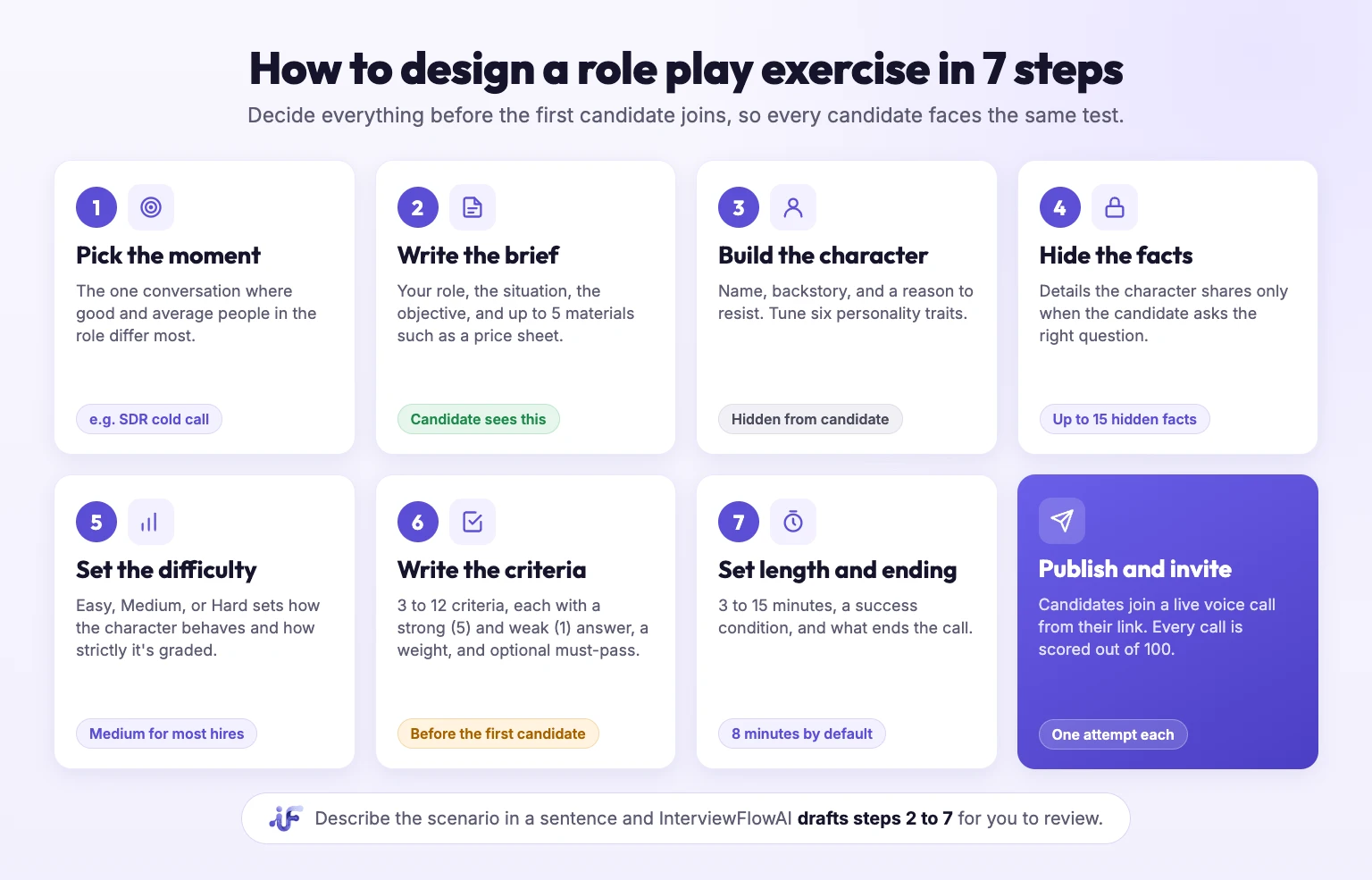
How to design a role play exercise in 7 steps
These steps apply whether a manager or an AI plays the character.
1. Pick the one conversation the job depends on
Pick the moment where good and average people in the role differ most: the first minute of an SDR's cold call, a renewal after a budget cut, or feedback to a strong performer whose behaviour has to change. If a candidate handled it well, you should feel noticeably more confident about hiring them.
In InterviewFlowAI: click New role play and describe the situation, or start from a template: SaaS discovery call, Cold call (SDR), Pricing objection, Frustrated customer escalation, Production incident debugging, Renewal at risk, or Difficult feedback.
2. Write the candidate's brief
Give only what a real person in the role would know: your role ("Account executive at a payroll software company"), the situation ("The buyer booked a demo after downloading a pricing guide"), the objective ("Understand their process and agree a next step"), and any materials such as a price sheet. Keep it short, or you are testing reading.
In InterviewFlowAI: add up to five materials and optional tips. The brief stays on screen during the call.
3. Build a character with a reason to resist
A character who agrees with everything tells you nothing. Give them a name, a backstory, and a reason to be hard work: a bad experience with a past vendor, a boss who wants costs cut, or too little time.
In InterviewFlowAI: set the name, voice, photo, opening line, and backstory, then tune six personality traits or describe the personality in your own words.
4. Hide the facts a good candidate would uncover
Decide which details the character shares only when the candidate earns them. For a discovery call: the budget is approved for this quarter only (shared if asked about timing); the finance director makes the final call (shared only after a follow-up on who else is involved).
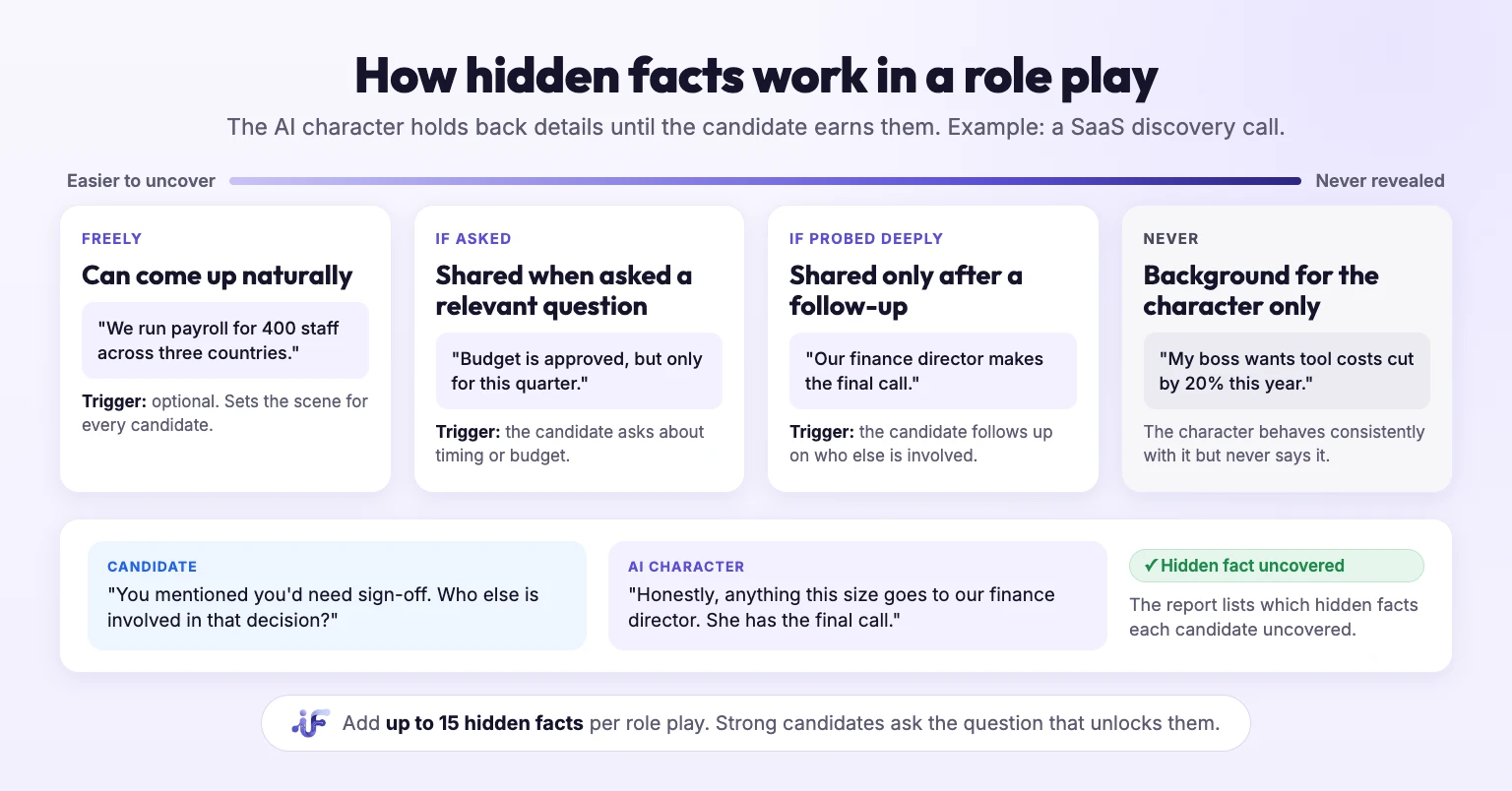
In InterviewFlowAI: add up to 15 hidden facts, each shared Freely, If asked, If probed deeply, or Never, with a trigger. The report shows which ones each candidate uncovered.
5. Match the difficulty to the role
| Difficulty | Character | Grading | Good for |
|---|---|---|---|
| Easy | Cooperative, shares facts readily | Credits reasonable attempts | Entry-level and graduate roles |
| Medium | Neutral, standard sharing | Expects a competent professional response | Most experienced hires |
| Hard | Guarded, needs deeper questions | Expects precise, complete answers | Senior and enterprise roles |
6. Write the scoring criteria before the first candidate
For each criterion, write what you are looking for, what a strong answer (5) and a weak answer (1) sound like, and how much it matters. Describe things you could hear on the recording: "asks about the current process before mentioning the product" can be scored; "good discovery" can't.
In InterviewFlowAI: use 3 to 12 criteria, each weighted 1 to 10 (a weight of 1 is informational). AI-tune rewrites anchors as observable behaviour, and Must pass turns the recommendation to No if the candidate scores 2 or lower, without changing the score. Candidates see criterion names only by default, never the anchors.
7. Set the length and the ending
Five to ten minutes is enough to get past small talk into the hard part. Decide in advance what ends the call: time, or the objective being reached.
In InterviewFlowAI: calls run 3 to 15 minutes (8 by default). A cold call setting plays a ring tone, and the character hangs up if the candidate hasn't earned more time within 20 to 180 seconds. See every setting in the docs.
Role play exercise examples by role
| Role | Scenario | Objective | Hidden fact worth uncovering | Must-pass criterion |
|---|---|---|---|---|
| SDR / BDR | Cold call to a busy operations manager | Earn two more minutes and book a meeting | Their current tool's contract ends in three months | A relevant reason to stay on the call in the first 30 seconds |
| Account executive | Discovery call with a buyer who downloaded a pricing guide | Qualify the deal and agree a next step | Finance has the final say, not the buyer | Asks about the problem before presenting the product |
| Senior AE | Buyer asks for 30% off to sign this month | Hold value and trade rather than discount | A cheaper competitor quote is a year old | No discount without getting something in return |
| Account manager / CSM | Renewal at risk after a budget cut | Find out what changed and protect the renewal | A new VP is questioning every tool | Confirms current goals before proposing options |
| Customer service | Customer charged twice, already passed between two agents | Calm the customer and resolve or escalate | They are about to post a public review | Acknowledges the frustration before process |
| Technical support | Stressed customer reports a production outage | Diagnose the cause with structured questions | A config change was deployed an hour earlier | Asks what changed recently before suggesting fixes |
| Team lead / manager | Feedback to a high performer who misses deadlines | Give clear, fair feedback and agree next steps | They are covering for a struggling colleague | Names the specific behaviour and its impact |
Pair the role play with a role-specific interview: see the AI interview guides for sales representatives and call centre agents, or how InterviewFlowAI supports sales hiring and high-volume hiring. For a full practice script, try the free sales role play script generator.
How to score a role play exercise: an example rubric
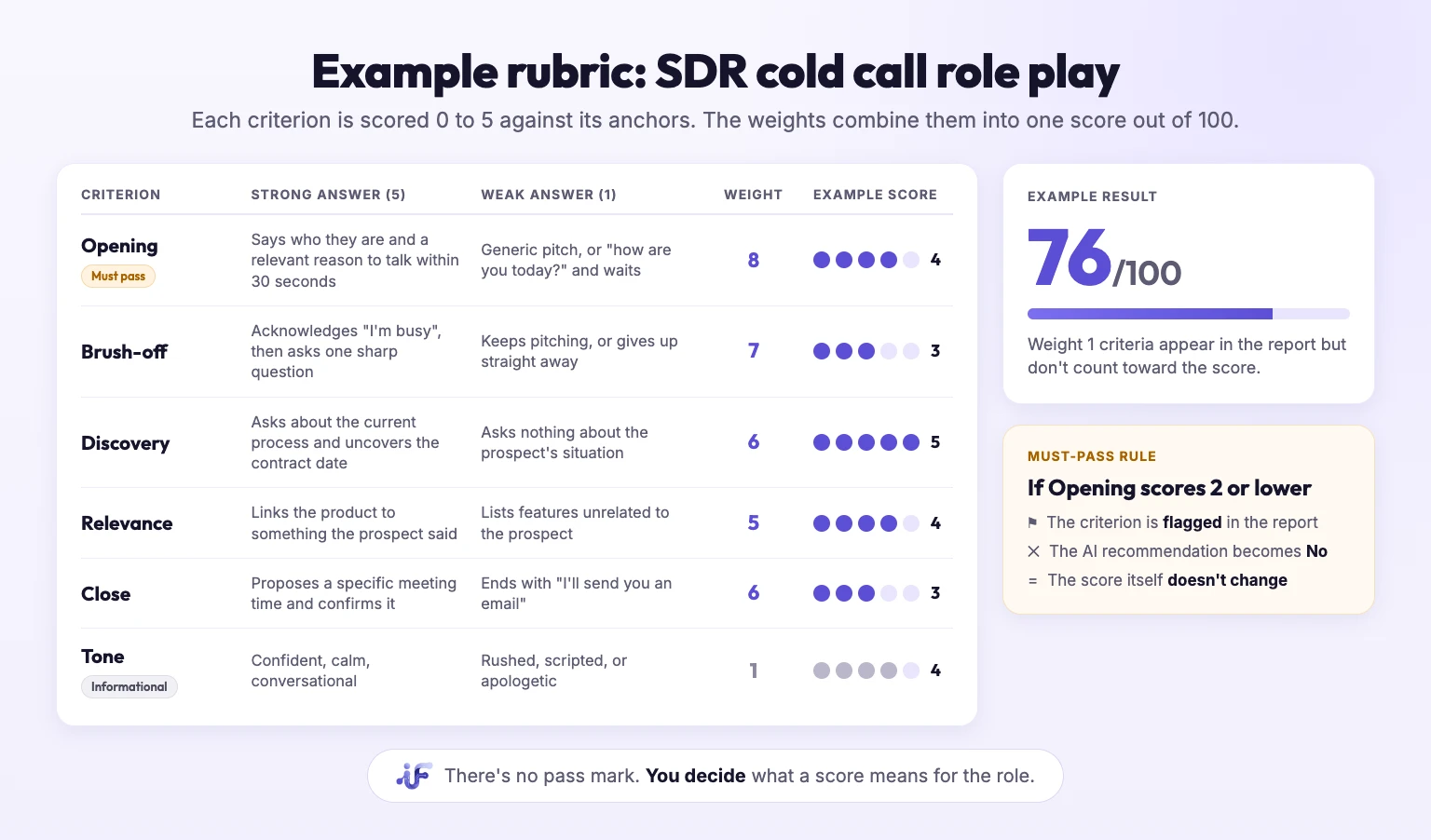
Each criterion is scored 0 to 5, and the weights combine them into one score out of 100. Here is a rubric for the SDR cold call above:
| Criterion | Strong answer (5) | Weak answer (1) | Weight |
|---|---|---|---|
| Opening (must pass) | Says who they are and a specific, relevant reason for calling within 30 seconds | Generic pitch, or "how are you today?" and waits | 8 |
| Handling the brush-off | Acknowledges "I'm busy", then asks one sharp question that earns more time | Keeps pitching, or gives up straight away | 7 |
| Discovery | Asks about the current process and uncovers the contract end date | Asks nothing about the prospect's situation | 6 |
| Relevance | Connects the product to something the prospect said | Lists unrelated features | 5 |
| Close | Proposes a specific meeting time and confirms it | Ends with "I'll send you an email" | 6 |
| Tone | Confident, calm, conversational | Rushed, scripted, or apologetic | 1 (informational) |
Anchors make a measurable difference: rating answers against anchored scales lifted interview validity to .35, up from .26 (Taylor & Small, 2002). Score against the anchors rather than other candidates, quote the evidence for each score, keep must-pass criteria to one or two, and don't change the rubric mid-process. InterviewFlowAI grades each session once, against the criteria in place when the call ended.
A real role play report, explained
The candidate opens an email link (no account needed), reads their brief, and sees the key facts up front: call length, live voice call, one attempt, language. Clicking Join role play starts the call, and results usually appear a few minutes after it ends. Set expectations in the invitation: explain that the role play is a live conversation with an AI character, how long it takes, and that a person on your team reviews every result.
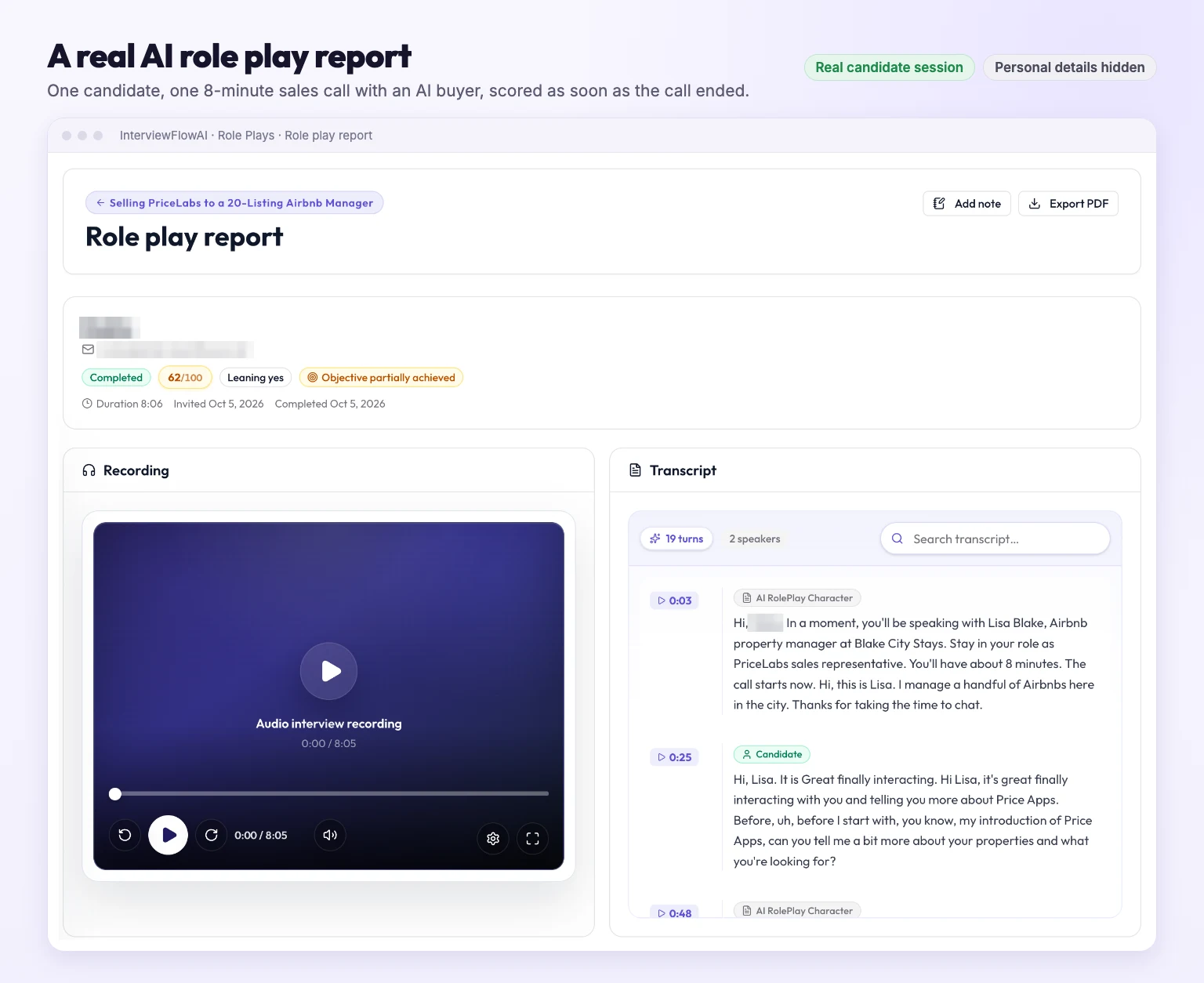
Here is a real report from a completed session in our own workspace. The candidate played a sales rep for PriceLabs, a pricing tool for short-term rentals, speaking with Lisa Blake, an AI character who manages 20 Airbnb listings. We have hidden the candidate's name and email.
| Measure | Result |
|---|---|
| Call length | 8 minutes 6 seconds, 19 turns |
| Score | 62 out of 100 across 7 criteria |
| AI recommendation | Leaning yes |
| Objective | Partially achieved |
| Hidden facts uncovered | 3 of 11 |
| Strengths and gaps | 4 strengths and 5 gaps, each linked to a moment in the recording |
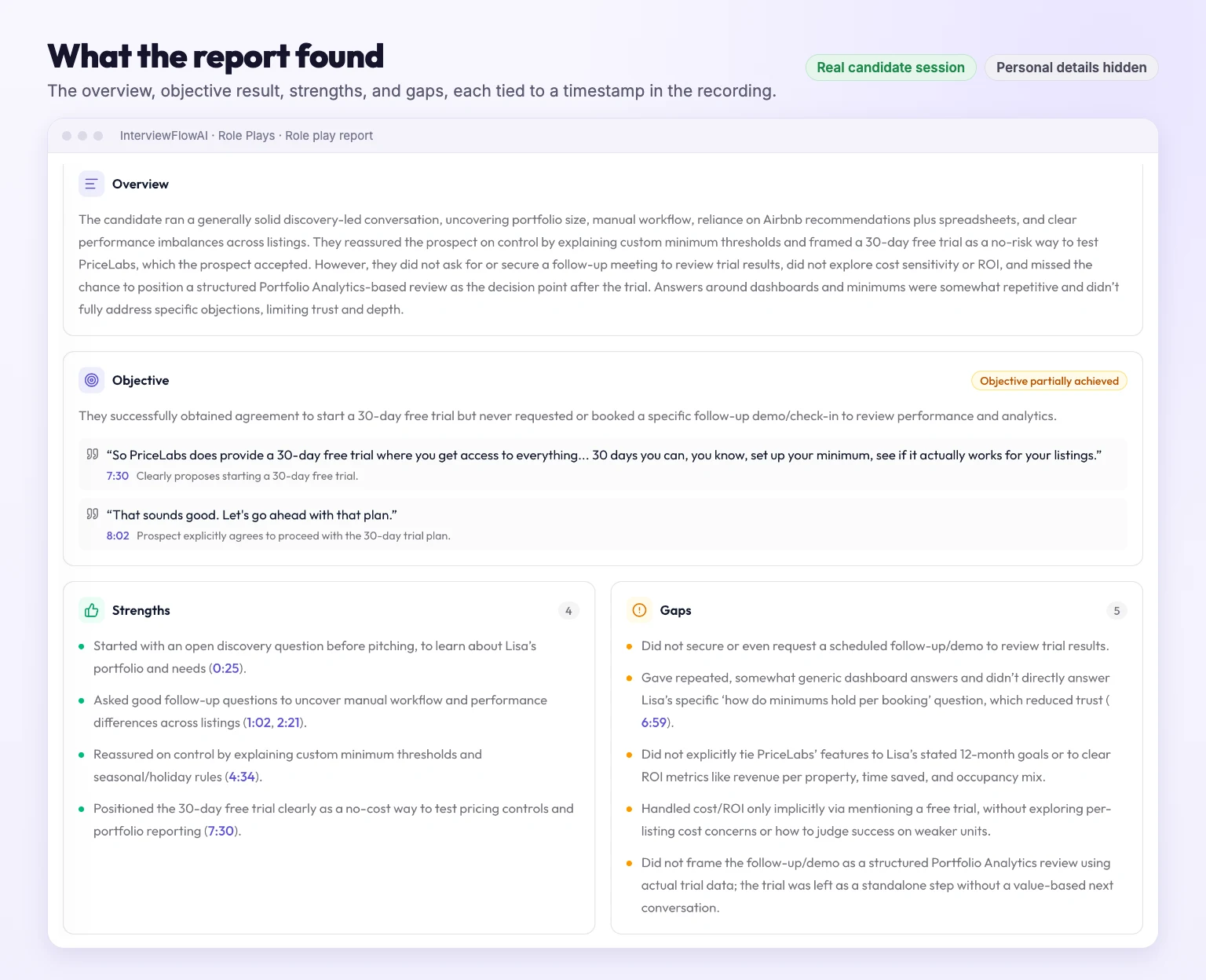
- Discovery before the pitch. The candidate opened with a question about Lisa's properties at 0:25, and follow-ups at 1:02 and 2:21 uncovered three hidden facts, including her reliance on a spreadsheet and the gap between her busiest and quietest units.
- A clear proposal, accepted. At 7:30 the candidate offered a 30-day free trial, and at 8:02 the AI character agreed: "That sounds good. Let's go ahead with that plan."
- A missing next step. The objective also called for a follow-up to review the trial results, and the candidate never asked for one. Cost concerns and Lisa's 12-month goals went unexplored.
The score tells a precise story: strong discovery, a weak close, which is exactly what to probe in the final interview. Each criterion card shows its reasoning and quoted evidence, and a Better response appears where a criterion scores 3 or lower. The report exports to PDF, like interview scorecards and transcripts. There is no pass mark: to set your bar, run the role play with two or three strong people already in the role and compare candidates against their scores.
Where role plays fit, and what they cost
Because nobody from your team needs to be on the call, an AI role play can come earlier in the process:
- AI screening interview: experience, motivation, and basics, with the AI Interviewer. See how AI candidate screening works and which screening interview questions to ask. For knowledge with right answers, add a skill assessment.
- AI role play: the shortlist handles the real conversation.
- Final interview: with the hiring manager, using the role play recording.
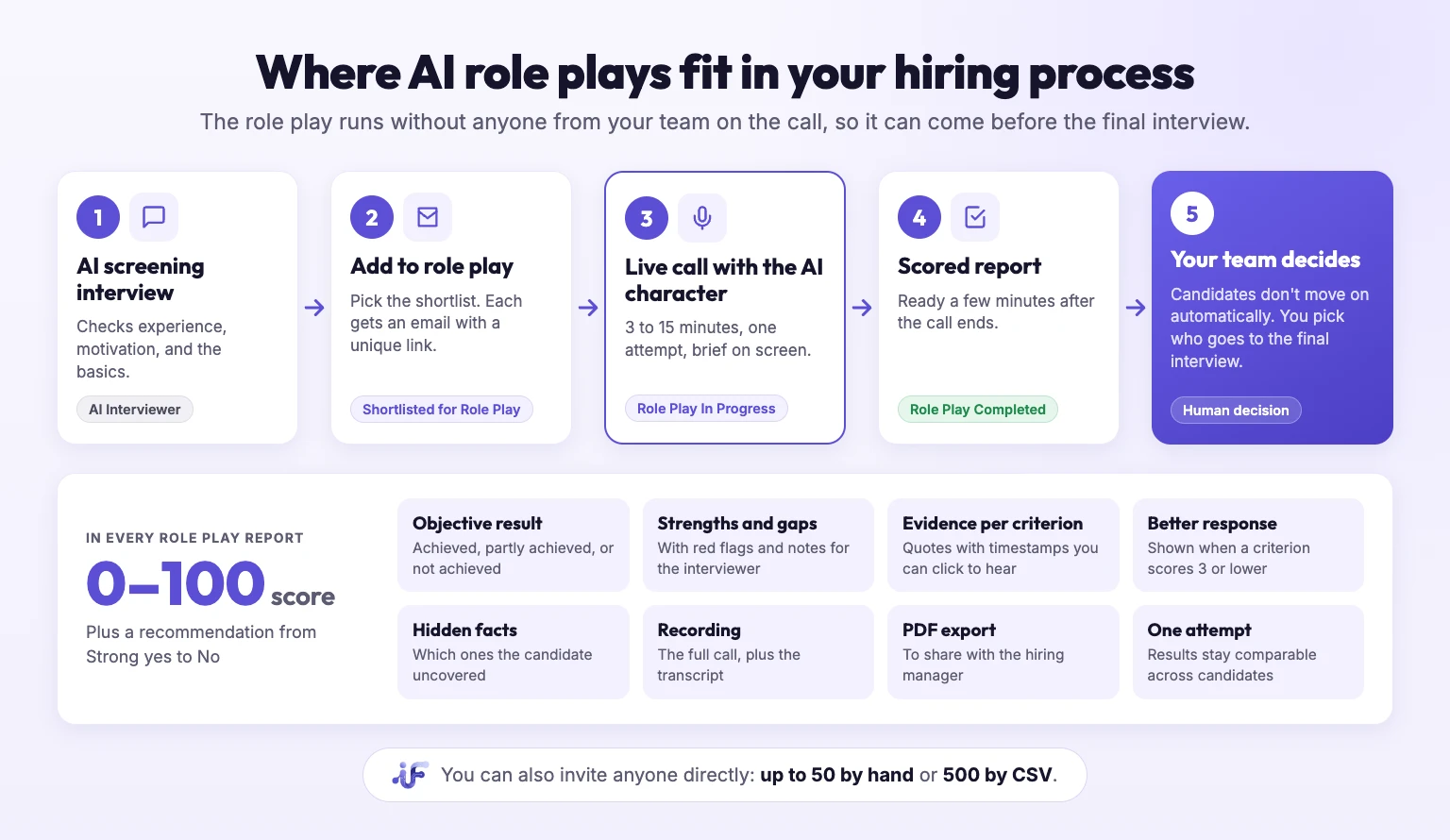
Select candidates in an Interviewer and click Add to role play, or invite anyone directly (up to 50 by hand or 500 by CSV). Each person gets one attempt per role play, and candidates move to the next stage only when your team moves them. Inviting candidates and reviewing results covers the details.
AI role plays cost $1.99 per scored role play, with no seat fees or annual contract. Calls that can't be scored, for example because they were too short, are free. See pricing.
Common role play exercise mistakes
- A character with no reason to resist. If the buyer agrees to everything, everyone scores well.
- Testing knowledge the candidate can't have. Provide it as materials and score how they use it.
- Criteria that describe personality. Score behaviour you can point to in the transcript, not "confident" or "charismatic".
- Too many criteria, or showing the full rubric. Six to eight criteria is plenty, and criterion names are usually all candidates need to see.
- Not explaining the format. Tell candidates they will talk to an AI character, how long the call lasts, and that a person reviews the result.
- Skipping the dry run. Take the role play yourself first to catch a brief that gives too much away.
Frequently asked questions
What is a role play exercise in an interview?
A simulated work conversation where the candidate plays themselves in the job and a person or AI plays a customer, prospect, or colleague. The candidate works towards an objective in real time and is scored against set criteria.
Do role play exercises predict job performance?
Yes, when they are structured. In Sackett and colleagues' 2022 re-analysis, structured interviews ranked first (.42) and work sample tests scored .33, and assessment centre exercises including role plays each relate to job performance.
How long should a role play exercise be?
Usually 5 to 10 minutes. InterviewFlowAI role plays run from 3 to 15 minutes, with 8 as the default.
How do you score a role play exercise fairly?
Write criteria before assessing anyone, with observable strong and weak answers for each, then score every candidate against them with quoted evidence. Give everyone the same brief, character, and difficulty.
Can candidates retake an AI role play?
No. Each person gets one attempt per role play, which keeps results comparable. Someone invited directly by email can be removed and re-invited if their call hasn't started.
Which roles suit role play exercises?
Any role where a conversation is the job: SDRs, account executives, account managers, customer success, customer service, technical support, and people managers.
What languages do AI role plays support?
16 languages, including English, Spanish, French, German, Portuguese, Arabic, Hindi, Japanese, and Chinese.
Try an AI role play exercise
Pick one conversation the job depends on, describe it in a sentence, and let the AI draft the scenario, character, and scoring for you to review. See the AI Role Plays feature, how teams run role play interviews, or our guide to AI role play software.
Sources
- Sackett, P. R., Zhang, C., Berry, C. M., & Lievens, F. (2022). Revisiting meta-analytic estimates of validity in personnel selection. Journal of Applied Psychology, 107(11), 2040–2068.
- Hoffman, B. J., Kennedy, C. L., LoPilato, A. C., Monahan, E. L., & Lance, C. E. (2015). A review of the content, criterion-related, and construct-related validity of assessment center exercises. Journal of Applied Psychology, 100(4), 1143–1168.
- Levashina, J., Hartwell, C. J., Morgeson, F. P., & Campion, M. A. (2014). The structured employment interview: Narrative and quantitative review of the research literature. Personnel Psychology, 67(1), 241–293.
- Anderson, N., Salgado, J. F., & Hülsheger, U. R. (2010). Applicant reactions in selection. International Journal of Selection and Assessment, 18(3), 291–304.
- CIPD (2026). Resourcing and Talent Planning report, Figure 28.
- Ashby (2026). Talent Trends Report: Recruiter productivity.
- GoodTime (2026). 90% of US companies say they missed their hiring goals in 2025.
- The Bridge Group (2025). SDR Models & Metrics Report.
- The Bridge Group (2026). AE Models, Motions & Metrics Report.
- ContactBabel (2024). The US Contact Center Decision-Makers' Guide, 16th edition.
- CareerBuilder (2017). Nearly three in four employers affected by a bad hire.
- Cabinet Office (2025). Success Profiles: Civil Service behaviours.
- Police Service of Northern Ireland. Call Handler Selection Testing Briefing.
- Join the Police. What's involved in the Briefing Exercise?
- Harver (2019). How Arvato reduced employee turnover by 63% (vendor case study).