AI sales role-play training lets a rep practice a sales conversation with an AI buyer, review feedback, and work on a specific skill before the next customer call. For a sales manager, the useful output is a conversation you can coach: what the rep asked, what they missed, and what they should try next.
This guide proposes a four-week program for new or existing reps, with a worked discovery scenario, an illustrative scorecard and a coaching debrief. The schedule is a starting point to adapt to your team, and the scenario and conversation are fictional examples written for this guide.

What should an AI sales role-play training program achieve?
Choose a conversation that your team needs to handle better. A new SDR might need to earn permission to continue a cold call. An AE might need to follow up when a buyer gives a vague answer. An account manager might need to uncover why a renewal is at risk.
Write the outcome so another manager could observe it. “Improve discovery” leaves too much room for interpretation. “Ask a follow-up question that reveals why the current process is failing” gives the rep something to practice and the reviewer something to look for.
| Purpose | What you need to learn | What happens afterward |
|---|---|---|
| Practice | Which behavior needs attention? | Explain the gap, rehearse a better response and assign a follow-up exercise. |
| Readiness check | Can the rep demonstrate the required behaviors in a fresh scenario? | A manager reviews the evidence and decides what support or supervision is needed. |
| Hiring assessment | How does a candidate handle a job-relevant conversation under consistent conditions? | Combine the evidence with the rest of the hiring process. |
This article focuses on employee practice and readiness. For candidate assessment, use the separate guide to designing and scoring role-play exercises for hiring, or see how teams run AI role plays for sales hiring. If you hire reps in large groups, place the role play after a first-round screen built from structured screening interview questions, as part of a consistent high-volume hiring process.
How do you run a four-week AI sales role-play training plan?
Show/hide animation

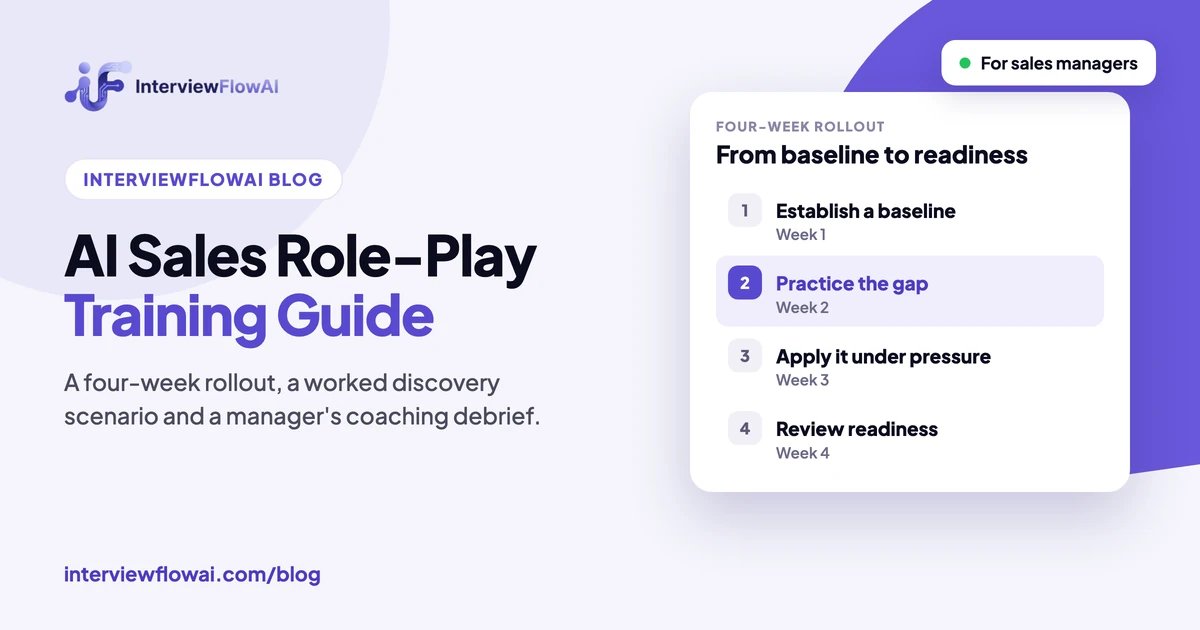
A four-week program moves from a baseline conversation to targeted practice, then a harder scenario, then a readiness check in a fresh situation, with one manager review each week. The design follows the research on practice-based training. A meta-analysis of 117 behavior modeling training studies found that trained skills and on-the-job behavior held steady or improved over time, while declarative knowledge faded. Skills carried over to the job best under four conditions: training showed both weak and strong examples, practice included trainee-generated scenarios, trainees set goals, and their managers were trained too (Taylor, Russ-Eft and Chan, 2005).
Simulation also works best alongside coaching, not instead of it. A meta-analysis of 65 samples and 6,476 trainees compared computer-based simulation games with other training. Trainees scored 14% higher on procedural knowledge, 11% higher on declarative knowledge and 9% higher on retention. The gains were larger when the simulation supplemented other instruction (Sitzmann, 2011). The same review found evidence of publication bias, so treat those figures as directional.
Time is the constraint. Employees now receive an average of 40 training hours a year, down from 47 the year before. Games and simulations are also the most frequently planned training purchase, cited by 49% of organizations (Training Magazine, 2025). A short, focused exercise each week fits that budget.
Start with a small group and one sales motion. Assign a manager to own the rubric and follow-up coaching. Before the first session, give reps the purpose of the program, the criteria they will be reviewed against and an explanation of who will see the results.
The following is a proposed schedule. Adjust the number of exercises to your team’s workload and the amount of useful feedback each manager can provide.
| Week | Rep activity | Manager activity | Evidence to retain |
|---|---|---|---|
| 1: Establish a baseline | Read the brief and complete an initial discovery scenario without mid-call coaching. | Review the recording and transcript. Identify one behavior to improve. | The scenario version, rubric, report and an excerpt supporting the feedback. |
| 2: Practice the gap | Rehearse the missing follow-up question in a coaching conversation, then complete a different scenario targeting the same skill. | Check whether the rep used the behavior at the relevant moment. | The new scenario, the observed behavior and any remaining gap. |
| 3: Apply it under pressure | Handle a buyer who is more guarded or introduces a time constraint. | Record the difficulty change. Review judgment, accuracy and the quality of follow-up questions. | What changed in the exercise and how the rep responded. |
| 4: Review readiness | Complete a fresh scenario at the difficulty chosen for the readiness check. | Review the full conversation against the agreed standard and decide the next action. | A manager’s decision, supporting evidence and a specific next practice or supervised task. |
Do not interpret a lower week-three score as proof that the rep regressed: the exercise became harder. For a closer comparison, use two scenarios with the same rubric, difficulty and disclosure rules. Record meaningful changes instead of putting every score on one unexplained trend line.
A rollout needs three owners: someone who approves the scenario, someone who reviews the evidence, and someone who follows up with the rep. In a small team, one manager can cover all three. The work still needs time on the calendar.
Worked example: discovery before the demo
The example below uses a fictional product and company. It shows how a scenario, the evidence and a coaching decision connect.
The rep’s brief
You sell RouteDesk, a fictional tool that routes support tickets to the right team. Maya, the operations lead at Northstar Fulfillment, has agreed to a short discovery call. She says ticket handovers are messy. Your goal is to understand what is going wrong and, if there is a useful fit, agree a workflow review with the appropriate people.
Your approved product facts are limited: RouteDesk can route tickets using rules and show ownership. Whether it fits the buyer’s systems needs a technical review. You must not promise a particular reduction in response time or claim an integration you have not checked.
The buyer’s private brief
- Opening concern: “We already have a help desk. I don’t want another tool.”
- Underlying problem: handovers between warehouse support teams leave some tickets without a clear owner. Reveal this if the rep asks what happens during a handover.
- Business impact: eight tickets missed the internal response target last week. Reveal this after a relevant follow-up about consequences.
- Time pressure: an operational review is due next month. Reveal this if the rep explores timing.
- Other stakeholder: the customer-service lead owns the process and should join any workflow review. Reveal this if the rep asks who manages the process or needs to be involved.
The buyer should answer relevant questions naturally and resist an immediate product pitch. The exercise tests whether the rep earns the information. If the buyer volunteers every private fact at the start, it becomes a different task.
You can use the sales role-play script generator to draft another brief. Review its buyer context, disclosure rules and scoring before assigning it.
An illustrative conversation that needs coaching
This shortened, fictional transcript deliberately shows missed opportunities.
Buyer: We already have a help desk. I don’t want another tool.
Rep: What is making you look at this now?
Buyer: Handovers between the warehouses are messy. Tickets get passed around.
Rep: We can automate that. Our software should halve your response time.
Buyer: I’m not sure that fixes the problem. We cannot take on a big implementation.
Rep: The best way to see it is a demo. Are you free on Thursday?
Buyer: Send me something first.
Rep: Sure, I’ll email you the deck.
The rep opens with a relevant question, then moves into a pitch before understanding the handover. The response-time claim is unsupported by the approved product facts. The rep also leaves the impact, timing and process owner unexplored.
How should managers score a sales role play?
Define the criteria before assigning the exercise. The free interview scorecard generator can draft a starting rubric to adapt for a role play. The sample below uses four criteria on a 0–5 scale. The anchors show examples at 1, 3 and 5; use 2 or 4 for behavior between those anchors, and 0 when there is no relevant demonstration. Adapt the wording to your sales motion.
| Criterion | 1: Weak | 3: Adequate | 5: Strong |
|---|---|---|---|
| Discovery follow-up | Pitches after the first general problem. | Clarifies how the current process works. | Uses relevant follow-ups to uncover the failure point and ownership. |
| Business impact | Assumes the consequence without asking. | Gets a concrete example of the consequence. | Establishes the scale or frequency and checks its importance with the buyer. |
| Product accuracy | Makes an unsupported outcome or capability claim. | Stays within the supplied facts and identifies what needs checking. | Connects a relevant capability to the problem while stating the limits clearly. |
| Next-step agreement | Suggests a generic demo or sends material without an agreed purpose. | Agrees a specific follow-up activity and its purpose. | Agrees a relevant activity with the right people and a clear outcome. |
For the excerpt above, a manager’s example ratings would be:
- Discovery 1/5: a relevant opening question, then a pitch after the first general problem.
- Impact 0/5: the consequence was never explored.
- Accuracy 1/5: the response-time promise is not in the approved facts.
- Next step 1/5: a generic demo request, then an unqualified deck send.
If two managers interpret an anchor differently, review the same passage independently, compare the evidence and make the anchor more specific.
Keep the report useful to the rep: criterion, evidence, explanation and next action. A number without the relevant moment from the conversation gives the manager little to coach. InterviewFlowAI pairs each score with the conversation in its scorecards and transcripts.
How do you turn a role-play score into coaching?

Pairing the weak response with a stronger one is deliberate. In the behavior modeling meta-analysis above, skills transferred best when training showed both negative and positive examples and trainees set goals. Start with the rep’s view, then examine the same conversation together. Keep the debrief focused enough that the rep can name the behavior they will change.
- Ask for self-review: “Where did you understand Maya’s problem, and where did you start assuming?”
- Find the moment: return to “Handovers between the warehouses are messy.” Ask what remained unknown at that point.
- Choose the follow-up: have the rep suggest a question that would clarify the handover before discussing a solution.
- Correct the product claim: review the approved facts and replace the promise about response time.
- Agree the next exercise: use a different buyer situation that requires the same discovery behavior.
A better response to rehearse could be:
“When a ticket moves from one warehouse team to another, who owns it until the handover is accepted?”
“What happens when that ownership is unclear? How often did that happen last week?”
“RouteDesk can make routing rules and ownership visible. We would need to review your workflow and systems before saying what it could change. Would a workflow review with your customer-service lead be useful?”
Use it as a question sequence that adapts to the buyer’s answers. The follow-up exercise should change the context so the rep has to listen again.
Show/hide animation

Review readiness across fresh situations
Separate a familiar exercise from a readiness check. A rep who knows which facts are hidden can score better without showing the same skill in a new conversation. Preserve the target behavior and use a fresh buyer context for the later check. If you also need to check product knowledge separately, pair the role play with a short skill assessment.
Before moving the rep to a supervised customer call, a manager might look for four things in this discovery exercise. The rep follows up on the handover problem, establishes a concrete consequence, stays within product facts and agrees a useful next step.
Use a simple tracker with the rep, date, scenario version, difficulty, observed gap and agreed next action. Store the supporting report or recording link where your team normally reviews coaching. A spreadsheet is sufficient for an initial pilot.
Keep these measurements separate:
- Participation: whether the rep completed the assigned exercise.
- Demonstrated behavior: whether the target skill appeared in the simulated conversation.
- Transfer to work: whether a manager observes that behavior in real conversations, through an appropriate review process.
Expect the effect to shrink at each step. In the behavior modeling meta-analysis, training effects were largest on learning outcomes, smaller on job behavior and smaller still on business results (Taylor, Russ-Eft and Chan, 2005). Participation is not proof of readiness, and a higher role-play score is not proof of higher revenue. If you want to make an outcome claim, define the measure, baseline, review period and other changes affecting the team before drawing a conclusion.
Can you run sales role-play training in InterviewFlowAI?
Yes. InterviewFlowAI, which publishes this guide, supports AI role plays for employee training as well as hiring. Its creation guide documents scenario drafting, hidden facts, conversation guidelines, 3–12 evaluation criteria and calls lasting 3–15 minutes.
Describe the training objective in the Scenario Studio, review the draft and publish it. Invite team members by email, then review the scored criteria, transcript and available recording. The report documentation explains how to inspect the reasoning and evidence for each criterion.
Plan repeat practice correctly: the current documentation allows one attempt per person per role play. For a later exercise, use a different role play with comparable criteria and difficulty. Directly invited participants can also be deleted and reinvited, with restrictions documented in the invite guide; preserve the baseline evidence you need before removing a participant.
If you are still choosing software, see our comparison of AI sales role-play tools or the broader guide to AI role-play software for hiring and training.
InterviewFlowAI runs and scores each role play. The tracking sheet and four-week plan are management practices you run alongside it.
Frequently asked questions
What is AI sales role-play training?
AI sales role-play training is AI role-play training for sales teams. An AI buyer simulates a sales conversation so a rep can practice a skill, review feedback and decide what to improve. A manager sets the exercise and scoring criteria, reviews evidence from the conversation and follows up with coaching.
How do you start an AI sales role-play training program?
Choose one sales skill and a small pilot group. Give reps a clear brief, define observable scoring criteria, run a baseline conversation and assign a manager to review the evidence. Use one specific coaching action to shape the next exercise.
How often should sales reps complete role-play training?
The proposed four-week pilot in this guide starts with one scored exercise and one coaching debrief each week. Adjust the cadence to the skill, the rep’s needs and the feedback managers can provide.
How should a manager score a sales role play?
Score observable behavior against criteria written before the exercise, and retain evidence supporting each rating. For discovery, criteria might include follow-up questions, business impact, product accuracy and next-step agreement. Use clear scoring anchors and review disagreements between evaluators.
Can reps repeat the same AI role play in InterviewFlowAI?
InterviewFlowAI’s documentation allows one attempt per person per role play. Use a different role play for a later exercise. Directly invited participants can also be deleted and reinvited under the documented restrictions; preserve any baseline evidence you need before removing them.
Does a high AI role-play score prove that a rep is ready for customers?
A score shows performance in a particular simulated situation. A manager should review the conversation against the required behaviors, consider performance in fresh scenarios and decide what supervision is appropriate. A higher practice score alone does not establish better customer-call performance or higher revenue. In a meta-analysis of 117 behavior modeling training studies, effects were largest on learning, smaller on job behavior and smaller still on business results.
Sources and editorial notes
Product details were checked against the official pages below on November 5, 2026. Research findings are taken from each study’s published abstract or report. The training plan, fictional scenario, transcript, scoring examples and coaching language are original editorial examples, not measured customer outcomes.
- Taylor, Russ-Eft and Chan (2005), A Meta-Analytic Review of Behavior Modeling Training, Journal of Applied Psychology
- Sitzmann (2011), A Meta-Analytic Examination of the Instructional Effectiveness of Computer-Based Simulation Games, Personnel Psychology
- Training Magazine, 2025 Training Industry Report
- Role plays overview: scoring and attempt rules
- Create a role play: scenario details, hidden facts and evaluation criteria
- Invite Candidates and review results: reports and reinvitation restrictions
- InterviewFlowAI AI role plays: product description for hiring and training
Mukul Munjal
Founder & CEO, InterviewFlowAI
I'm Mukul Munjal, founder and CEO of InterviewFlowAI. I have 7 years of experience in engineering, 3 of them building voice agents, and I lead the team that builds our AI interviewer. Before publishing, I check competitor prices and features against each vendor's own pages.