
Most startups do not need an enterprise recruiting suite. They need one or two tools that remove the slowest part of hiring without adding another system nobody maintains. That slow point differs by company. A pre-seed founder may need a free place to track applicants. A Series A team with 300 applications may need structured first-round screening. A startup hiring a niche engineer may need outbound sourcing rather than more applicants.
This guide compares 10 AI recruiting tools for startups across five jobs: sourcing, applicant tracking, screening, skills assessment, and interview documentation.
Top 10 Affordable AI Recruiting Tools for Startups (2026)
| Hiring problem | Best fit in this guide | Published starting price | What to know first |
|---|---|---|---|
| Founders spend hours on first-round screens | InterviewFlowAI | $0.99/interview on monthly plans | It adds a structured screening layer; it is not a full ATS. |
| The team needs a low-cost AI ATS | Manatal | $15/user/month, billed annually | Strong entry price, but costs rise with recruiter seats. |
| The team needs AI sourcing for niche talent | Juicebox | Free; paid from $99/user/month, billed annually | ATS integrations sit higher in the plan structure. |
| One recruiter needs a free ATS | Zoho Recruit | Free | The free plan supports one recruiter and one active job. |
| The startup needs candidates who want startup roles | Wellfound | Free job posts | Paid AI sourcing starts when you need outbound reach. |
| A small company needs job distribution plus an ATS | Recooty | $79/month, billed annually | Starter is capped at five active jobs. |
| Recruiters need AI sourcing or interview notes | Metaview | Free; paid modules vary | The complete agent platform uses custom pricing. |
| The team needs structured skills tests | TestGorilla | $142/month with annual commitment | AI interviews require the higher Plus plan. |
| The company wants a broader recruiting and HR suite | Workable | $299/month for 1 to 20 employees | Useful breadth, but expensive if only one stage is broken. |
| The team wants ATS, CRM, sourcing, and outreach together | Loxo | $149/user/month, billed annually | Best suited to active recruiting teams that will use the full stack. |
What counts as affordable recruiting software for a startup?
The lowest monthly price is not always the lowest cost. A $15-per-user ATS can become expensive when several founders and hiring managers need recruiter seats. A $299 all-in-one platform may be cheaper than four point solutions if the team uses every module. A pay-per-interview product can be economical during a hiring sprint and unnecessary during a quiet quarter.
Compare each tool using this basic calculation:
Monthly software cost + paid add-ons + seat fees + implementation time + recruiter review time
Then divide that number by a useful outcome, such as completed screens, qualified candidates advanced, or hires. Do not divide by the number of features on the pricing page.
Startups should also separate five product categories that listicles often mix:
-
Sourcing tools find candidates.
-
Applicant tracking systems organize candidates and workflows.
-
Screening tools collect evidence before live interviews.
-
Assessment tools test specific skills or job knowledge.
-
Interview intelligence tools document recruiter-led calls.
One product may cover several categories. Few early-stage teams need all five.
How we selected these tools
Each product had to meet three conditions:
-
It addresses a recurring startup hiring bottleneck.
-
It publishes a free entry point, self-serve pricing, or a clear starting price.
-
Its product information could be checked on an official page.
The order is based on startup use cases, not a claim that one product is universally best. Pricing can change, and taxes, annual billing, usage credits, implementation, and add-ons may change the final cost.
1. InterviewFlowAI: best for automating first-round phone and video interviews
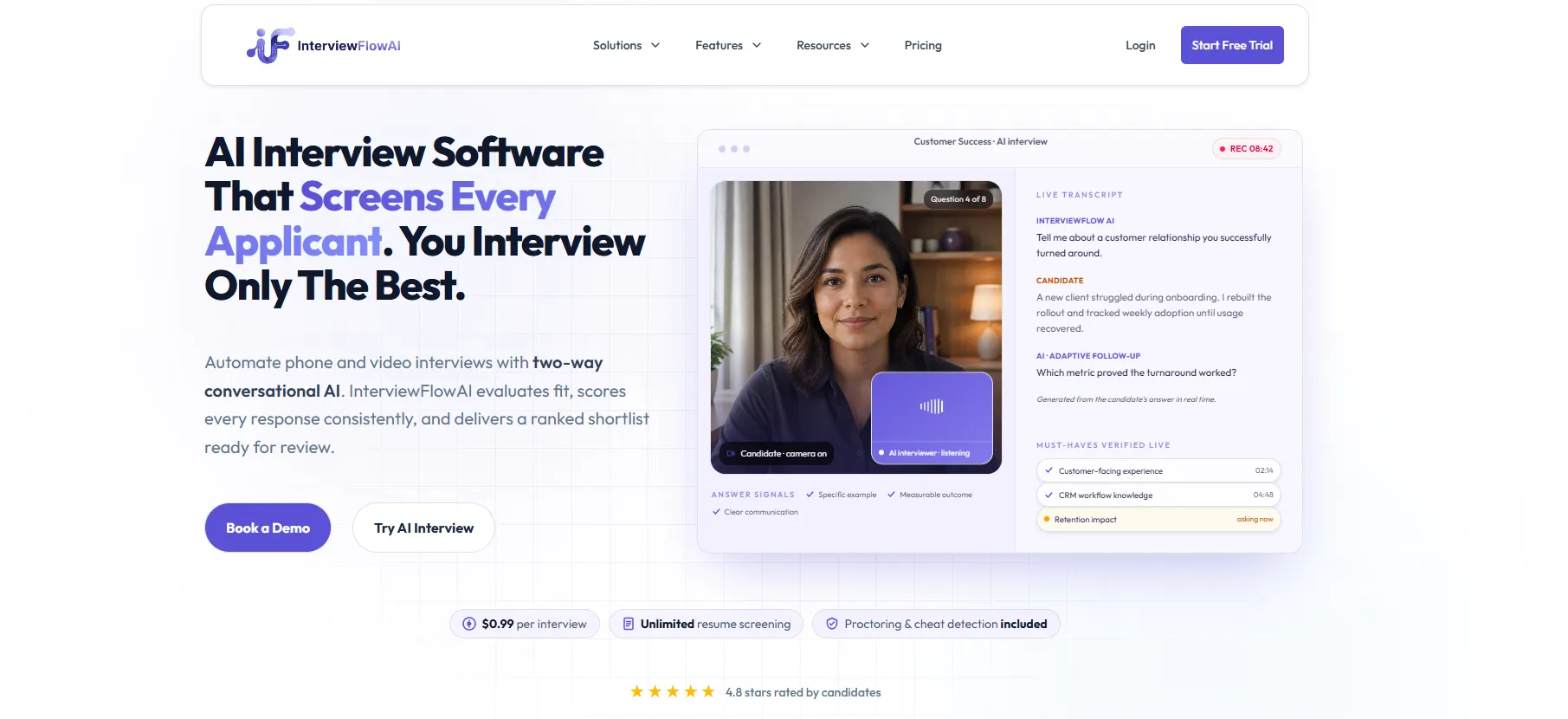
InterviewFlowAI fits teams that already attract applicants but cannot give each credible candidate a consistent first conversation. It runs two-way AI phone interviews and AI video interviews, asks role-specific follow-up questions, and produces recordings, transcripts, scorecards, trust signals, and a ranked shortlist for human review.
The current Pilot plan costs Costs only $0.99/interview and new users can run their first 10 AI interviews free.
This model makes sense when hiring volume changes from month to month and recruiter time is the constraint. It does not replace a proper ATS if the team needs requisition approvals, offer workflows, or a system of record.
InterviewFlowAI’s published benchmark covers 100,000+ completed AI interviews across 100+ businesses. Within that dataset, completion ranges from 70 to 85 percent under a four-day deadline, and post-completion respondents rate the experience 4.8/5 on average. Those figures describe customers and candidates who used this product; they are not a guarantee for every role. The methodology and limits are documented here.
Best fit: Seed to Series A teams, founder-led hiring, high-application roles, and lean recruiting teams that want more evidence before live calls.
Trade-off: You may still need an ATS, sourcing platform, or technical assessment tool beside it.
2. Manatal: best low-cost AI applicant tracking system
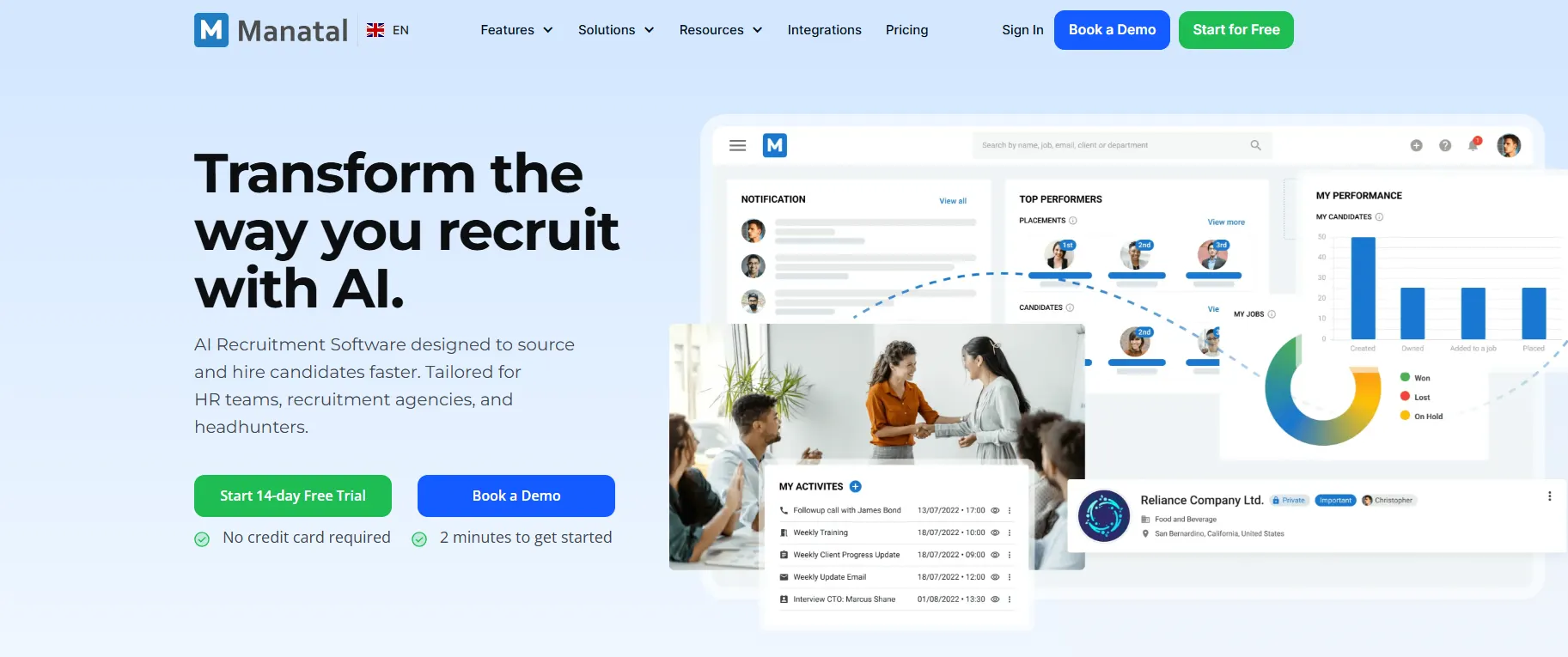
Manatal is an ATS with candidate pipelines, AI recommendations, job distribution, profile enrichment, and collaboration features. Its Professional plan supports up to 15 jobs and 10,000 candidates, which is enough room for many early-stage companies.
Manatal pricing starts at $15 per user per month when billed annually or $19 with monthly billing. A 14-day free trial is available without a credit card.
The low entry price is attractive when spreadsheets and inboxes no longer give the team a reliable view of candidate status. Check how many people need full recruiter accounts before comparing it with flat-price tools. Hiring-manager access and recruiter-seat pricing are not always the same thing.
Best fit: Startups replacing spreadsheets with their first structured ATS.
Trade-off: It tracks and recommends candidates, but it does not remove every live screening call.
3. Juicebox
Best for: AI-powered candidate sourcing and automated outbound recruiting.
Juicebox helps recruiting teams source passive candidates using plain-English search across 800M+ profiles, while AI Agents automate sourcing and outreach workflows around the clock. It works alongside existing ATS and CRM systems rather than replacing them.
4. Zoho Recruit: best free ATS for one recruiter
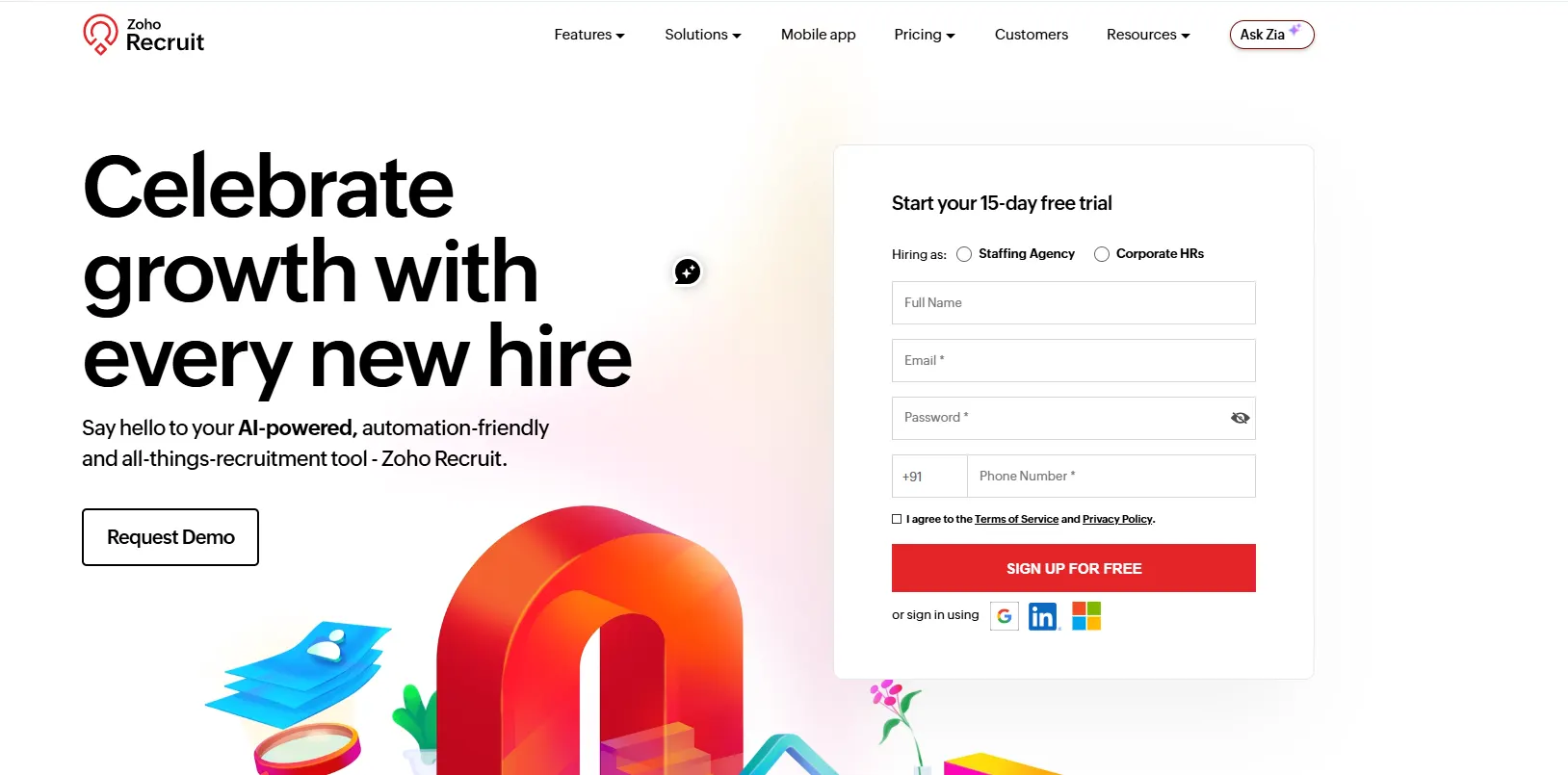
Zoho Recruit’s free plan gives a solo recruiter a candidate database, interview scheduling, email templates, a career site, and one active job. It allows up to 1,000 records per module and 500 API calls per day, according to Zoho Recruit’s free-plan page.
This is a practical first system of record for a founder, operations lead, or first people hire who needs more structure but cannot justify a monthly ATS bill. The limit of one active role matters. A company hiring several functions at once will outgrow it quickly.
Best fit: A startup making one hire at a time with one person managing the pipeline.
Trade-off: The free plan is an ATS starting point, not a full AI sourcing or conversational-screening system.
5. Wellfound: best for reaching startup-interested candidates
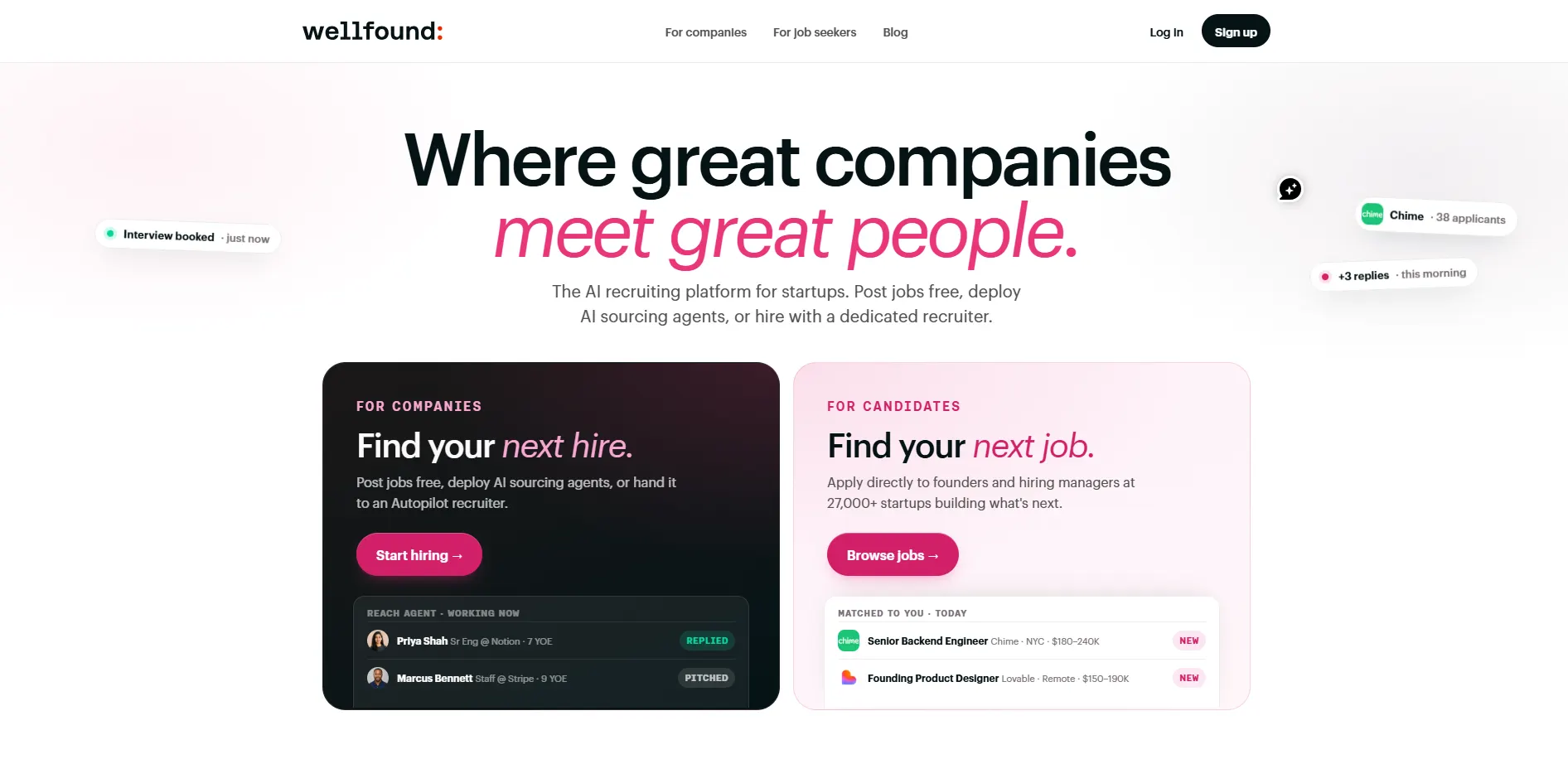
Wellfound combines a startup job marketplace with applicant tracking and optional AI sourcing. Companies can post unlimited jobs free. Paid job promotion starts from $200 per ad.
Wellfound Reach adds AI agents that source candidates and write outbound messages. Its Explore tier is free with 20 contact reveals per month. Starter costs $135 per seat per month, while Growth costs $199 and adds more contact reveals plus ATS integration.
For an unknown startup brand, audience fit can matter more than posting to another general job board. Wellfound is most useful when the company wants candidates who are already considering startup roles.
Best fit: Early-stage companies hiring startup-minded technical, product, sales, and operations talent.
Trade-off: Free job posts do not guarantee applicant quality or volume, and active sourcing requires a paid plan.
6. Recooty: best for job distribution and basic AI applicant tracking
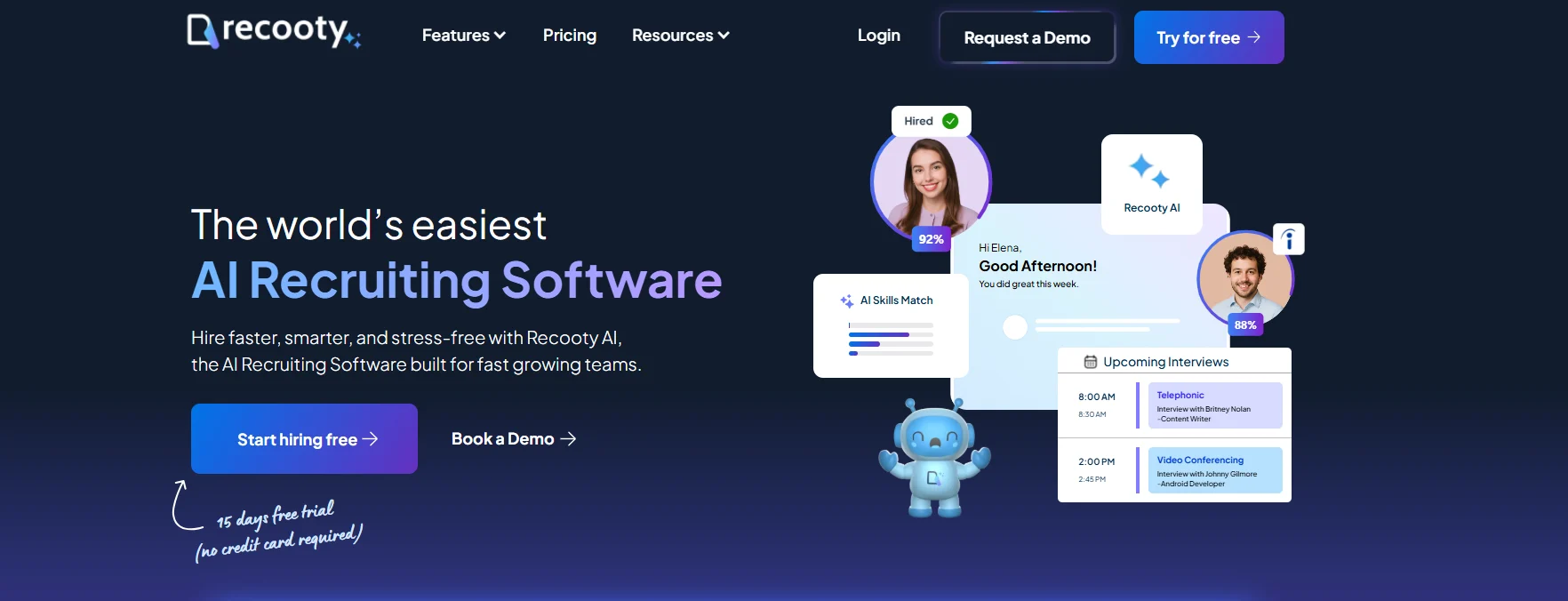
Recooty combines job-board distribution, a careers page, AI resume parsing and scoring, candidate matching, knockout questions, scheduling, and reporting.
Its Starter plan costs $79 per month when billed annually. It supports five active job posts, includes 500 AI credits per month on the displayed annual plan, and comes with a 15-day free trial. The Standard tier costs $149 per month and removes the active-job cap.
This is useful when the startup wants one tool for posting, tracking, and basic top-of-funnel automation. Teams with a strong ATS already in place may duplicate functions they already pay for.
Best fit: Companies with up to five active roles that need broader job distribution and a simple ATS.
Trade-off: The Starter plan is less attractive once the company hires across many roles or needs advanced integrations.
7. Metaview: best for AI sourcing and recruiter interview notes
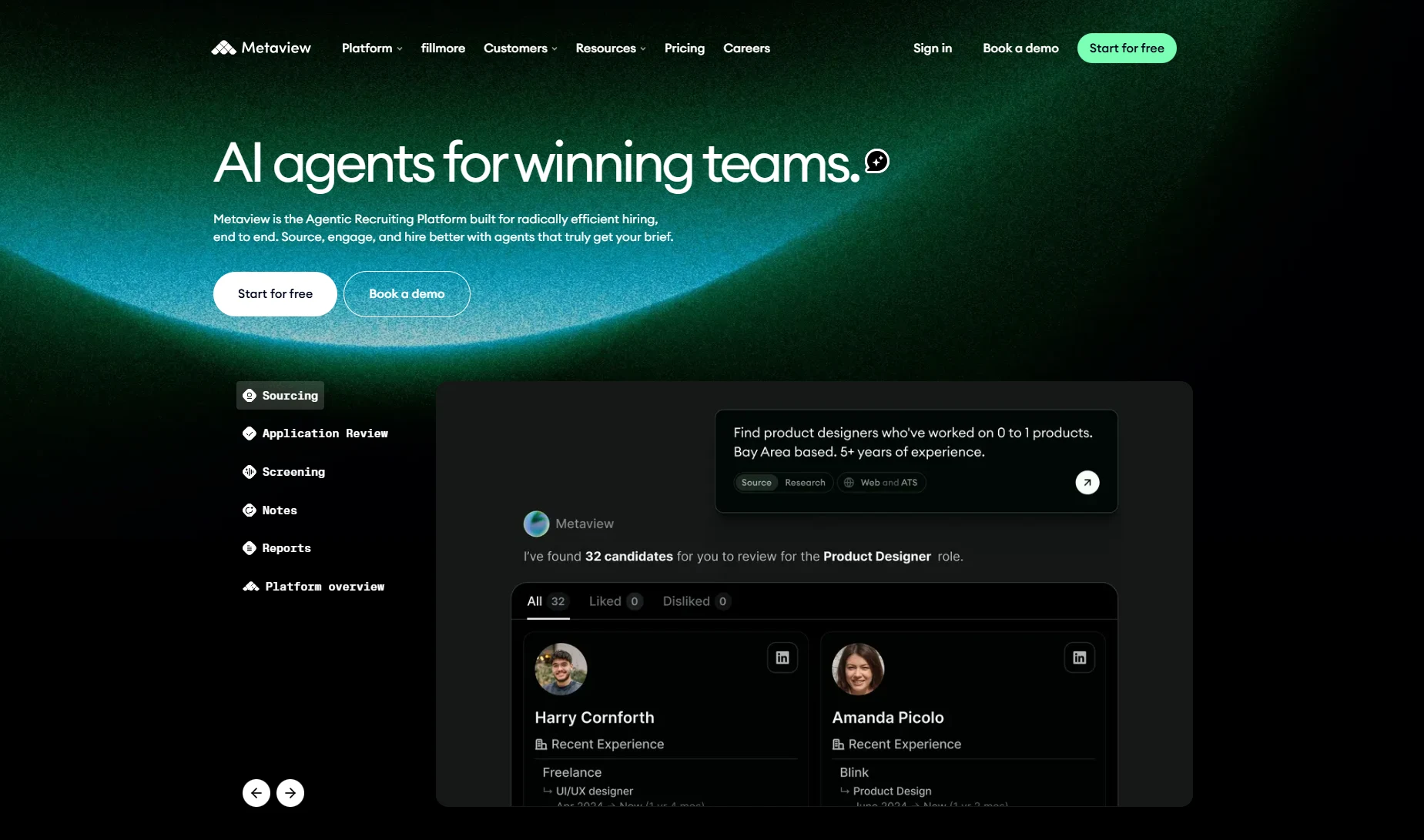
Metaview now covers sourcing, application review, interview notes, and recruiting reports. That breadth makes the pricing page worth reading by module rather than treating it as one plan.
For sourcing, Metaview offers a free tier with the first 100 profiles, a $100-per-user monthly Pro tier, and a $300 Max tier. The complete agentic recruiting platform uses custom pricing. Metaview’s notetaker can also capture and structure notes from recruiter-led interviews.
This can help an active recruiting team remove administrative work around sourcing and live interviews. A founder making two hires may not use enough of the platform to justify a larger plan.
Best fit: Recruiters who want AI assistance before and during human-led interviews.
Trade-off: Check the exact price and allowance for the module you intend to use. The full platform is not a single low-cost self-serve bundle.
8. TestGorilla: best for structured skills assessments
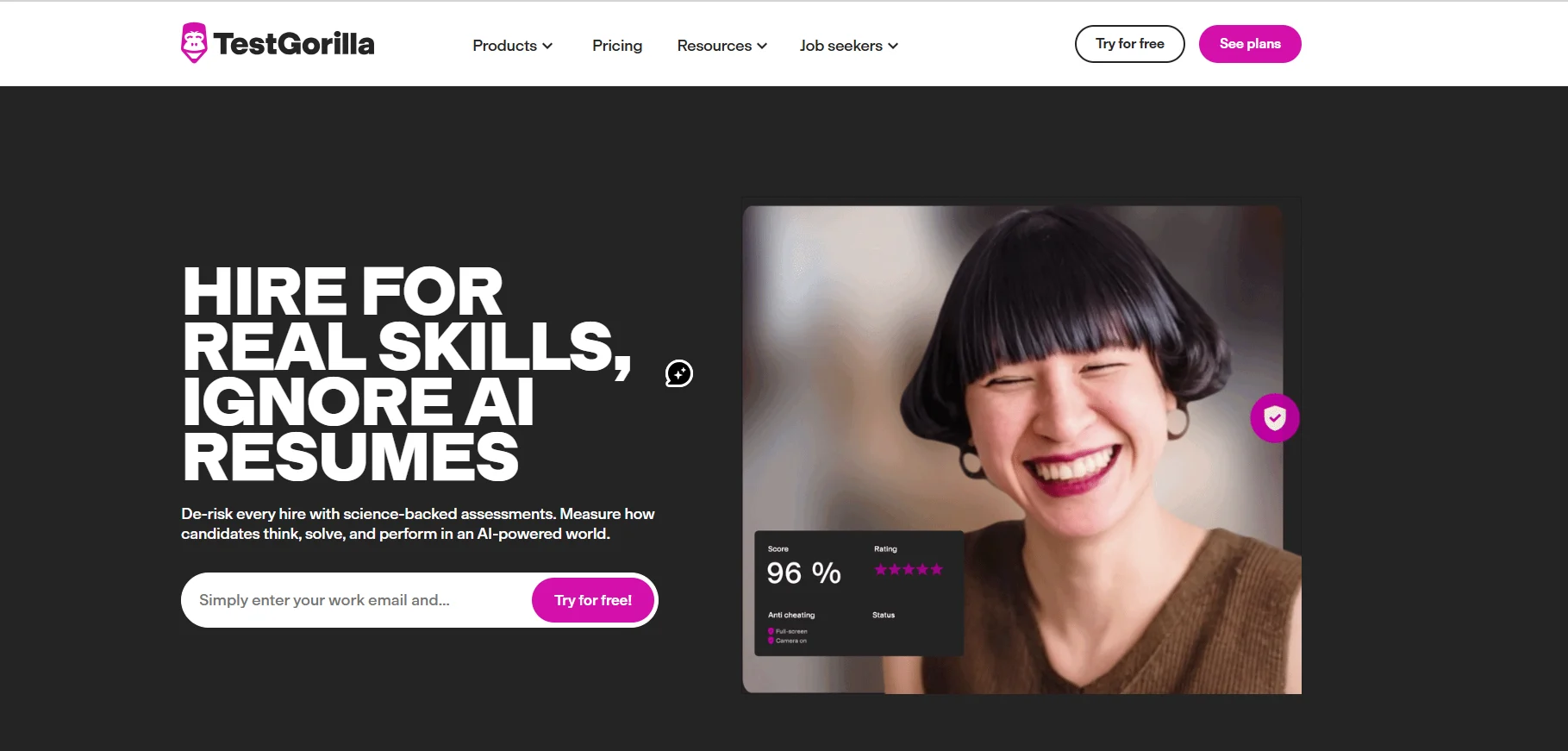
TestGorilla offers a library of skills tests, qualifying questions, resume scoring, video questions, and candidate comparisons. It is useful when a startup needs evidence of job-ready ability before investing time in interviews.
TestGorilla Core starts at $142 per month with an annual commitment. The free entry point includes resume scoring, qualifying questions, and custom questions. Custom AI interviews, ATS integrations, API access, and job simulations sit in Plus, which starts at $400 per month.
The platform is easier to justify when the team runs assessments repeatedly across several roles. For occasional hiring, the annual commitment and higher tier needed for AI interviews may be too much.
Best fit: Startups hiring for technical, analytical, or role-specific skills that can be tested consistently.
Trade-off: A skills assessment can show whether someone can perform a defined task. It does not replace a structured conversation about motivation, judgment, or role context.
9. Workable: best broader recruiting and HR suite
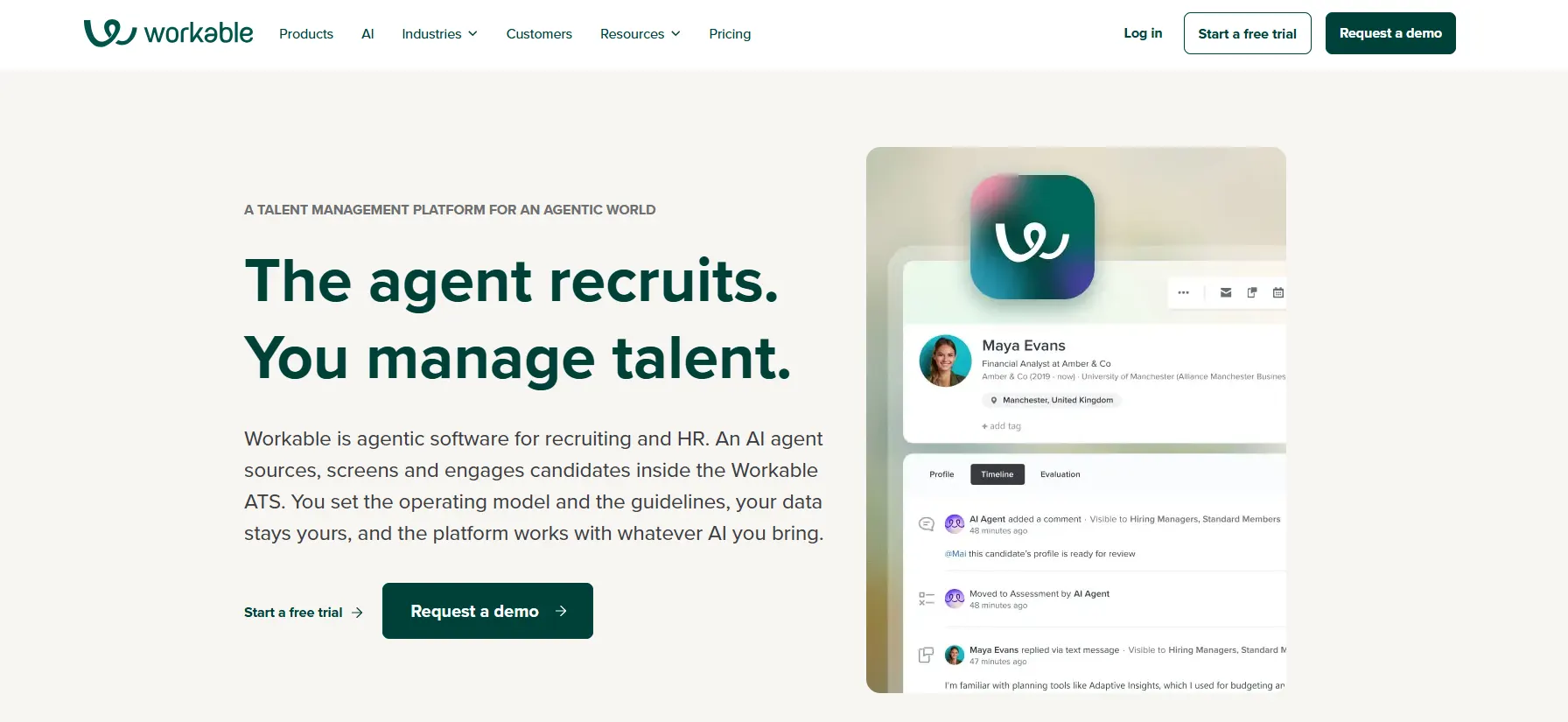
Workable combines an ATS, candidate sourcing, job distribution, hiring plans, reporting, and HR administration. The breadth can reduce the number of separate systems a growing company maintains.
The displayed Standard plan is $299 per month for a company with 1 to 20 employees. Video interviews, assessments, texting, and some AI-agent capacity have separate plan or add-on considerations.
Workable is expensive if the only problem is scheduling or first-round screening. It becomes more reasonable when the company needs an ATS and HR system, is hiring for several roles, and will use the bundled functionality.
Best fit: Funded startups hiring across several functions and formalizing recruiting plus people operations.
Trade-off: The entry price and add-ons can exceed the budget of an occasional hiring team.
10. Loxo: best consolidated recruiting stack for active teams
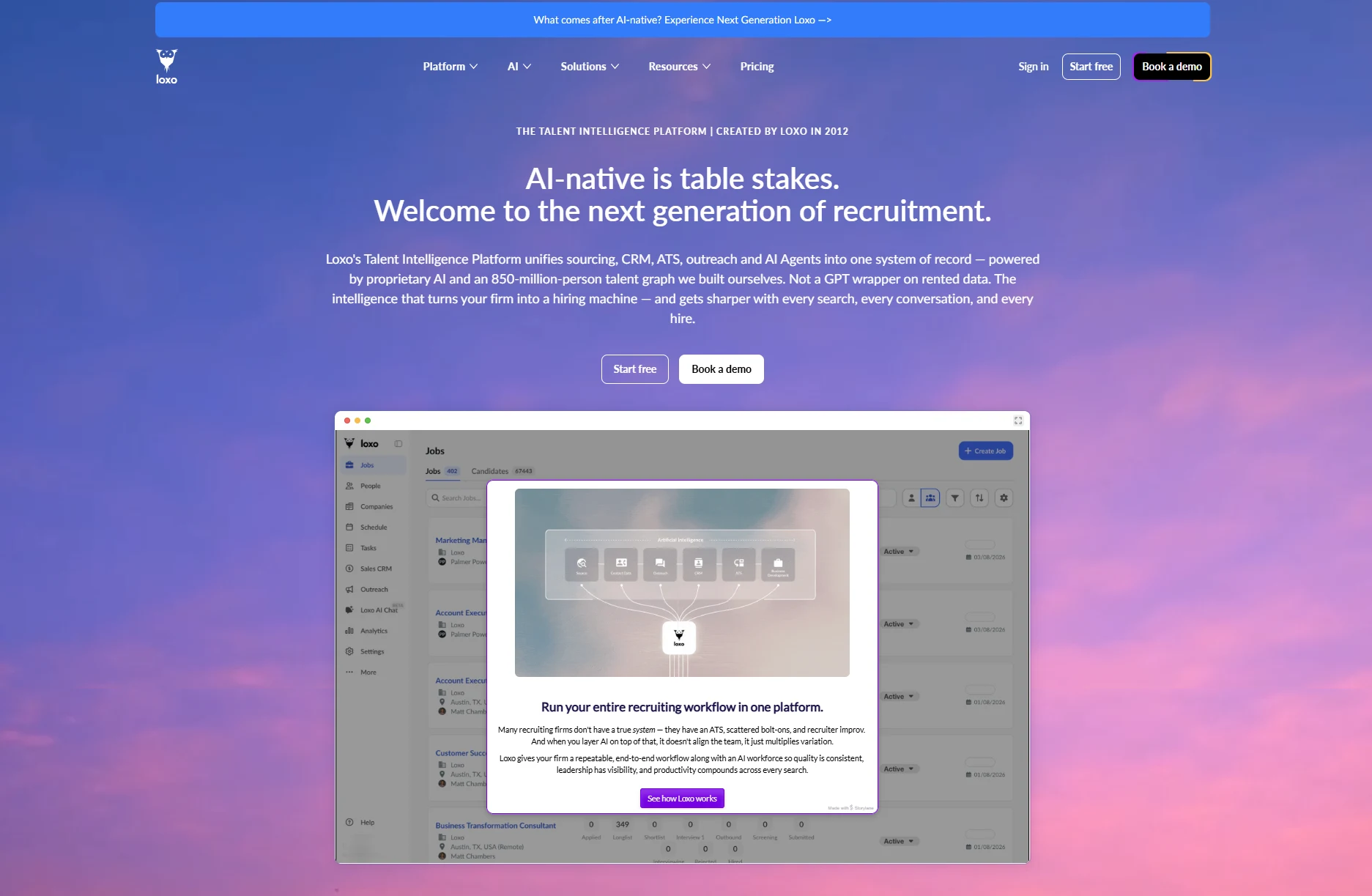
Loxo combines an ATS, recruiting CRM, AI search, email and calendar sync, outreach, reporting, and a large talent graph. Its product is built for teams that actively source rather than wait for inbound applicants.
Loxo Core starts at $149 per user per month, billed annually. Professional starts at $199 per user per month and adds Loxo Source, contact information, API access, and its agent workforce.
For a startup recruiting agency or an internal team running many searches, replacing several separate tools may justify the price. A founder with one open role will probably pay for more system than the company needs.
Best fit: Startup recruiting agencies and active internal talent teams that want ATS, CRM, sourcing, and outreach together.
Trade-off: Annual per-user pricing makes the economics harder for low-volume or occasional hiring.
Which hiring stack fits your startup stage?
Do not buy all 10 tools. Choose one system of record, then add one specialist product only where the bottleneck is measurable.
| Startup situation | Lean stack | Why it works |
|---|---|---|
| Pre-seed, one active role | Zoho Recruit Free or Wellfound job posts | Keeps tracking and job distribution free while the process is small. |
| Seed team with too many applicants | Manatal or Recooty plus InterviewFlowAI | The ATS tracks the pipeline; AI interviews remove repetitive first-round calls. |
| Startup hiring a niche engineer | Juicebox or Wellfound Reach plus a lightweight ATS | Adds outbound sourcing without buying a broad enterprise suite. |
| Team hiring technical roles at volume | ATS plus TestGorilla and InterviewFlowAI | Tests job skills, then collects structured conversational evidence. Use both only if each stage has a clear pass criterion. |
| Scale-up hiring across several departments | Workable, or Loxo for a sourcing-heavy team | A broader system can cost less than maintaining several disconnected tools. |
How to choose an AI recruiting tool without creating more work
Start with the bottleneck, not the feature list
Measure one week of hiring work. Count hours spent sourcing, moving records, screening, scheduling, writing notes, and chasing feedback. The largest repeatable block is the first buying problem.
If the team has too few qualified applicants, buy sourcing help. If candidates are stuck in spreadsheets, buy an ATS. If founders repeat the same phone screen 30 times, use structured AI interviews. If interviewers cannot compare skill, use a job-relevant assessment.
Check the pricing unit
Recruiting products charge per recruiter, employee, active job, contact reveal, assessment, interview, or annual contract. Model your own hiring pattern against that unit.
A per-seat system may work for one recruiter and become costly when five founders need access. Usage-based pricing may suit seasonal hiring but rise during a large campaign. Annual plans make sense only when the workflow is stable enough to use them for the full year.
Decide where candidate data will live
One system should own candidate status. Before buying a point tool, check whether it sends scores, transcripts, notes, and status changes back to the ATS. A logo on an integrations page is not enough. Ask to see the exact fields that sync.
Review the output, not the demo
Run real candidates through the workflow and inspect what the hiring manager receives. A useful output should explain why a candidate scored well, show the underlying evidence, and allow a person to disagree.
Avoid tools that give a mysterious score with no job-related evidence. AI can help collect and organize information. A human should remain accountable for advancement and rejection decisions.
Measure candidate experience
Track invitation delivery, start rate, completion rate, completion time, accommodation requests, and candidate feedback. A workflow that saves recruiter time but drives good candidates away is not cheaper.
InterviewFlowAI’s own data shows why implementation matters. Its disclosed, conversational interviews complete at 70 to 85 percent within a four-day window, with a 4.8/5 average rating among post-completion respondents. The same benchmark also explains the limits of those figures. Teams should measure their own role and candidate population rather than borrow a vendor average.
Pilot one live role
Use one role with enough candidates to expose the bottleneck. Define success before the trial:
-
Recruiter hours spent per completed screen
-
Time from application to first evidence
-
Percentage of candidates who complete the step
-
Qualified-candidate pass-through to the next human round
-
Hiring-manager agreement with the shortlist
-
Candidate complaints or accommodation requests
Do not judge the tool only by how quickly the team can create an account.
How to use AI in hiring responsibly
Small companies do not receive a compliance exemption because they bought an inexpensive tool. The employer still owns the hiring process.
The EEOC and US Department of Justice warn that algorithmic hiring tools can create unlawful barriers for candidates with disabilities. New York City’s Local Law 144 guidance requires bias audits and candidate notices for covered automated employment decision tools. The EU AI Act adds governance obligations for covered high-risk uses.
Before launching any AI-assisted hiring step:
-
Tell candidates where AI is used and what a human will review.
-
Use job-related questions and criteria decided before seeing candidate results.
-
Offer a clear accommodation or alternative process.
-
Keep a person accountable for advancement and rejection.
-
Review outcomes for unexpected group differences and false negatives.
-
Ask the vendor how data is stored, retained, deleted, and used to improve models.
-
Recheck the workflow when the role, model, rubric, or law changes.
This is an operating checklist, not legal advice. Seek qualified counsel for the locations where candidates and employees are based.
Frequently asked questions
What is an AI recruiting tool?
An AI recruiting tool uses machine learning or generative AI to support one or more hiring tasks, such as finding candidates, parsing resumes, ranking applicants, conducting structured screens, assessing skills, scheduling interviews, or writing notes. An ATS can include AI features, but an ATS primarily stores and moves candidates through a hiring process.
What is the most affordable AI recruiting tool for a startup?
The most affordable option depends on which part of recruiting you want to automate. For applicant tracking, Zoho Recruit offers a free plan for one recruiter with one active job, while Manatal starts at $15 per user per month when billed annually. Wellfound also allows startups to post jobs for free.
For conversational candidate screening, InterviewFlowAI starts at $0.99 per interview, allowing startups to automate first-round AI interviews without paying a high per-seat subscription fee.
Are free AI recruiting tools good enough for a small business?
They can be enough for one role, one recruiter, or a short pilot. Free tiers usually limit active jobs, searches, contact reveals, integrations, storage, or collaboration. Check the limit that will affect your actual workflow rather than treating “free” as a complete product category.
Does a startup need an ATS?
A startup needs an ATS when candidate status, notes, communication, and ownership become hard to track in one place. If one person is managing one role and a small applicant pool, a free ATS may be sufficient. Once several roles or decision-makers are involved, a shared system of record usually prevents missed follow-ups and duplicate work.
Can AI replace a recruiter or founder in hiring?
No. AI can take over repeatable work such as searching, scheduling, structured question delivery, transcription, and initial evidence organization. People still need to set the hiring bar, review exceptions, make employment decisions, sell the opportunity, and remain accountable for fairness.
How can startups screen AI-written applications?
Do not try to solve an AI-written resume with another keyword filter alone. Use resumes to check basic eligibility, then collect new evidence through job-related knockout questions, a work sample, a skills assessment, or a structured conversation. The goal is to verify what the candidate can explain and do.
Do AI recruiting tools prevent candidate cheating?
Some products flag browser changes, copied responses, identity anomalies, or suspicious answer patterns. These are signals, not proof. Use checks that are proportionate to the role, tell candidates what is monitored, and let a person review any flag before acting on it.
Are AI hiring tools biased?
They can reproduce bias from data, criteria, design, or deployment. They can also apply a well-designed rubric more consistently than an improvised interview. Do not assume either outcome. Validate job relevance, keep human oversight, provide accommodations, and review results for adverse patterns.
How should a startup measure ROI from recruiting software?
Track cost per completed screen or qualified candidate, recruiter hours returned, time to first evidence, candidate completion, pass-through to the next round, and hiring-manager agreement. Compare those measures with the previous manual process over the same type of role.