Unilever is the most quoted example of AI in recruitment. Conference slides and vendor blogs repeat the same figures: 100,000 hours saved, $1 million a year, time-to-hire cut from four months to four weeks, and a 16% increase in diversity. They are rarely quoted with a source, and they are often mixed up. Some figures count recruiter time, some count candidate time, and some come from different years, regions, or vendors.
We traced every common Unilever AI recruitment statistic back to its original source. This page shows what each number actually measures, how Unilever's process worked, what has changed since, and what a hiring team without an enterprise budget can learn from it.
Quick answer: From 2016, Unilever replaced campus recruiting for its graduate Future Leaders Programme with a digital process: Pymetrics neuroscience games, HireVue recorded video interviews, and an in-person Discovery Centre. A Unilever spokeswoman told The Guardian in 2019 that it saved "100,000 hours of interviewing time and roughly $1m in recruitment costs each year". Other popular figures (4 months to 4 weeks, 50,000 hours, 16% diversity) come from a 2017 Business Insider report and HireVue's own case study. As of 2026, Unilever's careers site says it does not use AI as a screening tool and that a person reviews every digital interview.
Unilever AI recruitment statistics: fact-checked
| Claim | What it actually measures | Original source |
|---|---|---|
| 100,000 hours and ~$1M saved per year | Interviewing time and recruitment costs saved each year, globally. Stated by a Unilever spokeswoman. | The Guardian, October 25, 2019 (syndicated text) |
| 50,000 hours saved | Candidate time, not recruiter time. Reported for North America between July 2016 and June 2017. | Business Insider, June 2017; HireVue case study |
| 70,000 person-hours saved | Time spent interviewing and assessing candidates. A third figure that appears in later write-ups. | Bernard Marr |
| Time-to-hire cut from 4 months to 4 weeks | Full hiring cycle for entry-level roles in North America. | Business Insider, June 2017 |
| 75% reduction | Business Insider reports a 75% drop in recruiter review time. HireVue's case study says Unilever "reduced recruiting time by 75%." | Business Insider; HireVue case study |
| 90% reduction in time-to-hire | A headline figure in the same HireVue case study that also says 75% in its body text. Treat it as vendor marketing. | HireVue case study |
| £1M+ annual cost savings | Vendor-reported savings in pounds. The Guardian quote says "roughly $1m," so the currency varies by source. | HireVue case study |
| 16% increase in new-hire diversity | Vendor-reported. Business Insider describes Unilever's "most diverse class to date," with gender balance and more nonwhite hires. | HireVue case study; Business Insider |
| 96% completion rate (vs. 50%) | Candidate completion of the digital process, vendor-reported. Business Insider separately reports a 98% completion rate for the games. | HireVue case study; Business Insider |
| Candidate satisfaction | An average of 4.1 out of 5 from 25,000 respondents. HireVue separately says more than 80% of candidate feedback was positive. | Business Insider; HireVue case study |
| "No CV" recruitment | Candidates applied with their LinkedIn profile instead of a traditional application, then moved straight to the games. | Business Insider |
| A recruitment chatbot answered candidate questions | We found no primary source for this. Unilever's well-documented bot, Unabot, answers questions from employees about HR, IT, parking, and salary reviews. It is not a candidate screening tool. | Bernard Marr |
In short, the numbers are real but measure different things. "100,000 hours" is Unilever's own annual estimate of interviewing time saved. "50,000 hours" is time saved by candidates. Most other percentages come from HireVue's marketing material, which reports both 75% and 90% for time-to-hire.
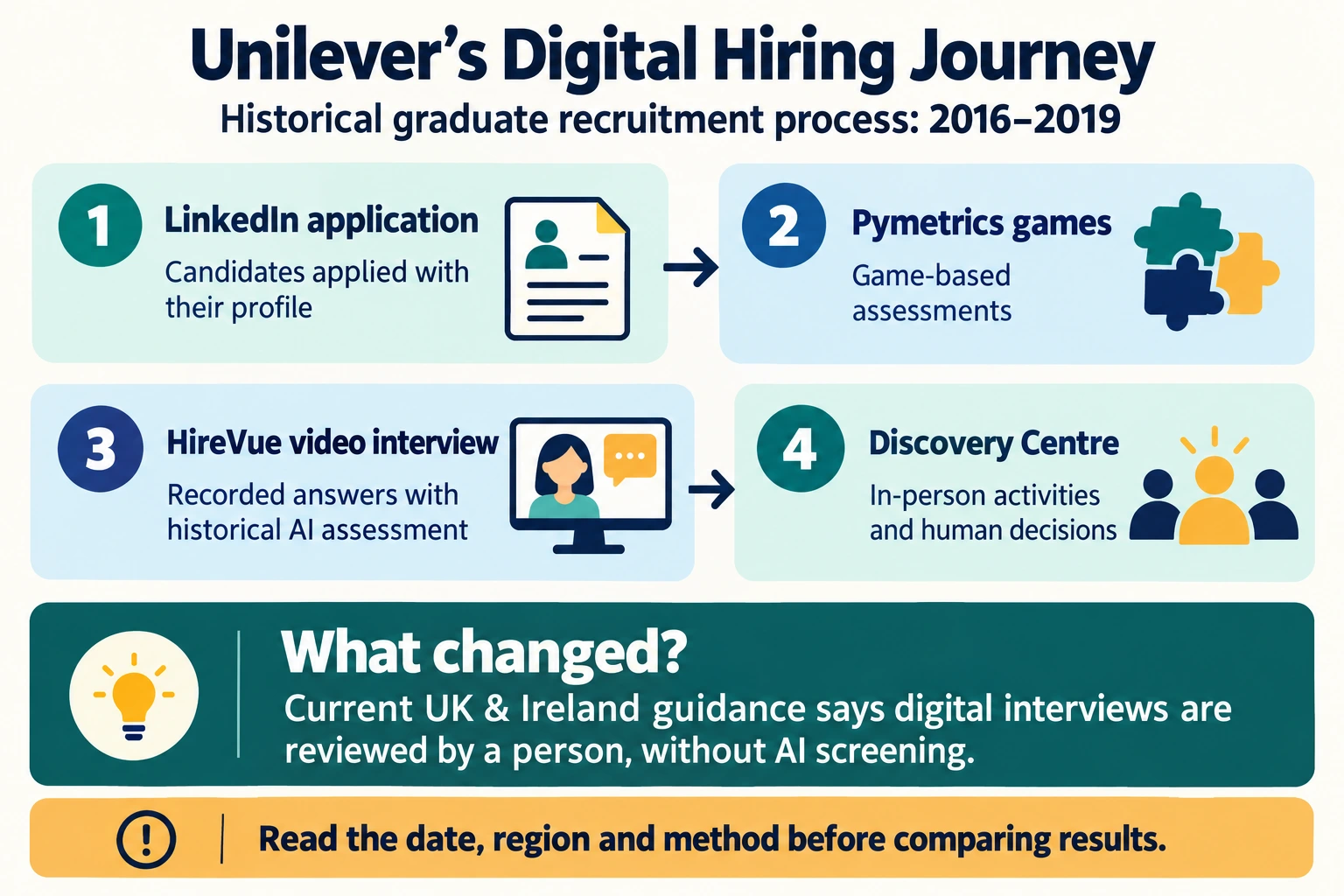
How Unilever's AI recruitment process worked
The Unilever Future Leaders Programme (UFLP) is Unilever's graduate programme, with tracks in business functions such as marketing, finance, and supply chain. It selected about 800 graduates from roughly 250,000 applications, according to HireVue's case study. Under the old process, sifting those applications took four to six months and depended on campus visits, paper forms, and phone screens. Mike Clementi, then VP of HR for North America, told Business Insider: "We were going to campus the same way I was recruited over 20 years ago."
From July 2016, Unilever moved entry-level hiring to a four-step digital funnel:
- Apply with a LinkedIn profile. No traditional CV or long application form.
- Play neuroscience-based games (Pymetrics). Twelve games, about 20 minutes in total, designed to measure cognitive and emotional traits rather than past experience.
- Record a video interview (HireVue). Candidates answered questions on their own schedule. In the 2017–2019 version, HireVue's AI analyzed the recordings and, according to the case study, filtered up to 80% of the candidate pool.
- Attend a Discovery Centre. A day of in-person activities and interviews with Unilever staff, followed by offers decided by people.
Every candidate received feedback at each step, including those who weren't selected. Business Insider reported that the number of universities represented among applicants rose from 840 to 2,600, and that offer acceptance rose from 64% to 82%.
What has changed since 2019
The Unilever story is often told as if it were current. Three later developments change how it should be read:
- Facial analysis was dropped. The 2019 coverage described HireVue's software analyzing facial expressions, body language, word choice, and tone. HireVue removed facial analysis from its assessments in January 2021 after criticism that it could disadvantage some candidates and added little predictive value.
- Regulation tightened. AI systems that infer emotions in the workplace have been banned in the EU since February 2025. The European Commission's guidelines apply that ban to candidates during hiring. NYC (since 2023), California (since October 2025), and Illinois (since January 2026) now regulate AI in hiring.
- Unilever's own process now says humans review interviews. Its UK & Ireland Future Leaders Programme page states: "we do not use AI as a screening tool in our recruitment process therefore, your digital interview submission will be reviewed by a real person". The digital structure remains: an online application, profile assessments, a digital interview, and a Discovery Centre.
That last point matters. Unilever kept the parts that made the process fast and consistent: asynchronous digital interviews, structured assessments, and fast feedback. It moved the advancement decision firmly back to people. That matches what candidates say they want today. In Greenhouse's 2026 candidate survey, the most common US preference was more AI with stronger human oversight at key decision points (22%), and only 19% wanted less AI.
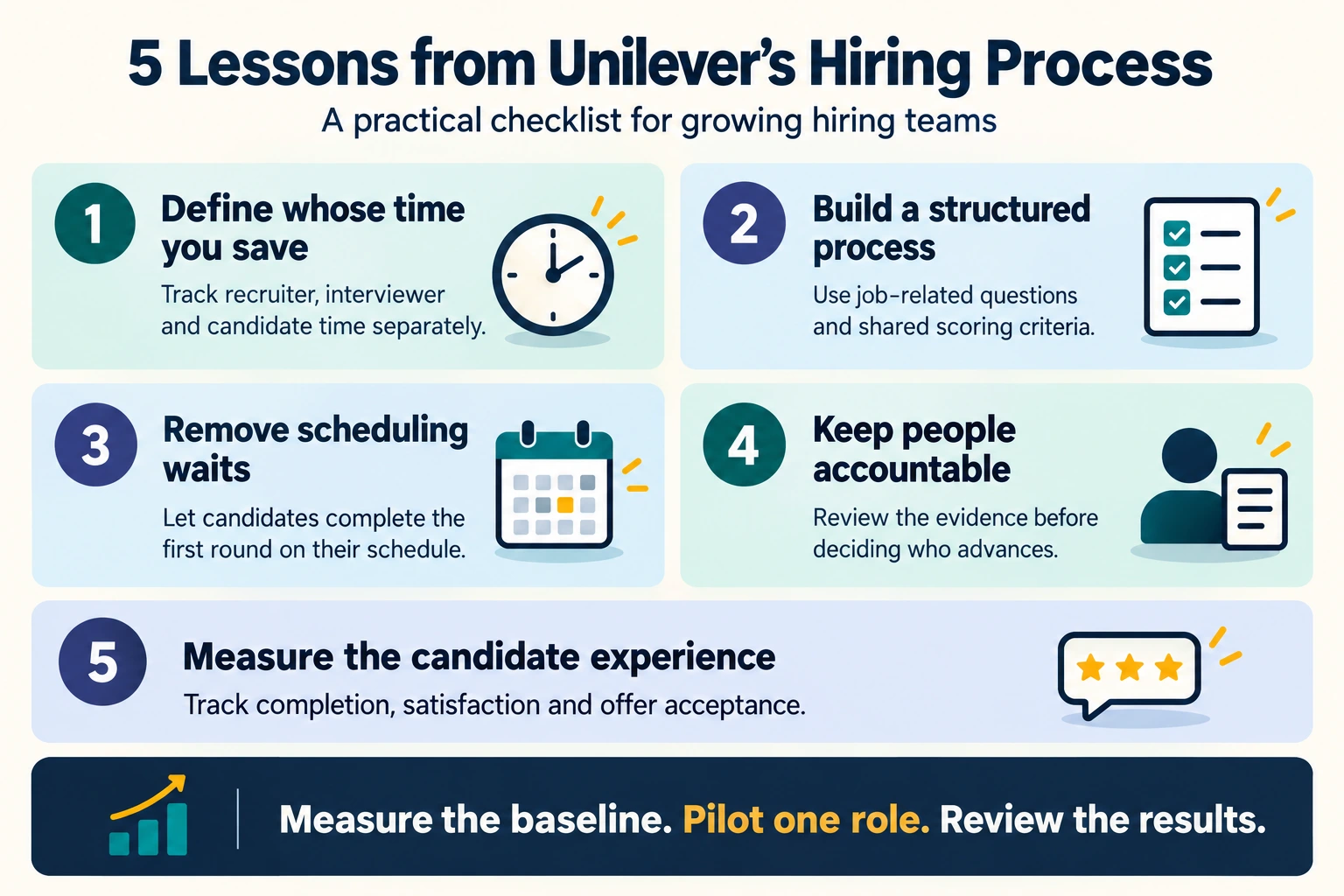
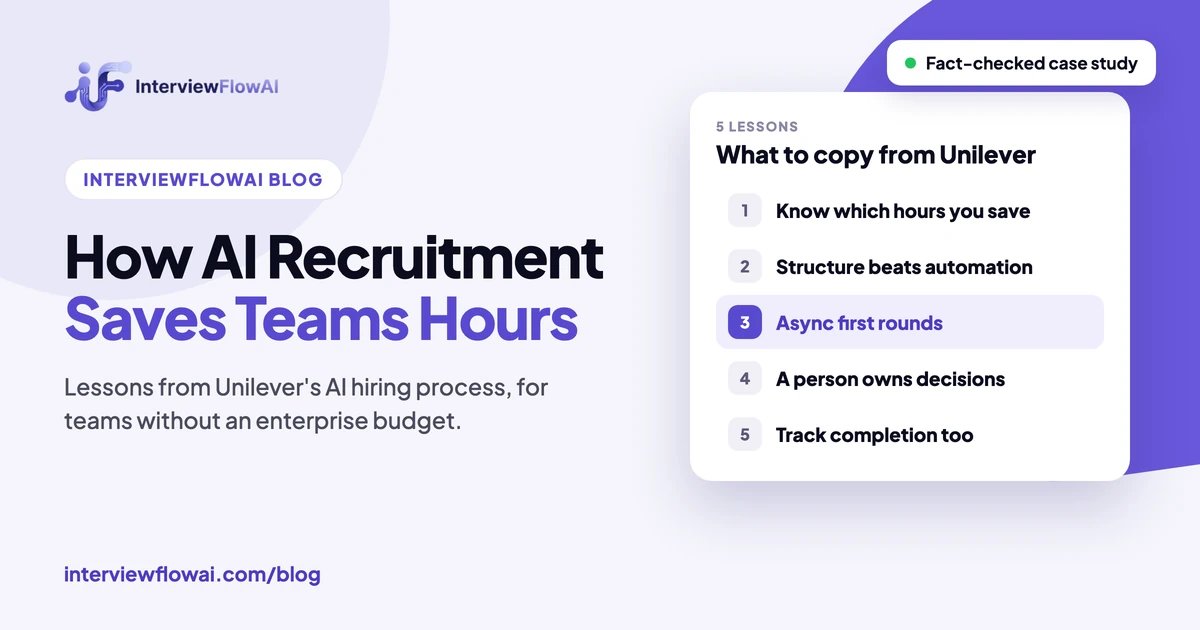
5 lessons for teams without Unilever's budget
1. Know which hours you are saving
Unilever's figures mix recruiter hours, interviewer hours, and candidate hours. Decide which one you are trying to reduce, and measure it before you change anything. Recruiter phone-screen time is usually the largest and easiest to measure.
2. The savings come from structure, not just automation
Unilever's process worked because every candidate went through the same job-related steps in the same order. A structured interview is one where every candidate answers the same job-related questions and is scored against the same criteria. Structured interviews are among the strongest predictors of job performance. A 2022 meta-analysis found they had the highest mean validity (.42) of the selection methods studied. AI makes that structure affordable at volume.
3. Asynchronous first rounds remove the scheduling bottleneck
An asynchronous interview is one the candidate completes on their own schedule, with no recruiter on the call. Much of the drop from four months to four weeks came from this. Candidates completed steps on their own time instead of waiting for campus visits and phone slots. Any team can get this benefit, whatever its size.
4. Keep a person accountable for decisions
The most criticized part of the 2019 setup, automated filtering based on video analysis, was the first part to change. Use AI to collect and organize evidence, and have a recruiter or hiring manager decide who advances.
5. Track completion and candidate experience, not just speed
Unilever measured completion rates, candidate satisfaction, and offer acceptance, not just hours. Speed only pays off when good applicants finish the process, so track completion as closely as hours saved.
How many hours could your team save?
You don't need Unilever's 250,000 applications to see meaningful savings. Use this simple estimate:
Hours saved per month = first-round screens per month × (minutes per screen + minutes of scheduling and notes) ÷ 60
For example, take a team running 200 phone screens a month. Each screen takes 30 minutes, plus 10 minutes of scheduling and notes. That team spends about 133 recruiter hours a month on first-round screening. Moving that round to an AI interview turns most of that time into review time. Reading a scorecard and skimming a transcript takes minutes, not a 30-minute call. To add up what each hire costs, try the free cost-per-hire calculator. The same math works for technical roles. Our guide to AI interviews for backend developers shows which engineering skills a first-round AI interview can assess.
Where InterviewFlowAI fits
InterviewFlowAI gives growing teams the same structured, asynchronous first round that Unilever built at enterprise scale. Monthly plans start at $59, and the platform offers:
- Conversational first-round interviews by video, or by phone on Growth and above. Candidates take them without waiting for a recruiter's calendar, and the AI asks follow-up questions based on their answers.
- Custom interview questions and criteria for each role, so every candidate is assessed against the same job-related standard.
- Scorecards and full transcripts for every interview, so recruiters review evidence and make the decision.
Across 100+ businesses, completed InterviewFlowAI interviews average about 13 minutes. In one week (July 30 to August 5, 2026), the platform ran 53,509 minutes of AI-led first-round screening. That is about 892 hours of first-round interviewing that recruiters did not have to run themselves. If you hire at volume, see how this works for high-volume hiring. If you are comparing costs, see our list of affordable AI recruiting tools for startups and our Apriora Alex AI vs InterviewFlowAI pricing comparison.
Get Unilever-style screening speed without the enterprise contract
Run structured AI phone and video interviews, review scorecards and transcripts, and keep your team in charge of every decision.
Frequently asked questions
How did Unilever use AI in recruitment?
Starting in 2016, Unilever moved graduate and entry-level hiring to a digital process. Candidates applied with LinkedIn, played Pymetrics neuroscience games, and recorded a HireVue video interview that AI analyzed. Finalists then attended an in-person Discovery Centre, where people made the final decisions.
How many hours did Unilever save with AI recruitment?
A Unilever spokeswoman told The Guardian in 2019 that the system saved about 100,000 hours of interviewing time a year globally. A separate, earlier figure of 50,000 hours refers to time saved by candidates in North America in the program's first year.
How much money did Unilever save?
Unilever cited "roughly $1m" in recruitment costs a year in 2019. HireVue's case study reports "£1M+ annual cost savings." Both figures come from Unilever or its vendor, not an independent audit.
Did Unilever cut time-to-hire by 75% or 90%?
Both figures appear in HireVue's case study. Business Insider reported that the hiring cycle in North America fell from four months to four weeks and that recruiter review time dropped by 75%. Four months to four weeks is roughly a 75% reduction, so 75% is the better-supported figure.
Does Unilever still use AI to screen candidates?
Unilever's 2026 UK & Ireland Future Leaders Programme page says it does not use AI as a screening tool and that a real person reviews every digital interview submission. The digital interview and online assessments remain part of the process.
Did Unilever's AI analyze facial expressions?
The 2019 coverage said HireVue's software analyzed facial expressions, body language, and word choice. HireVue removed facial analysis from its assessments in January 2021, and the EU has banned workplace emotion recognition since February 2025.
What tools did Unilever use for AI hiring?
Pymetrics for game-based assessments and HireVue for recorded video interviews and AI assessment. Unabot, Unilever's chatbot, is an employee-facing HR assistant, not a candidate screening tool.
Methodology: We traced each Unilever figure to the earliest source we could find: Unilever's own statements, the original press coverage, and HireVue's case study. We label vendor-reported numbers as such. Every source below was checked on 7 November 2026, and the InterviewFlowAI figures come from our own platform records.
Sources
- Business Insider (Richard Feloni), "Consumer-goods giant Unilever has been hiring employees using brain games and artificial intelligence — and it's a huge success", June 28, 2017, checked 7 November 2026.
- HireVue, "Unilever Finds Top Talent Faster with HireVue Assessments" (customer case study, PDF), checked 7 November 2026.
- The Guardian (Robert Booth), "Unilever saves on recruiters by using AI to assess job interviews", October 25, 2019 (also syndicated in the Taipei Times), checked 7 November 2026.
- Bernard Marr, "The Amazing Ways How Unilever Uses Artificial Intelligence To Recruit & Train Thousands Of Employees", checked 7 November 2026.
- Unilever Careers, UK & Ireland Unilever Future Leaders Programme, checked 7 November 2026.
- AI Incident Database, "Job Screening Service Halts Facial Analysis of Applicants", checked 7 November 2026.
- Future of Privacy Forum, "Red Lines under EU AI Act: Unpacking the prohibition of emotion recognition in the workplace and education institutions", checked 7 November 2026.
- European Commission, Guidelines on prohibited artificial intelligence practices under the AI Act, checked 7 November 2026.
- Washington University School of Law, AI Policy and Regulation Resources: Labor & Employment, checked 7 November 2026.
- Sackett, Zhang, Berry and Lievens, "Revisiting meta-analytic estimates of validity in personnel selection", Journal of Applied Psychology (2022), checked 7 November 2026.
- Greenhouse, 2026 Candidate AI Interview Report, April 2026, checked 7 November 2026.
Mukul Munjal
Founder & CEO, InterviewFlowAI
I'm Mukul Munjal, founder and CEO of InterviewFlowAI. I have 7 years of experience in engineering, 3 of them building voice agents, and I lead the team that builds our AI interviewer. Before publishing, I check competitor prices and features against each vendor's own pages.